


Sintered Filter Meaning
In industrial filtration, the term "sintered filter" refers to a high-performance porous component manufactured through a thermal process known as sintering. Understanding the technical sintered filter meaning is essential for engineers and procurement specialists who require filtration solutions capable of withstanding extreme temperatures, high pressures, and corrosive environments. Unlike traditional disposable filters made of paper, fabric, or polymers, sintered filters are typically constructed from metal powders or multi-layered wire meshes that are fused together at a molecular level.
The fundamental principle behind a sintered filter is the creation of a rigid, porous structure that maintains its mechanical integrity under stress while providing precise particle retention. By controlling the raw material characteristics and the sintering parameters, manufacturers like Kaifil can engineer filters with specific porosity, permeability, and strength to meet the rigorous demands of chemical processing, pharmaceutical manufacturing, and aerospace engineering.
Understanding the Sintering Process in Filtration
To grasp the full sintered filter meaning, one must look at the metallurgy involved. Sintering is a heat treatment process that bonds particles together without melting them to the point of liquefaction. The material—typically stainless steel powder or layers of stainless steel wire mesh—is placed in a controlled-atmosphere furnace and heated to a temperature just below its melting point.
During this process, atomic diffusion occurs across the boundaries of the particles. This creates "necks" or metallurgical bonds at the contact points between the metal grains or wire strands. As these bonds strengthen, the material transforms from a loose collection of particles or layers into a solid, integrated porous matrix. The resulting structure is exceptionally robust, as the filter medium becomes a single piece of metal.
For engineers, the significance of this process lies in the stability of the pore size. In non-sintered depth filters, the pores can shift or enlarge under high differential pressure, leading to "unloading" where trapped contaminants are pushed through the filter. In Sintered Metal Filters, the pores are fixed in place by the metallurgical bonds, ensuring consistent filtration performance throughout the life of the component.
Structural Variations: Sintered Powder vs. Sintered Wire Mesh
The broader sintered filter meaning encompasses two primary types of construction, each offering distinct advantages for different industrial applications. Choosing between them depends on the required filtration efficiency, flow rate, and the nature of the contaminants being removed.
Sintered Metal Powder Filters
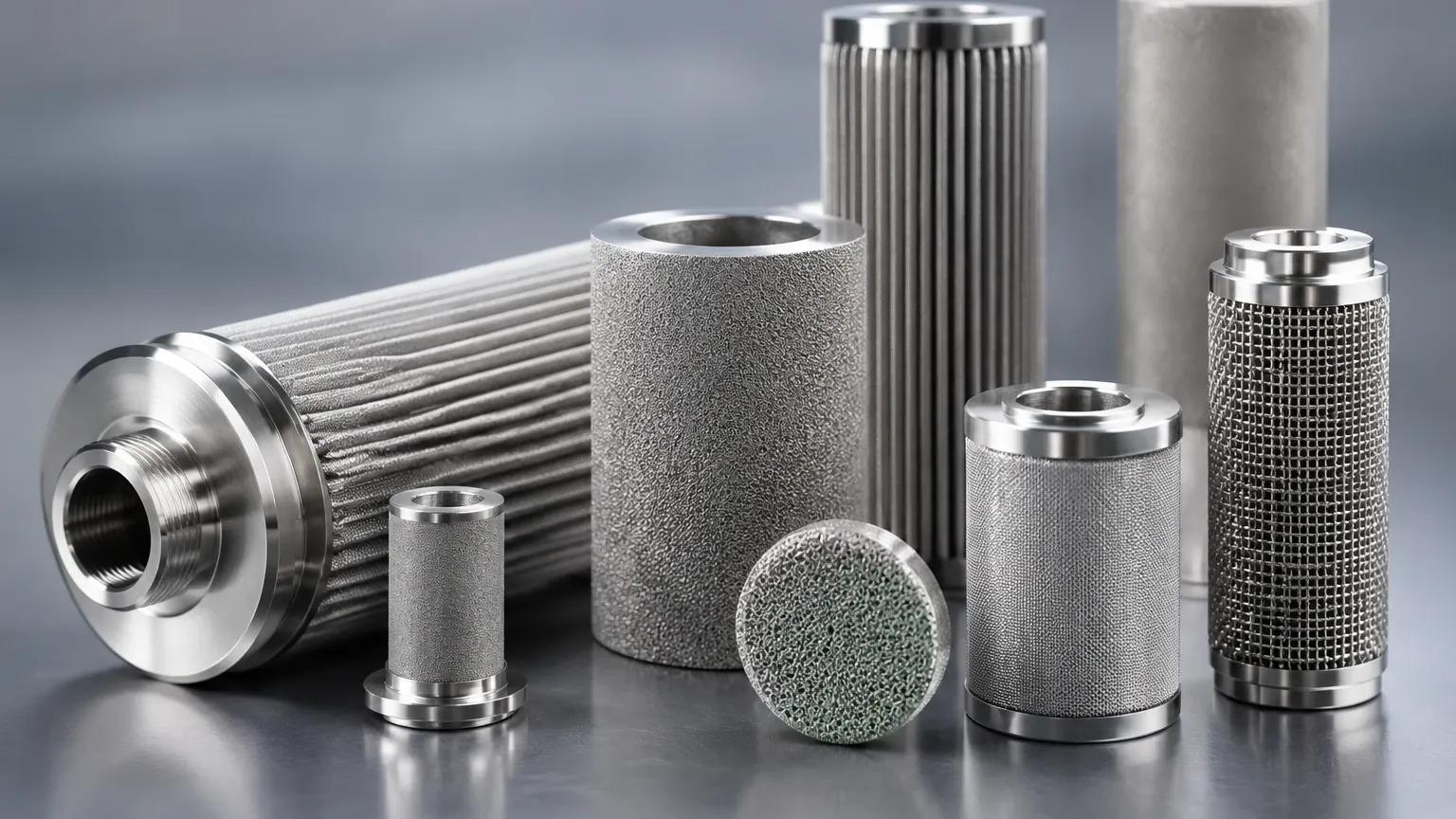
These are produced by compacting metal powder (usually 316L stainless steel, titanium, or nickel alloys) into a mold and then sintering it. This results in a "depth" filtration medium with a tortuous path. As fluid passes through the interconnected pores, particles are trapped not just on the surface, but within the thickness of the filter wall. Sintered powder filters are ideal for applications requiring high precision and the removal of very fine particulates, often down to 0.1 microns.
Sintered Wire Mesh Filters
These are constructed by laminating multiple layers of woven wire mesh—ranging from coarse support layers to fine filtration layers—and sintering them together. The sintering process prevents the individual wires from shifting, which is a common failure point in standard woven mesh. Sintered mesh filters provide "surface" filtration, making them easier to clean via backpulsing or backwashing. They are frequently used in high-flow applications where mechanical strength and ease of regeneration are priorities.
Performance Metrics and Technical Evaluation
When evaluating the sintered filter meaning for a specific project, engineers must consider several critical performance metrics. These parameters define how the filter will behave in a live system and determine its suitability for the process fluid.
1. Micron Rating (Absolute vs. Nominal): Sintered filters are often rated by their absolute micron rating, which refers to the diameter of the largest hard spherical particle that will pass through the filter under specified test conditions. Because of the rigid pore structure, sintered filters offer much more reliable absolute ratings than flexible media.
2. Permeability and Pressure Drop: Permeability refers to the ease with which a fluid passes through the porous medium. A higher permeability results in a lower initial pressure drop (Delta P). Engineers must balance the need for fine filtration (which usually decreases permeability) with the system's pump capacity and energy efficiency requirements.
3. Porosity: This is the measure of the void space within the filter. High porosity (often 30% to 50% in sintered metals) allows for higher flow rates and greater dirt-holding capacity, extending the time between cleaning cycles.
4. Mechanical Strength: One of the primary reasons to choose a sintered metal filter is its ability to withstand high differential pressures. These components can often handle hundreds of bars of pressure without collapsing or deforming.
Material Selection and Chemical Compatibility
A critical component of the sintered filter meaning is the versatility of materials used in production. While stainless steel (316L) is the industry standard due to its balance of cost and corrosion resistance, other alloys are used for specialized environments:
* 316L Stainless Steel: Offers excellent resistance to general corrosion and is suitable for most food, beverage, and pharmaceutical applications.
* Hastelloy®: Used in highly aggressive chemical environments, particularly those involving mineral acids or chlorides where stainless steel might suffer from pitting or stress corrosion cracking.
* Inconel®: Selected for extreme high-temperature applications, maintaining its structural integrity and oxidation resistance at temperatures exceeding 600°C (1100°F).
* Monel®: Often used in marine environments or in the handling of hydrofluoric acid and oxygen systems.
Selecting the correct material ensures that the filter does not leach metallic ions into the process stream and that it does not degrade over time, which could lead to system failure or product contamination.
Industrial Applications and Operational Advantages
Sintered filters are utilized across a wide spectrum of industries where reliability is non-negotiable. Their unique properties solve problems that other filter types cannot address.
* Chemical Processing: In catalyst recovery, sintered metal filters allow for the separation of expensive catalysts from liquid or gas streams at high temperatures, enabling the catalysts to be reused.
* Food and Beverage: The smooth surface and high-temperature tolerance of sintered stainless steel make it ideal for steam filtration and the removal of bacteria or yeast, as the filters can be sterilized in place (SIP).
* Pharmaceuticals: Precise pore size control is vital for the filtration of active pharmaceutical ingredients (APIs). Sintered filters provide the necessary cleanliness and can be manufactured to meet stringent FDA and cGMP requirements.
* Hydraulics and Lubrication: High-pressure hydraulic systems benefit from the mechanical robustness of sintered mesh, which protects sensitive valves and pumps from wear-inducing particulates.
Beyond simple filtration, these components are also used for sparging (introducing gas into liquid), fluidization, and flame arrestors, demonstrating the versatility inherent in the sintered filter meaning.
Maintenance, Cleaning, and Total Cost of Ownership
One of the most significant advantages of sintered metal filters is that they are cleanable and reusable. While the initial acquisition cost of a sintered metal filter is higher than that of a disposable cartridge, the total cost of ownership (TCO) is often lower over the long term due to the extended service life and reduced waste.
Cleaning methods for sintered filters include:
* Backpulsing/Backwashing: Using a reverse flow of liquid or gas to dislodge accumulated solids from the filter surface. This is highly effective for sintered mesh filters.
* Ultrasonic Cleaning: Using high-frequency sound waves in a cleaning solvent to remove fine particulates trapped deep within the pores of sintered powder media.
* Chemical Cleaning: Using acids, caustic solutions, or solvents to dissolve specific types of contaminants without damaging the metal matrix.
* Thermal Cleaning (Burn-off): In cases where organic contaminants have hardened, the filter can be heated in a controlled furnace to oxidize and remove the residue.
By following a regular cleaning schedule, industrial operators can restore the filter to near-original pressure drop levels, significantly extending the replacement cycle and reducing the environmental impact associated with disposable filtration media.
Conclusion: Selecting the Right Sintered Solution
Understanding the technical sintered filter meaning allows engineers to move beyond generic specifications and focus on the precise needs of their application. Whether the goal is to protect downstream equipment, ensure product purity, or recover valuable materials, the choice of a sintered filter represents a commitment to durability and precision.
When sourcing these components, it is vital to work with a manufacturer that understands the nuances of metallurgy and fluid dynamics. Kaifil provides customized filtration solutions, ensuring that every sintered component is optimized for the specific pressures, temperatures, and chemical exposures of the target environment. By considering the material, pore structure, and cleaning requirements early in the design phase, purchasing teams can secure filtration systems that deliver consistent performance and long-term value.
