


Sintered Metal Filter Cartridge
In industrial filtration, the requirement for components that can withstand extreme temperatures, corrosive chemicals, and high mechanical stress is paramount. The sintered metal filter cartridge represents a critical solution for these demanding environments. Unlike traditional polymer or disposable fiber filters, these components are engineered through a thermal bonding process that creates a rigid, porous structure capable of precise particulate separation under conditions that would cause other media to fail. For engineers and procurement specialists, understanding the technical nuances of sintered metal filters is essential for optimizing process efficiency and reducing long-term operational costs.
Understanding the Sintering Process and Structural Integrity
The performance of a sintered metal filter cartridge is fundamentally rooted in the sintering process. Sintering is a metallurgical technique where metal powders or layers of woven wire mesh are heated in a controlled-atmosphere furnace to a temperature just below their melting point. This heat causes the contact points of the metal particles or wires to bond through a process of molecular diffusion.
When the material cools, it forms a monolithic, porous structure. This structure is characterized by a "tortuous path"—a complex network of interconnected pores that trap contaminants. Because the bonds are metallic and permanent, the resulting filter media does not require binders or resins, which are common points of failure in other filter types. This structural integrity ensures that the filter maintains its pore size and shape even when subjected to high differential pressures or significant thermal cycling.
For industrial applications, Kaifil utilizes advanced manufacturing capabilities to control the porosity and pore size distribution during this process. By precisely managing the particle size of the metal powder or the weave pattern of the mesh, manufacturers can produce Sintered Metal Filters with specific micron ratings, ranging from sub-micron levels to several hundred microns. This level of precision is vital for applications requiring absolute filtration ratings rather than nominal approximations.
Material Specifications for Industrial Applications
Material selection is the most significant factor in determining the chemical compatibility and longevity of a sintered metal filter cartridge. While stainless steel is the industry standard, specific grades are chosen based on the operating environment.
1. Stainless Steel 316L: This is the most frequently specified material due to its excellent corrosion resistance and mechanical strength. The "L" denotes low carbon content, which is crucial during the sintering and welding processes to prevent carbide precipitation, thereby maintaining the alloy's resistance to intergranular corrosion.
2. Stainless Steel 304: Often used in less aggressive environments or food and beverage applications where cost-effectiveness is prioritized over extreme chemical resistance.
3. Hastelloy and Inconel: For highly specialized applications involving concentrated acids, high-salinity environments, or temperatures exceeding 800°C, nickel-based superalloys like Hastelloy C-276 or Inconel 600 are utilized. These materials provide superior resistance to pitting and stress corrosion cracking.
4. Titanium: In aerospace or specific chemical processing roles where weight reduction and high strength-to-weight ratios are required, titanium sintered filters offer a unique combination of biocompatibility and resistance to oxidizing media.
Engineers must confirm the pH levels, presence of chlorides, and peak operating temperatures of their process fluid before selecting a material. Failure to match the alloy to the chemical environment can lead to premature degradation and potential process contamination.
Performance Metrics: Filtration Efficiency and Pressure Drop
The efficacy of a sintered metal filter cartridge is measured by two primary metrics: filtration efficiency (micron rating) and the clean pressure drop ($ΔP$).
Absolute vs. Nominal Ratings
In high-precision industries like pharmaceuticals or semiconductor manufacturing, absolute filtration is required. An absolute rating means that 99.9% of particles at or above the specified micron size will be captured. Sintered metal media is particularly adept at providing absolute ratings because the rigid pore structure does not shift or unload trapped particles under pressure surges, a common issue with flexible media.
Flow Dynamics and Porosity
Porosity refers to the percentage of open space within the filter volume. A higher porosity typically leads to a lower initial pressure drop and higher flow rates. However, there is an engineering trade-off: higher porosity can reduce the mechanical strength of the cartridge. Sintered powder filters generally offer higher depth filtration capabilities, while sintered wire mesh filters provide better surface filtration and easier cleaning.
When designing a system, engineers must calculate the total surface area required to keep the initial $ΔP$ within acceptable limits. This often involves selecting the appropriate length and diameter of the cartridge or utilizing a multi-cartridge housing to distribute the flow.
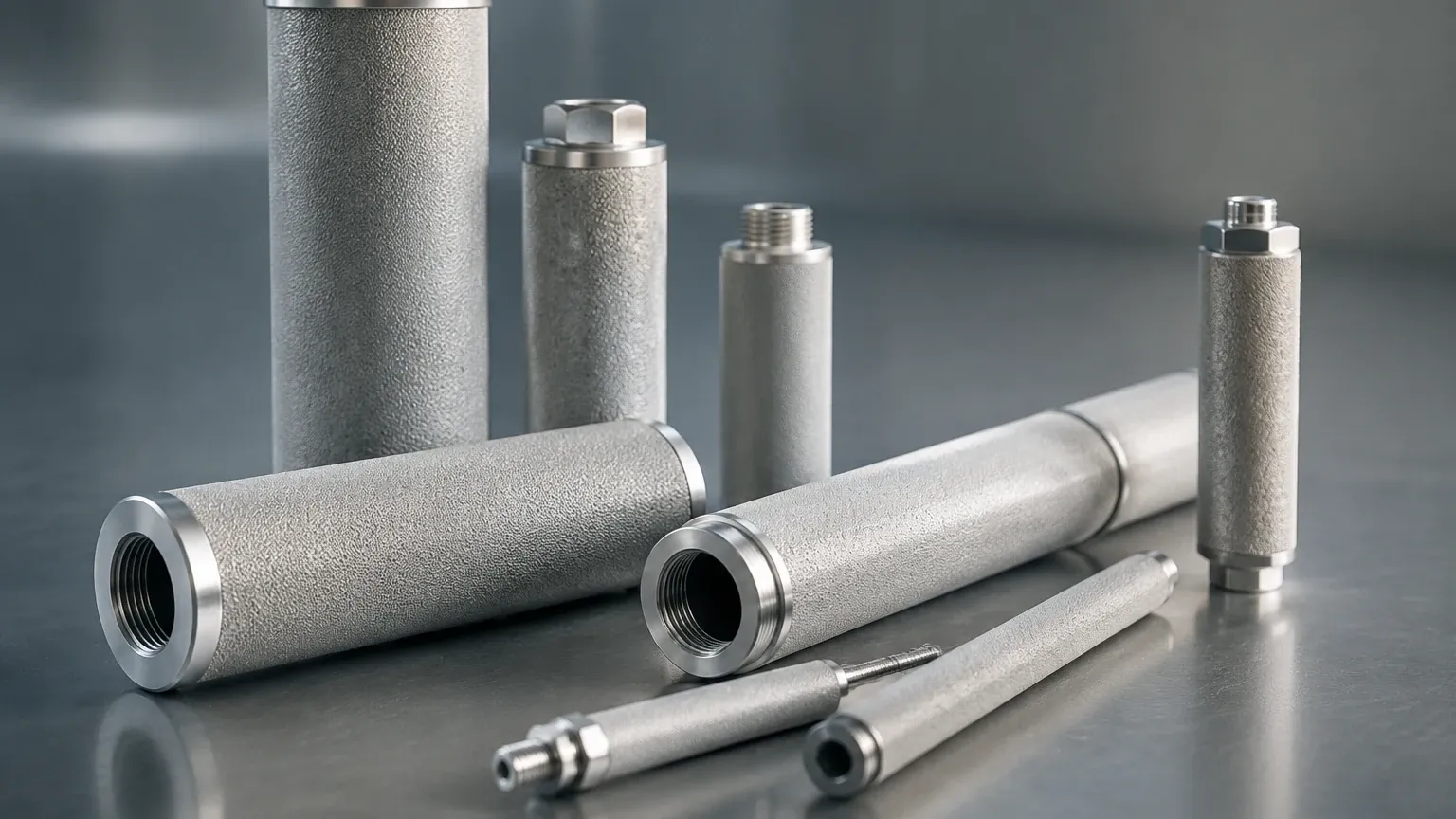
Customization Options for Sintered Metal Filter Cartridges
Industrial filtration systems are rarely one-size-fits-all. Customization is often necessary to integrate a new filter into an existing housing or to meet specific process requirements. As a specialized manufacturer, Kaifil provides extensive OEM and customized design options for the sintered metal filter cartridge.
End Fitting Configurations
To ensure a leak-proof seal, the end fittings must match the filter housing specifications. Common configurations include:
* Double Open End (DOE): Features flat gaskets on both ends, typically used in housings with a tie-rod assembly.
* Single Open End (SOE) with Code 7 (226): Features a double O-ring seal with a locking bayonet tab, providing high security against bypass.
* Code 3 (222): A double O-ring seal without the locking tabs, common in liquid filtration.
* Threaded Connections: NPT or BSP threads are often used in high-pressure hydraulic or gas systems to ensure a rigid, high-pressure-capable connection.
Physical Dimensions and Reinforcement
Cartridges can be manufactured in standard lengths (10", 20", 30", 40") or custom dimensions to fit specialized machinery. In applications involving extreme pressure differentials or backpulsing, internal support cores or external protective cages are added to the cartridge design to prevent structural collapse or bursting.
Cleaning Protocols and Service Life Extension
One of the primary economic advantages of a sintered metal filter cartridge is its cleanability. Unlike disposable cartridges that contribute to waste and recurring procurement costs, sintered metal filters can be restored to near-original performance through various cleaning methods.
In-Situ Cleaning (Backpulsing/Backwashing)
In many continuous processes, such as chemical vapor deposition or large-scale liquid filtration, the filter is cleaned without removal. By reversing the flow of the fluid (backwashing) or using a high-pressure pulse of gas (backpulsing), the accumulated filter cake is dislodged from the surface of the media. This process is highly effective for surface-filtration mesh cartridges.
Ex-Situ Cleaning Methods
When depth-filtration powder cartridges become heavily fouled, more intensive cleaning is required:
* Ultrasonic Cleaning: Uses high-frequency sound waves in a cleaning solvent to create cavitation bubbles that dislodge fine particles from deep within the pores.
* Chemical Cleaning: Involves soaking the cartridge in acids, caustic solutions, or specialized solvents to dissolve organic or inorganic foulants.
* Furnace Cleaning (Burn-off): For filters clogged with organic polymers or carbonaceous materials, controlled heating in a furnace can oxidize and remove the contaminants without damaging the metal structure.
Establishing a regular cleaning schedule based on pressure drop triggers can significantly extend the service life of the cartridge, often spanning several years of continuous operation.
Selecting the Right Filter for Demanding Environments
For engineers and purchasing teams, the selection of a sintered metal filter cartridge should be guided by a comprehensive evaluation of the total cost of ownership (TCO). While the initial capital expenditure (CAPEX) for a stainless steel filter is higher than that of a disposable unit, the reduction in downtime, disposal costs, and replacement frequency often results in a lower TCO over the life of the project.
Before finalizing a specification, it is recommended to confirm the following data points with the manufacturer:
1. Operating Temperature (Continuous and Peak): To ensure material and seal integrity.
2. Fluid Chemistry: To prevent corrosion or media migration.
3. Maximum Differential Pressure: To determine if internal reinforcement is necessary.
4. Target Particle Size and Efficiency: To select the correct micron rating and media type (powder vs. mesh).
5. Flow Rate and Viscosity: To calculate the required surface area and avoid excessive pressure drop.
By addressing these technical considerations, organizations can implement filtration solutions that provide reliable, repeatable performance in the most challenging industrial environments. Kaifil’s expertise in custom stainless steel filtration ensures that each cartridge is engineered to meet these rigorous standards, supporting industries from pharmaceutical manufacturing to heavy hydraulic systems.
