


2 Basket Strainers
In industrial fluid handling, the continuity of a process often dictates the specific configuration of filtration hardware. For systems where shutting down a line to clean a filter is not an option, engineers frequently specify 2 basket strainers—commonly referred to in the industry as duplex strainers. These systems utilize two separate strainer chambers connected by a diverter valve, allowing fluid to flow through one chamber while the other is isolated for maintenance or cleaning.
As a specialized manufacturer of stainless steel filtration solutions, Kaifil understands that the selection of Strainers & Baskets involves more than just matching pipe diameters. It requires a deep understanding of fluid dynamics, material compatibility, and the specific mechanical stresses of the application environment. This guide examines the technical nuances of 2 basket strainers to assist engineering and procurement teams in making informed decisions for their industrial infrastructure.
Understanding the Configuration of 2 Basket Strainers
The primary advantage of a 2 basket strainer system is its ability to provide uninterrupted flow. In a simplex (single-chamber) setup, the process must stop whenever the basket reaches its dirt-holding capacity. In contrast, a 2 basket configuration integrates a central valve assembly—typically a plug, ball, or butterfly valve—that redirects the flow from a dirty basket to a clean one without dropping system pressure.
Duplex vs. Parallel Simplex Setups
While "2 basket strainers" often refers to a single duplex unit, some engineers design systems using two independent simplex strainers connected by external piping and manual valves. While this provides redundancy, integrated duplex units are generally preferred due to their compact footprint and the reduced risk of operator error during the switchover process. Integrated units ensure that the flow path is never fully closed, preventing hydraulic shock or "water hammer" that can damage downstream pumps and instrumentation.
The Role of the Diverter Valve
The heart of a 2 basket system is the diverter mechanism. High-quality industrial strainers use a synchronized valve system that ensures the secondary chamber is fully engaged before the primary chamber is closed. This "overlap" is critical in high-pressure applications where even a momentary blockage could lead to catastrophic pipe failure or pump cavitation.
Engineering Considerations: Materials and Construction
When specifying 2 basket strainers, material selection is the most significant factor affecting longevity and performance. Stainless steel is the industry standard for demanding environments due to its inherent resistance to corrosion and high-temperature stability.
Stainless Steel Grades: 304 vs. 316L
* Grade 304: Suitable for general industrial use, water treatment, and mildly corrosive fluids. It offers excellent mechanical strength and cost-effectiveness for standard applications.
* Grade 316/316L: Preferred for chemical processing, pharmaceutical manufacturing, and marine environments. The addition of molybdenum provides superior resistance to chlorides and pitting. 316L (low carbon) is specifically chosen when the strainer body or baskets require extensive welding, as it minimizes carbide precipitation that can lead to intergranular corrosion.
Basket Media and Reinforcement
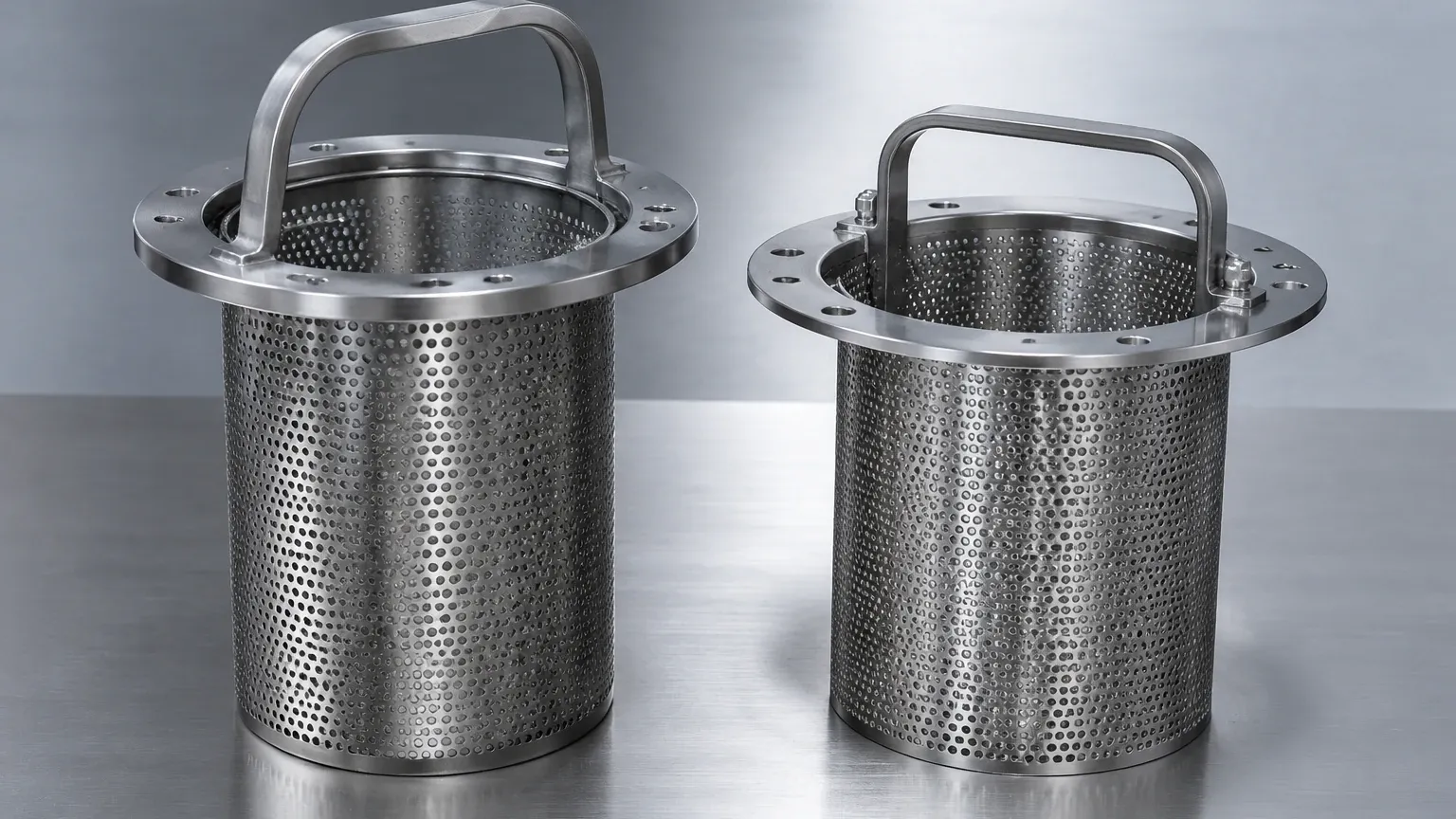
The internal baskets in these systems are typically constructed from perforated metal or a combination of perforated plate and fine wire mesh. For high-viscosity fluids or high-pressure differentials, the mesh is often sintered or reinforced with a heavier outer cage to prevent the media from collapsing under the weight of the accumulated debris.
Key Performance Metrics for Industrial Strainers
To optimize the performance of 2 basket strainers, engineers must evaluate several quantitative metrics during the design phase. Relying on nominal pipe size alone often leads to undersized units that require frequent cleaning.
Pressure Drop (ΔP)
The pressure drop across a strainer is the difference between the inlet and outlet pressure. A well-engineered 2 basket system should have a low "clean" pressure drop, typically under 2 psi. As the basket collects contaminants, the ΔP increases. Engineers must define the "terminal pressure drop"—the point at which the flow must be diverted to the clean chamber. If the ΔP exceeds the structural limits of the basket, the media may rupture, allowing bypass and potentially damaging downstream equipment.
Open Area Ratio (OAR)
The Open Area Ratio is the ratio of the total area of the holes in the strainer basket to the cross-sectional area of the inlet pipe. A common industrial standard for 2 basket strainers is an OAR of at least 6:1. A higher ratio means the strainer can hold more debris before the pressure drop becomes significant, extending the intervals between cleaning cycles and reducing labor costs.
Filtration Accuracy (Micron Rating)
Determining the correct micron rating requires a balance between protecting equipment and maintaining flow. If the mesh is too fine, the 2 basket strainers will clog prematurely; if it is too coarse, harmful particles will pass through. In many industrial applications, a "staged" approach is used, where the basket utilizes a coarse outer layer to catch large debris and a fine inner mesh for precision filtration.
Selection Criteria for Engineers and Purchasing Teams
When sourcing Strainers & Baskets, purchasing teams should confirm several technical specifications to ensure the hardware is fit for purpose.
1. Connection Types: Depending on the piping standards, strainers may require flanged (ANSI, DIN, or JIS), threaded (NPT or BSP), or socket-weld connections. Flanged connections are typically preferred for 2 basket strainers above 2 inches to facilitate easier removal and maintenance.
2. Seal and Gasket Compatibility: The choice of O-rings and gaskets (Buna-N, EPDM, Viton, or PTFE) must be compatible with the fluid's chemical composition and temperature. A mismatch here can lead to external leaks or internal bypassing between the two chambers.
3. Cover Design: For 2 basket strainers, the speed of maintenance is a priority. Quick-opening covers (such as swing-bolt or clamp designs) allow operators to access the baskets without specialized tools, significantly reducing the time the secondary chamber is offline.
4. Vent and Drain Ports: High-quality units include vent ports on the cover to release trapped air and drain ports at the bottom of the chamber to facilitate the removal of liquid before the basket is extracted.
Maintenance and Operational Longevity
The total cost of ownership (TCO) for 2 basket strainers is heavily influenced by maintenance requirements. Because these units are designed for continuous operation, the mechanical components of the diverter valve must be robust enough to handle frequent cycling.
Cleaning Cycles and Monitoring
Automating the monitoring process is highly recommended for industrial 2 basket strainers. Installing differential pressure gauges with electrical switches can alert operators or trigger an automated diverter valve when the dirty chamber reaches a specific ΔP. This prevents the system from operating in a high-stress state and ensures that cleaning occurs only when necessary.
Replacement Baskets
Over time, even the most durable stainless steel baskets will experience wear from abrasive particles or fatigue from pressure fluctuations. It is a best practice to keep a spare set of baskets on-site. When ordering replacements, it is essential to provide the original manufacturer’s specifications to ensure a precision fit. An ill-fitting basket allows fluid to bypass the filtration media entirely, rendering the strainer useless.
Applications in Demanding Industrial Environments
2 basket strainers are indispensable in sectors where downtime translates to significant financial loss or safety risks.
* Chemical and Petrochemical: Used to protect heat exchangers and reactors from scale and foreign particulates found in process piping.
* Food and Beverage: Stainless steel 2 basket strainers are used in the filtration of syrups, oils, and juices, where hygienic design and the ability to clean components without stopping production are mandatory.
* Power Generation and Cooling Water: These units filter large volumes of intake water to protect condensers and cooling towers from organic debris and silt.
* Lubrication Systems: In large turbines and compressors, 2 basket strainers ensure that the lubricating oil remains free of metal shavings, preventing catastrophic bearing failure.
Conclusion
Selecting the right 2 basket strainers is a critical engineering decision that impacts the efficiency, safety, and continuity of industrial operations. By focusing on material quality, appropriate Open Area Ratios, and robust diverter mechanisms, facilities can ensure long-term reliability. Kaifil’s expertise in custom stainless steel filtration allows for the development of tailored Strainers & Baskets that meet the specific pressure, temperature, and filtration requirements of modern industry. Whether for OEM integration or system upgrades, understanding these technical fundamentals is the first step toward optimized fluid management.
