


22mm Strainers
In industrial fluid handling and process engineering, the efficiency of a system often depends on the smallest components. Among these, 22mm strainers represent a specialized category of filtration hardware designed for precision protection in small-bore piping, hydraulic circuits, and specialized machinery. Whether used as a primary defense against debris or a secondary safety measure for sensitive valves, these components are essential for maintaining the structural integrity and operational uptime of industrial assets.
As a professional manufacturer of stainless steel filtration solutions, Kaifil understands that selecting the correct strainer involves more than just matching a diameter. It requires a deep understanding of material science, fluid dynamics, and the specific environmental stressors of the application. This guide examines the technical nuances of 22mm strainers, providing engineers and purchasing teams with the factual data needed to optimize their filtration systems.
Understanding the Role of 22mm Strainers in Industrial Systems
Strainers are technically defined as closed vessels with a cleanable screen designed to remove foreign particles from a flowing medium. While the terms "filter" and "strainer" are often used interchangeably, in an engineering context, a strainer is typically used to remove larger macroscopic particles that could damage downstream equipment like pumps, meters, and spray nozzles.
22mm strainers are frequently utilized in applications where space is constrained or where the flow rate is relatively low but the requirement for reliability is high. Common roles include:
* Pump Suction Protection: Preventing ingress of metal shavings, scale, or construction debris into high-precision pump housings.
* Nozzle Protection: In food processing or chemical coating lines, a 22mm basket can prevent clogging of expensive precision spray tips.
* Heat Exchanger Defense: Removing suspended solids that could lead to scaling or mechanical blockage within the narrow channels of plate heat exchangers.
By integrating high-quality Strainers & Baskets, facilities can significantly reduce the Total Cost of Ownership (TCO) by extending the intervals between major equipment overhauls.
Engineering Considerations: Material Selection and Durability
The performance of 22mm strainers is fundamentally tied to the materials used in their construction. Because these components are often exposed to corrosive chemicals, high pressures, and extreme temperatures, stainless steel is the industry standard. At Kaifil, we focus on several key alloys to meet diverse industrial demands:
AISI 304 Stainless Steel
This is the most common material for general-purpose industrial strainers. It offers excellent strength and good corrosion resistance for water treatment, hydraulic oils, and mild chemical applications. It is cost-effective for environments where high-purity or extreme chemical resistance is not the primary concern.
AISI 316 and 316L Stainless Steel
For more demanding environments, such as pharmaceutical processing or marine applications, 316 stainless steel is preferred due to the addition of molybdenum, which enhances resistance to chloride-induced pitting. The "L" (low carbon) variant is essential for components that require extensive welding, as it prevents carbide precipitation and maintains corrosion resistance at the weld joints.
Specialized Alloys
In specific cases involving highly aggressive media or extreme temperatures, exotic alloys like Monel or Hastelloy may be required. Engineers must evaluate the pH levels, presence of oxidizing agents, and the operating temperature range before finalizing the material specification for their 22mm strainers.
Technical Configurations of 22mm Strainers
The geometry of a strainer determines its dirt-holding capacity and the frequency of required maintenance. When specifying 22mm strainers, several structural configurations are available:
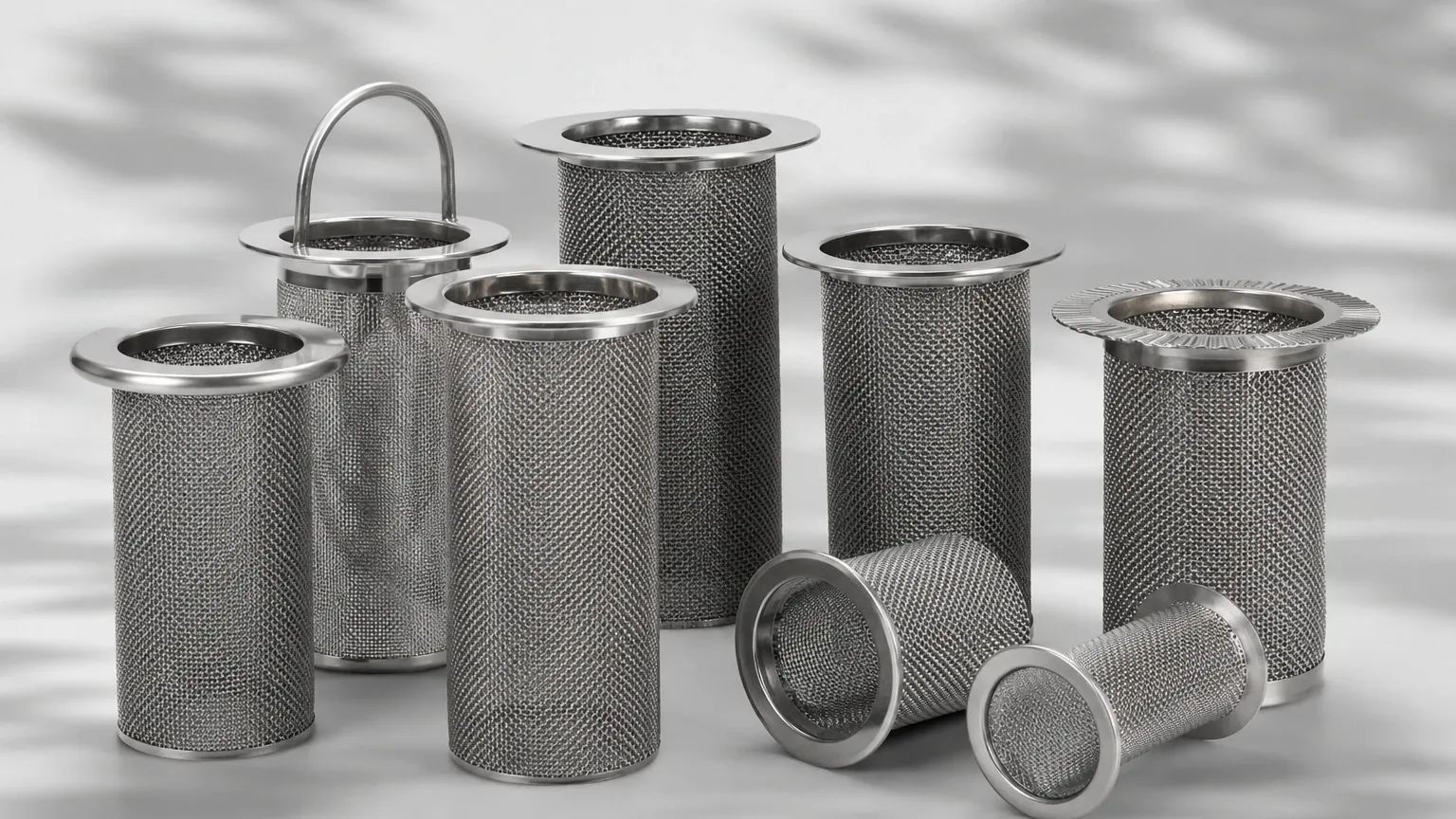
1. Cylindrical Strainers: These are the most straightforward design, often used in inline applications. They provide a high length-to-diameter ratio, which allows for a significant surface area within a narrow envelope.
2. Basket Strainers: These feature a "top-hat" or basket shape. The primary advantage of a basket design is the ease of cleaning; the debris is trapped inside the basket, which can be lifted out without spilling contaminants back into the downstream line.
3. Conical (Witch’s Hat) Strainers: Often used during system startup, these are temporary strainers designed to catch construction debris. However, precision-engineered 22mm conical strainers are also used in permanent installations where high-velocity flow is expected.
Each configuration must be evaluated based on the "Open Area Ratio" (OAR). The OAR is the relationship between the internal cross-sectional area of the pipe and the total open area of the strainer mesh. A higher OAR (typically 4:1 or higher) results in a lower pressure drop and longer service life between cleanings.
Performance Metrics: Micron Ratings and Pressure Drop
For an engineer, the two most critical performance metrics for 22mm strainers are the filtration accuracy and the clean pressure drop.
Filtration Accuracy (Micron Rating)
The mesh size determines the smallest particle the strainer will reliably capture. For 22mm strainers, mesh sizes can range from coarse (several millimeters) to fine (down to 20-40 microns). It is a common mistake to specify a mesh that is too fine for the application. While finer mesh removes more particles, it also increases the rate of clogging and the initial pressure drop. The rule of thumb is to select a mesh size slightly smaller than the smallest orifice or clearance in the downstream equipment.
Calculating Pressure Drop (ΔP)
Pressure drop is the loss of fluid pressure as it passes through the strainer. It is influenced by:
* Fluid Viscosity: Thicker fluids (like heavy oils) generate higher pressure drops.
* Flow Velocity: As flow increases, ΔP increases exponentially.
* Percent Clogging: As the strainer collects debris, the effective open area decreases, rapidly increasing the pressure drop.
Kaifil provides technical data to help engineers calculate the expected ΔP for their specific flow conditions, ensuring that the pump system can handle the resistance without cavitation or loss of efficiency.
Installation and Maintenance Best Practices
Proper installation is vital for the longevity of 22mm strainers. Even the highest quality stainless steel component can fail if subjected to improper mechanical stress.
* Orientation: Basket strainers should always be installed in horizontal lines with the basket housing facing downward to ensure gravity assists in debris collection.
* Seal Integrity: For 22mm strainers used in high-pressure hydraulic systems, the choice of O-ring or gasket material (Viton, EPDM, PTFE) must be compatible with the process fluid to prevent leaks.
* Monitoring: We recommend installing differential pressure gauges upstream and downstream of the strainer. A sudden or steady increase in ΔP indicates that the strainer requires cleaning. Ignoring these signals can lead to mesh collapse or "bypass," where the pressure forces contaminants through the mesh or around the seals.
Maintenance cycles depend heavily on the "cleanliness" of the process fluid. In closed-loop systems, cleaning may only be required annually. In raw water or open-process applications, weekly or even daily cleaning may be necessary. Because Kaifil manufactures these components from high-grade stainless steel, they are designed for repeated ultrasonic cleaning or manual backwashing without losing their structural shape.
Customization and OEM Solutions
Standard off-the-shelf components often fail to meet the rigorous demands of specialized industrial equipment. This is where Kaifil’s manufacturing expertise becomes a strategic advantage. When sourcing 22mm strainers, engineers often require specific modifications:
* Reinforced Mesh: For high-pressure applications, a fine inner mesh can be supported by a coarser, heavy-duty outer perforated metal layer.
* Custom End Fittings: Whether the system requires NPT threads, flanged connections, or custom weld-on ends, the interface must be precise to ensure a leak-free fit.
* Unique Geometries: If a standard cylindrical or basket shape does not fit the housing, custom-formed metal components can be engineered to maximize surface area within the available spatial constraints.
Kaifil works closely with global technical teams to develop these customized solutions, moving from material selection and filtration accuracy requirements to final production. Our focus on precision ensures that every 22mm strainer delivered meets the exact tolerances required for demanding industrial environments.
Conclusion: Selecting the Right Partner for Filtration
The selection of 22mm strainers is a technical decision that impacts the reliability and safety of an entire industrial process. By focusing on high-quality materials, understanding the fluid dynamics of the application, and adhering to strict maintenance protocols, engineers can ensure their systems operate at peak efficiency.
When evaluating suppliers, it is essential to look for a manufacturer that provides not just a product, but a technical partnership. Reliable filtration components are the result of rigorous engineering, quality-controlled manufacturing, and a clear understanding of the end-user's challenges. Whether you are designing a new hydraulic system or upgrading a chemical processing line, choosing the right Strainers & Baskets is a fundamental step toward operational excellence.
