


3 8 Strainers
In industrial fluid handling, the efficiency of a system is often determined by the protection of its most sensitive components. While large-scale pipelines receive significant engineering attention, small-bore piping systems—specifically those utilizing 3/8-inch connections—require equally rigorous filtration standards. 3 8 strainers serve as the primary line of defense for small-diameter lines, protecting valves, pumps, nozzles, and instrumentation from particulate contamination that can lead to mechanical failure or process downtime.
Selecting the correct 3/8-inch strainer involves more than simply matching a thread size. Engineers must evaluate material compatibility, pressure ratings, filtration fineness, and the specific flow characteristics of the medium. As a specialized manufacturer of stainless steel filtration solutions, Kaifil provides precision-engineered components designed to meet the demanding requirements of industrial applications.
Understanding the Role of 3/8 Strainers in Industrial Systems
A 3/8-inch strainer is typically integrated into systems where flow rates are relatively low but the precision of the fluid delivery is high. These sizes are common in chemical dosing, laboratory equipment, hydraulic pilot lines, and food-grade flavoring or additive systems. The "3/8" designation usually refers to the National Pipe Thread (NPT) or British Standard Pipe (BSP) connection size, which dictates the volumetric capacity the strainer can handle.
The primary function of these components is the mechanical removal of solids from a flowing liquid or gas. By trapping debris such as pipe scale, weld beads, or external contaminants, the strainer prevents the clogging of downstream orifices. Because 3/8-inch lines often feed into precision nozzles or sensitive sensors, even microscopic particles can cause significant operational disruptions.
Engineering Considerations: Materials and Construction
For industrial B2B applications, material selection is the most critical factor in ensuring the longevity of a 3/8-inch strainer. While plastic or brass options exist for residential or light commercial use, industrial environments necessitate the durability of stainless steel.
Stainless Steel 304 vs. 316
Most industrial 3 8 strainers are manufactured from either Grade 304 or Grade 316 stainless steel.
- Grade 304: Suitable for general industrial use, providing excellent strength and basic corrosion resistance for water and mild chemical applications.
- Grade 316: Contains molybdenum, which significantly enhances resistance to chlorides and acetic acids. This is the standard choice for marine environments, pharmaceutical processing, and aggressive chemical handling.
Pressure and Temperature Ratings
Small-bore strainers are often subjected to high-pressure environments, particularly in hydraulic or steam applications. Engineers must verify that the housing and the internal filter element can withstand the maximum operating pressure (MAOP) of the system. Stainless steel 3/8-inch strainers can often be rated for several thousand PSI, depending on the wall thickness and the type of seal (such as PTFE or Viton) used in the assembly.
Comparing Strainers & Baskets for Small-Bore Applications
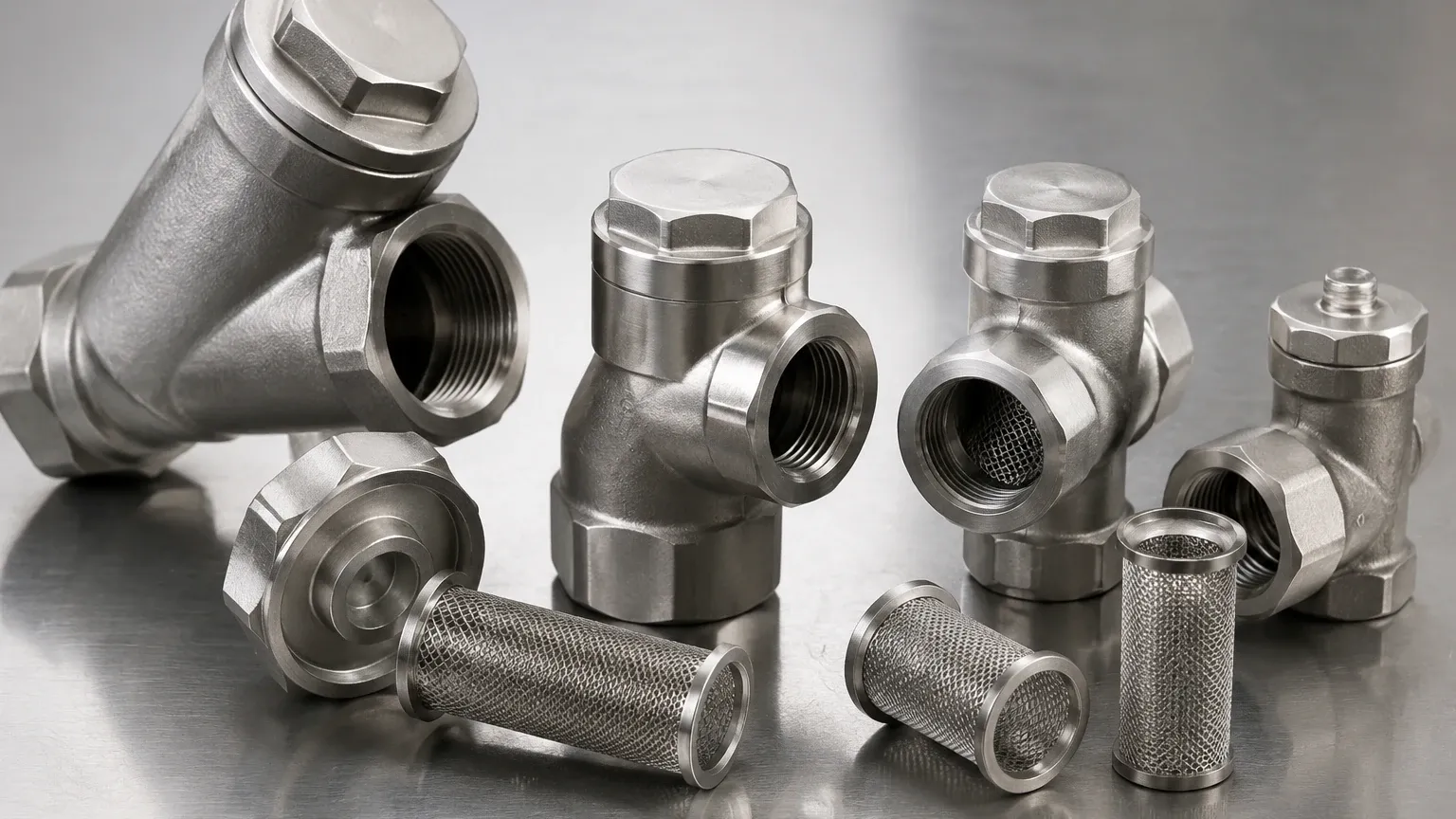
When designing a filtration stage, engineers must choose between different configurations. The choice between Y-type strainers and basket-type strainers depends largely on the installation space and the frequency of maintenance.
Y-Strainers
Y-strainers are the most common configuration for 3/8-inch lines. They feature a compact design where the filter element is housed in a leg that branches off the main flow path at an angle.
- Pros: Can be installed horizontally or vertically; typically less expensive; capable of handling high pressures.
- Cons: Smaller dirt-holding capacity compared to baskets; requires more frequent cleaning in high-debris applications.
Basket Strainers
For applications where the fluid contains a higher concentration of solids, Strainers & Baskets are the preferred choice. These units feature a vertical cylinder that houses a removable basket.
- Pros: Larger surface area for filtration; lower pressure drop; easier to clean without spilling fluid.
- Cons: Usually limited to horizontal installations; larger footprint than Y-strainers.
In 3/8-inch sizes, basket strainers are often used in batch processing where the fluid must be highly polished before reaching the final stage of production.
Technical Specifications: Mesh, Perforation, and Micron Ratings
The performance of 3 8 strainers is defined by the internal element. This element is typically constructed from either perforated metal or woven wire mesh, often supported by a heavier cage for structural integrity.
Perforated Metal
Perforated elements are used for coarse filtration, typically removing particles larger than 0.5mm. In a 3/8-inch strainer, a perforated basket might serve as a "roughing" filter to protect a finer mesh screen inside.
Woven Wire Mesh
For precision filtration, stainless steel wire mesh is utilized. Mesh is defined by the number of openings per linear inch. For example, a 100-mesh screen has 100 openings per inch, which corresponds to approximately 150 microns. In 3/8-inch applications, mesh sizes can range from 20 (coarse) to 500 (extra fine), depending on the sensitivity of the downstream equipment.
Effective Filtration Area (EFA)
The EFA is the total area of the openings in the filter element. A higher EFA results in a lower initial pressure drop and a longer interval between cleanings. When selecting 3 8 strainers, engineers should look for designs that maximize the basket or screen surface area within the compact 3/8-inch housing.
Flow Characteristics and Pressure Drop (Delta P)
Every strainer introduces a restriction into the flow path. This restriction causes a pressure drop, known as Delta P. In 3/8-inch systems, where pump head may be limited, calculating the pressure drop is essential.
Factors influencing Delta P include:
1. Viscosity of the Fluid: Thicker fluids (like oils or syrups) require larger mesh openings or larger strainer bodies to maintain flow.
2. Specific Gravity: Heavier fluids increase the pressure drop.
3. Percentage of Clogging: As debris builds up, the open area decreases, and the pressure drop increases exponentially.
Engineers typically aim for a clean pressure drop of less than 2 PSI. If the calculated Delta P exceeds this, it may be necessary to move to a larger strainer size or a high-capacity basket design.
Industrial Applications for 3/8-Inch Filtration
Despite their small size, 3 8 strainers are utilized across a broad spectrum of heavy industries. Their ability to provide localized protection makes them indispensable in decentralized systems.
Chemical Processing
In chemical plants, 3/8-inch lines are frequently used for sampling systems and additive injection. Stainless steel strainers ensure that no particulate matter interferes with the accuracy of flow meters or the integrity of chemical reactions.
Food and Beverage
Hygiene is paramount in food production. 3/8-inch stainless steel strainers are used in lines carrying flavorings, oils, and cleaning agents (CIP systems). The use of 316L stainless steel ensures that the filtration component does not leach contaminants into the product and can withstand rigorous sterilization cycles.
Hydraulic and Lube Oil Systems
High-pressure hydraulic systems use 3/8-inch pilot lines to control larger valves. A single piece of grit in a pilot line can jam a spool valve, leading to a total system shutdown. Fine mesh 3 8 strainers are critical for maintaining the ISO 4406 cleanliness codes required by modern hydraulic components.
Pharmaceutical and Biotech
In laboratory and cleanroom environments, small-bore piping is the standard. Precision metal filter components provide the necessary filtration accuracy to protect sensitive analytical instruments and chromatography columns.
Maintenance, Replacement Cycles, and Total Cost of Ownership
One of the most common mistakes in industrial procurement is focusing solely on the initial purchase price of a 3/8-inch strainer. The total cost of ownership (TCO) includes maintenance labor, downtime, and the cost of replacement elements.
Cleaning Protocols
For Y-strainers, a "blow-down" valve can be installed on the drain port. This allows the operator to flush out accumulated debris without opening the strainer. However, for thorough cleaning or when using fine mesh, the strainer must be opened and the element manually cleaned.
Replacement Intervals
The lifespan of a stainless steel filter element depends on the corrosivity of the fluid and the physical wear from abrasive particles. In many 3/8-inch applications, it is more cost-effective to have spare baskets or screens on hand to allow for immediate replacement, minimizing the time the process is offline.
Signs of Failure
Engineers should monitor for:
- Increased Pressure Drop: Indicates the screen is blinded or clogged.
- Bypass: If the internal seals fail, fluid will bypass the filter element entirely, leading to downstream contamination.
- Structural Collapse: High differential pressure can crush a 3/8-inch mesh screen if it is not properly supported by a perforated backup tube.
Customization and OEM Solutions with Kaifil
In many specialized industrial applications, off-the-shelf 3/8-inch strainers do not meet specific engineering requirements. This is where custom manufacturing becomes essential. Kaifil specializes in developing bespoke filtration solutions tailored to unique operational parameters.
Customization options include:
- Non-Standard Mesh Sizes: Tailoring the micron rating to a specific particle size distribution.
- Specialized End Connections: Beyond standard NPT/BSP, including flanged, socket weld, or sanitary tri-clamp fittings.
- High-Alloy Materials: Utilizing materials like Hastelloy or Monel for extreme chemical environments.
- Integrated Sensors: Designing strainer housings that accommodate differential pressure gauges or electronic clog indicators.
By working closely with an experienced manufacturer, purchasing teams can ensure that their 3 8 strainers are optimized for both performance and durability. Whether you require a single custom component for a prototype or large-scale OEM production for an equipment line, selecting a partner with deep technical expertise in stainless steel filtration is vital.
Conclusion: Selecting the Right 3/8 Strainer
The selection of a 3/8-inch strainer is a technical decision that impacts the reliability of the entire fluid system. By considering the chemical compatibility of the stainless steel, the required filtration fineness (mesh vs. perforation), and the expected flow conditions, engineers can prevent costly equipment failures.
For those seeking high-performance, durable, and precisely manufactured filtration components, exploring the range of Strainers & Baskets is the first step toward optimized system protection. Understanding the nuances of 3 8 strainers ensures that even the smallest components in your facility contribute to a more efficient and reliable operation.
