


5 Gallon Paint Strainers
In industrial coating, finishing, and chemical processing, the integrity of the final product is heavily dependent on the purity of the fluid. Particulate contamination, whether from undissolved resins, skinning, or environmental debris, can lead to surface imperfections, clogged spray nozzles, and significant downtime. For operations utilizing standard 5-gallon containers, the implementation of 5 gallon paint strainers is a fundamental engineering requirement to ensure consistent flow and finish quality.
Industrial-grade filtration goes beyond simple screening; it involves a calculated selection of materials, mesh geometries, and structural designs to handle varying viscosities and chemical compositions. This guide examines the technical specifications, engineering considerations, and selection criteria for Strainers & Baskets used in 5-gallon batch processing.
The Engineering Necessity of Filtration in Coating Processes
Filtration in a 5-gallon context serves two primary purposes: protecting the application equipment and ensuring the aesthetic and functional properties of the coating. In high-pressure spray systems, even microscopic particles can cause abrasive wear on nozzles or lead to intermittent clogs that disrupt the spray pattern.
From a material science perspective, paints and coatings are complex suspensions. Over time, or due to temperature fluctuations, components may agglomerate. 5 gallon paint strainers act as the final defense, removing these solids before they enter the pump or the spray gun. For engineers, the challenge lies in selecting a strainer that provides high-efficiency particle removal without inducing a significant pressure drop or shearing the fluid's delicate chemical structure.
Material Specifications: Synthetic vs. Metallic Media
When specifying 5 gallon paint strainers for industrial environments, the choice of media is the most critical decision. The two primary categories are synthetic fibers (nylon/polyester) and stainless steel mesh.
Synthetic Mesh Strainers
Synthetic strainers are often designed as bag-style inserts. They are typically made from monofilament nylon or polyester.
- Nylon: Offers excellent abrasion resistance and is compatible with most water-based and some solvent-based coatings. However, it can swell in certain alcohols or strong acids.
- Polyester: Provides better resistance to acids and is less prone to moisture absorption, making it more dimensionally stable in varying humidity levels.
Stainless Steel Strainers & Baskets
For high-demand industrial applications, stainless steel (typically 304 or 316 grade) is the preferred material. Stainless steel Strainers & Baskets offer several technical advantages:
- Chemical Inertness: They are compatible with virtually all industrial solvents, including MEK, Toluene, and Xylene, which would degrade many synthetic fibers.
- Structural Rigidity: Unlike bags that can collapse under the weight of high-viscosity fluids, rigid metal baskets maintain their shape, ensuring the entire surface area of the mesh is utilized.
- Thermal Stability: Stainless steel can withstand high-temperature coatings that would melt or deform synthetic mesh.
- Reusability: While synthetic bags are generally disposable, stainless steel components can be cleaned and returned to service, reducing the total cost of ownership and waste stream volume.
Understanding Micron Ratings and Mesh Geometry
The performance of 5 gallon paint strainers is defined by their micron rating, which indicates the size of the particles the mesh is designed to trap. In industrial painting, common ratings range from 100 to 600 microns, depending on the coating type.
1. Fine Filtration (100–150 Microns): Used for base coats, clear coats, and low-viscosity inks where surface smoothness is paramount.
2. Medium Filtration (200–300 Microns): The standard for most industrial primers and enamels. It balances particle removal with flow rate.
3. Coarse Filtration (400–600+ Microns): Utilized for heavy-bodied coatings, textured finishes, or as a pre-filtration step to remove large skins and debris.
Engineers must also consider the "open area" percentage of the mesh. A higher open area allows for greater flow rates and lower pressure drops but may compromise the structural integrity of the mesh if not supported by a perforated metal basket. The weave type—plain weave versus twill weave—also impacts the filtration characteristics and the ease with which the strainer can be cleaned.
Hydraulic Considerations: Flow Rate and Viscosity
Selecting 5 gallon paint strainers requires an understanding of fluid dynamics, particularly the relationship between viscosity and pressure drop ($ΔP$). As the viscosity of the paint increases, the resistance to flow through the mesh increases exponentially.
Viscosity Management
Industrial coatings can range from water-like consistency to heavy, thixotropic pastes. For high-viscosity materials, a larger surface area is required to prevent the strainer from blinding (clogging) prematurely. If a 5-gallon pail is being emptied via a pump, an undersized strainer will cause cavitation in the pump, leading to mechanical failure and inconsistent coating application.
Gravity vs. Pressure-Fed Systems
In gravity-fed applications, the head pressure is minimal. Therefore, the mesh must be coarse enough to allow the fluid to pass under its own weight. In pressure-fed or vacuum-drawn systems, the 5 gallon paint strainers must be structurally reinforced to prevent the mesh from tearing or bypassing. Rigid Strainers & Baskets are engineered to withstand these mechanical stresses, providing a secure seal against the container rim to ensure no fluid bypasses the filtration media.
Structural Design and Integration
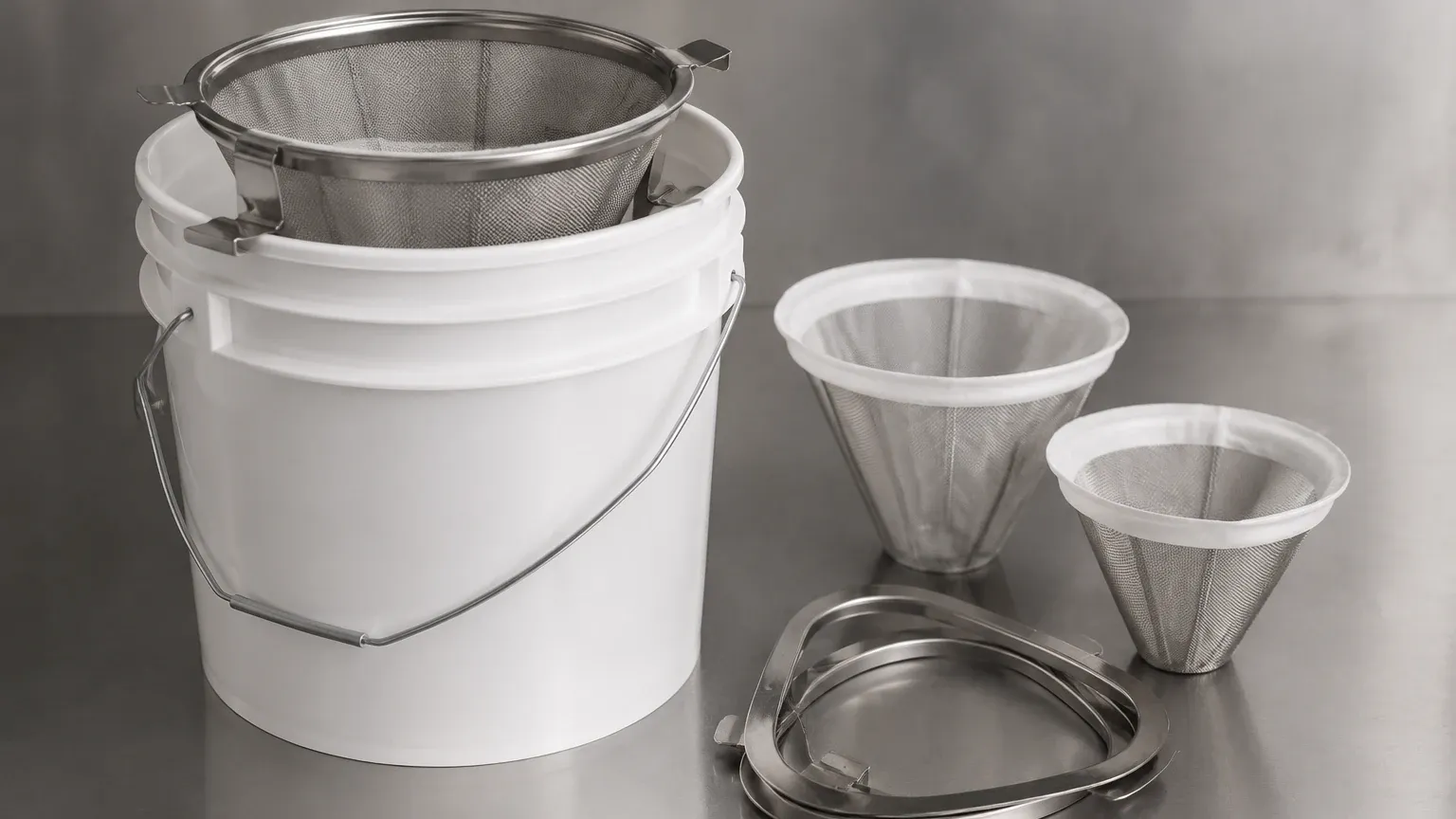
The physical design of the strainer must match the operational workflow. For 5-gallon applications, there are several common configurations:
- Elastic-Top Bags: These stretch over the rim of the 5-gallon pail. They are simple but prone to slipping if the fluid weight is too high or if the fit is not precise.
- Rigid Rim Strainers: These feature a plastic or metal ring that sits securely on the pail's edge. This design is more reliable for industrial use as it prevents the strainer from falling into the paint.
- Insert Baskets: These are heavy-duty, often stainless steel, and fit deep into the pail. They are frequently used in conjunction with pneumatic agitators or dip tubes for continuous extraction.
For OEM applications, custom-designed Strainers & Baskets can be manufactured to fit specific pressure pots or specialized 5-gallon mixing stations. Customization options include reinforced bottoms, specialized handle configurations for easy removal, and multi-stage mesh layers for graduated filtration.
Chemical Compatibility and Environmental Factors
In a B2B context, the longevity of filtration components is tied to their resistance to the process environment. Engineers must verify the compatibility of the strainer material with the solvent package of the coating.
| Material | Solvent Resistance | Acid Resistance | Max Operating Temp | Reusability |
| :— | :— | :— | :— | :— |
| Nylon | Moderate | Poor | 250°F | Low |
| Polyester | Good | Good | 300°F | Low |
| 304 Stainless | Excellent | Moderate | 800°F+ | High |
| 316 Stainless | Excellent | Excellent | 800°F+ | High |
Beyond chemical resistance, the environment of the paint room—such as humidity and ambient temperature—can affect synthetic fibers. Stainless steel remains the most stable option for facilities requiring high precision and repeatability across different shifts and seasons.
Total Cost of Ownership (TCO) in Industrial Filtration
While disposable 5 gallon paint strainers have a lower upfront unit cost, the total cost of ownership often favors high-quality, reusable stainless steel Strainers & Baskets. The TCO calculation includes:
1. Unit Cost: The purchase price of the filter.
2. Disposal Costs: Expenses related to hazardous waste disposal of paint-soaked synthetic bags.
3. Downtime: The time lost replacing clogged or failed disposable filters.
4. Quality Rejects: The cost of rework or scrapped parts due to filtration failure.
5. Labor: The time required for cleaning reusable units versus managing inventory for disposables.
In high-volume production lines, switching to a durable stainless steel basket often pays for itself within a few months by reducing waste and improving the reliability of the filtration step.
Maintenance and Cleaning of Reusable Strainers
To maintain the performance of reusable 5 gallon paint strainers, a standardized cleaning protocol is essential. If paint is allowed to dry on the mesh, the effective open area is reduced, and the micron rating is effectively altered in an uncontrolled manner.
- Immediate Rinsing: Strainers should be cleaned immediately after a batch is completed using the appropriate solvent.
- Ultrasonic Cleaning: For fine stainless steel mesh, ultrasonic baths are highly effective at removing dried resins from the intersections of the wires.
- Inspection: Regular visual inspection under magnification can identify broken wires or mesh displacement, which would allow oversized particles to pass through.
Conclusion: Selecting the Right Solution
The selection of 5 gallon paint strainers is an engineering decision that impacts the entire production chain. For light-duty, one-off batches, synthetic bags may suffice. However, for industrial processes where consistency, chemical resistance, and equipment protection are non-negotiable, heavy-duty Strainers & Baskets are the industry standard.
When evaluating filtration options, engineers should confirm the following with their supplier:
- Exact micron requirements based on the coating's solids content.
- Chemical compatibility with all solvents and cleaning agents used in the process.
- Mechanical requirements, including flow rates and potential pressure differentials.
- The feasibility of custom designs to integrate seamlessly with existing 5-gallon processing equipment.
By prioritizing technical specifications over initial purchase price, purchasing teams and engineers can optimize their coating processes, reduce waste, and ensure the highest quality standards for their finished products.
