


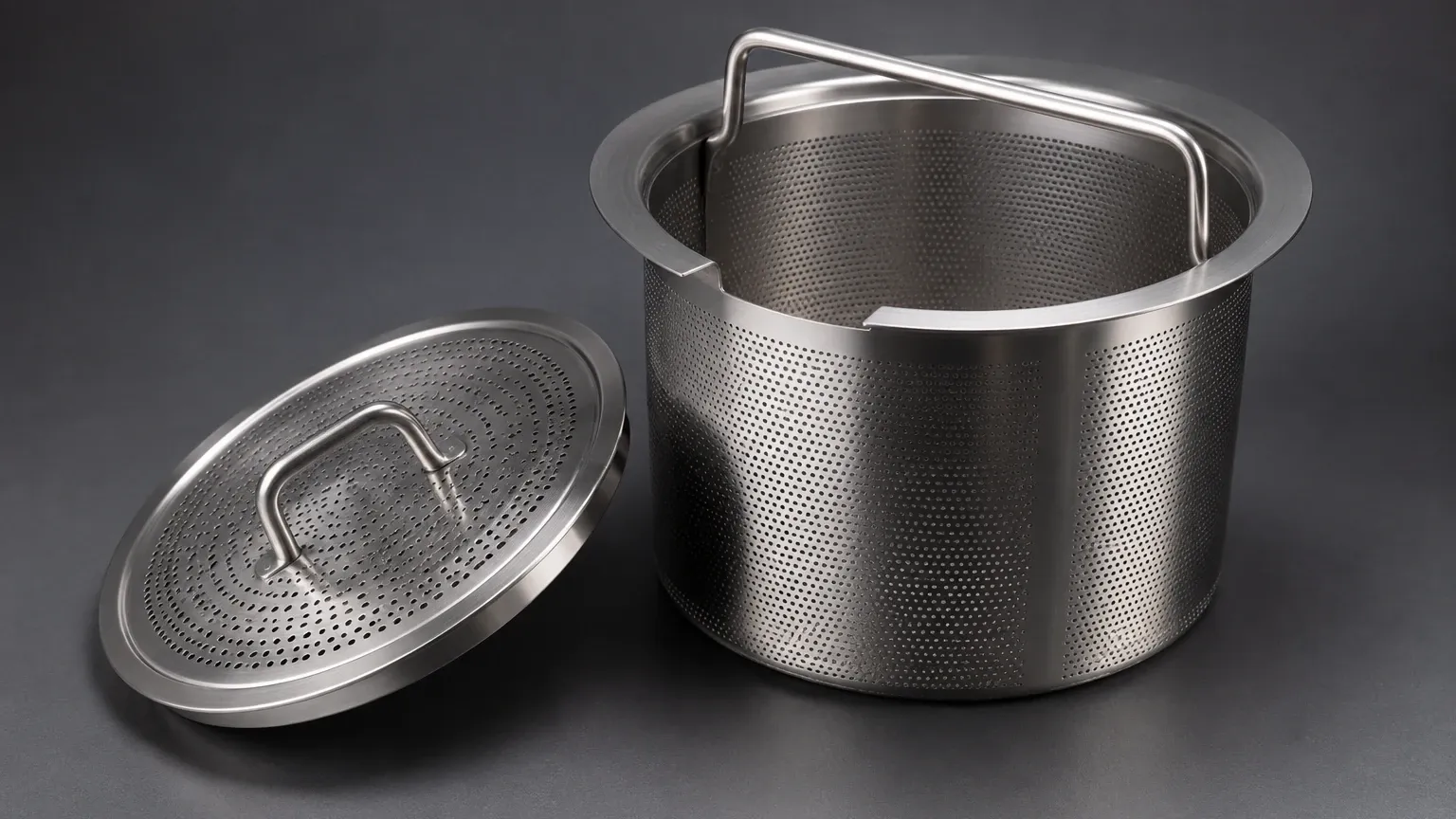
8in Basket Strainer
In industrial fluid handling, the 8in basket strainer serves as a critical component for protecting downstream equipment from particulate contamination. Designed for high-flow piping systems, these strainers are typically installed in suction or pressure lines to remove debris, scale, and other solids that could otherwise damage pumps, valves, and heat exchangers. Selecting the correct 8-inch configuration requires a deep understanding of fluid dynamics, material compatibility, and the specific filtration requirements of the application.
As a specialized manufacturer of stainless steel filtration solutions, Kaifil provides engineered Strainers & Baskets designed to withstand the rigorous demands of chemical processing, water treatment, and heavy industrial sectors. This guide examines the technical specifications, design considerations, and selection criteria essential for engineers and procurement teams evaluating an 8in basket strainer for their infrastructure.
Technical Specifications and Material Engineering
The performance of an 8in basket strainer is fundamentally tied to its construction materials and mechanical design. In industrial environments, stainless steel is the standard for durability and chemical resistance.
Material Selection: SS304 vs. SS316L
For most general-purpose industrial applications, Grade 304 stainless steel offers excellent strength and basic corrosion resistance. However, in environments involving chlorides, high-salinity water, or aggressive chemicals, Grade 316 or 316L is preferred. The addition of molybdenum in 316 stainless steel significantly enhances its resistance to pitting and crevice corrosion. For pharmaceutical or food-grade applications, 316L (low carbon) is often specified to minimize carbide precipitation during welding, ensuring a smoother, more sanitary surface finish.
Pressure and Temperature Ratings
An 8-inch piping system often operates under significant pressure. Standard 8in basket strainers are typically designed to meet ASME B16.5 flange standards, with common ratings including Class 150 and Class 300. It is vital to confirm that the strainer housing and the internal basket can handle the maximum operating pressure (MAOP) of the system, including potential pressure surges. Temperature also plays a role; as temperatures rise, the allowable working pressure of the stainless steel housing may decrease, a factor that must be accounted for during the engineering phase.
Design Configurations: Simplex vs. Duplex Systems
When specifying an 8in basket strainer, the decision between a simplex and a duplex design depends entirely on the system's tolerance for downtime.
Simplex Basket Strainers
A simplex 8in basket strainer is used in systems where the flow can be periodically interrupted. These are common in batch processing or in systems with redundant parallel lines. When the internal basket reaches its dirt-holding capacity—indicated by an increase in differential pressure—the system is shut down, the strainer is depressurized, and the basket is removed for cleaning.
Duplex Basket Strainers
For continuous-flow operations, such as cooling water loops or 24/7 chemical production, a duplex 8in basket strainer is required. This configuration consists of two separate strainer chambers connected by a diverter valve. When one basket becomes clogged, the flow is switched to the clean chamber without interrupting the process. This ensures that the 8in basket strainer remains functional while maintenance is performed on the standby unit.
Fluid Dynamics and Open Area Ratio (OAR)
The efficiency of an 8in basket strainer is not just about the size of the inlet and outlet; it is about the relationship between the internal basket surface area and the cross-sectional area of the pipe. This is known as the Open Area Ratio (OAR).
Calculating OAR
A high-quality 8in basket strainer should ideally offer an OAR of at least 6:1 or 8:1. This means the total open area of the holes or mesh in the basket is six to eight times the area of the 8-inch pipe. A higher OAR results in:
* Lower Initial Pressure Drop: Less energy is required to move fluid through the strainer.
* Longer Service Cycles: The strainer can accumulate more debris before the pressure drop reaches a critical level.
* Reduced Velocity: Lower fluid velocity through the mesh prevents "particle bypass," where flexible or high-velocity debris is forced through the filtration media.
Flow Velocity Considerations
In an 8-inch line, flow velocities typically range from 5 to 10 feet per second (fps) for liquids. If the velocity is too high, it can cause turbulence and excessive wear on the basket. Engineers must ensure the internal basket is reinforced with a heavy-duty perforated metal backup to prevent collapse under high differential pressure conditions.
Filtration Media: Perforated Metal and Wire Mesh
The internal element of the 8in basket strainer is where the actual filtration occurs. Depending on the required level of clarity, the basket may use perforated metal alone or a combination of perforated metal and fine wire mesh.
Perforated Baskets
Perforated metal baskets are used for "coarse" straining, typically removing particles larger than 1/32 inch (0.8 mm). They are robust and easy to clean, making them ideal for removing large scale, stones, or welding slag from new piping systems.
Mesh-Lined Baskets
When finer filtration is required—down to 20 microns or less—the perforated basket acts as a support cage for a fine stainless steel wire mesh liner. In an 8in basket strainer, the mesh must be securely pleated or bonded to the support cage to withstand the mechanical stresses of high-volume flow. Common mesh counts range from 20 mesh (840 microns) to 400 mesh (37 microns). Selecting the right micron rating is a balance; a mesh that is too fine will clog rapidly, while a mesh that is too coarse will fail to protect downstream components.
Industrial Applications for 8-Inch Filtration
The 8in basket strainer is a staple in large-scale industrial infrastructure due to its balance of flow capacity and manageable physical footprint.
* Water Treatment and Desalination: Used to protect high-pressure pumps and membranes from sand, shells, and organic debris in intake structures.
* Chemical and Petrochemical: Employed in bulk loading and unloading stations to ensure that raw materials or finished products are free of contaminants that could affect quality or damage processing equipment.
* Food and Beverage: In large-scale processing plants, 8in basket strainers with sanitary finishes (Ra < 0.8 µm) are used for straining juices, syrups, and wash water, ensuring compliance with hygiene standards.
* HVAC and Cooling Towers: Large commercial and industrial cooling loops utilize 8-inch strainers to remove atmospheric dust and biological growth that can foul heat exchanger tubes.
Maintenance and Operational Efficiency
To ensure the longevity of an 8in basket strainer, a proactive maintenance schedule based on differential pressure (DP) monitoring is essential.
Differential Pressure Monitoring
Most industrial 8-inch installations include DP gauges or transmitters. A clean 8in basket strainer typically shows a pressure drop of 1-2 psi. Once the DP reaches 5-10 psi, cleaning is usually recommended. Allowing the DP to exceed 20 psi can risk structural damage to the basket or cause the bypass of contaminants if seals fail under the load.
Cleaning Procedures
Because an 8-inch basket can be heavy when filled with debris and fluid, many housings feature a davit arm or swing-bolt cover to facilitate easier access. The basket should be cleaned using a high-pressure water jet or ultrasonic bath, depending on the nature of the contaminant. It is also a critical time to inspect the O-rings or gaskets (typically Viton, EPDM, or PTFE) to ensure a bubble-tight seal upon reassembly.
Customization and Engineering Support
Every industrial facility has unique constraints, from space limitations to specific chemical compatibilities. Standard off-the-shelf solutions may not always meet the precise needs of a complex 8-inch piping system.
At Kaifil, we specialize in the custom manufacture of Strainers & Baskets, offering tailored designs that include:
* Custom Flange Orientations: To fit into existing tight-space piping layouts.
* Specialized Coatings: For enhanced chemical resistance beyond standard stainless steel.
* Reinforced Baskets: Designed for high-viscosity fluids or extreme pressure differentials.
* Automated Blow-down Valves: To allow for partial cleaning without full disassembly.
When specifying an 8in basket strainer, engineers should confirm the fluid viscosity, specific gravity, minimum and maximum flow rates, and the nature of the solids to be removed. This data allows for the calculation of the precise pressure drop and the selection of the most cost-effective filtration media.
Conclusion
The 8in basket strainer is more than a simple filter; it is a vital safeguard for industrial productivity. By selecting the appropriate materials, understanding the fluid dynamics of the 8-inch system, and implementing a robust maintenance strategy, facilities can significantly reduce equipment wear and unplanned downtime. Whether for a simplex water intake or a duplex chemical process line, the right strainer configuration ensures that the integrity of the fluid system remains uncompromised.
