


Basket Strainer Cad Block
In the realm of industrial piping design and fluid handling systems, precision is the primary requirement for operational efficiency and safety. For mechanical engineers and system designers, integrating filtration components into a complex layout requires accurate technical documentation. A basket strainer cad block serves as the foundational digital representation used to ensure that physical space, connection points, and maintenance clearances are accounted for long before the first pipe is welded.
As a specialized manufacturer of Strainers & Baskets, Kaifil understands that a CAD block is not merely a geometric shape; it represents a critical piece of process equipment designed to protect downstream pumps, valves, and heat exchangers from particulate damage. This guide explores the technical considerations, engineering specifications, and selection criteria essential for integrating basket strainers into industrial projects.
The Role of CAD Blocks in Industrial Piping Design
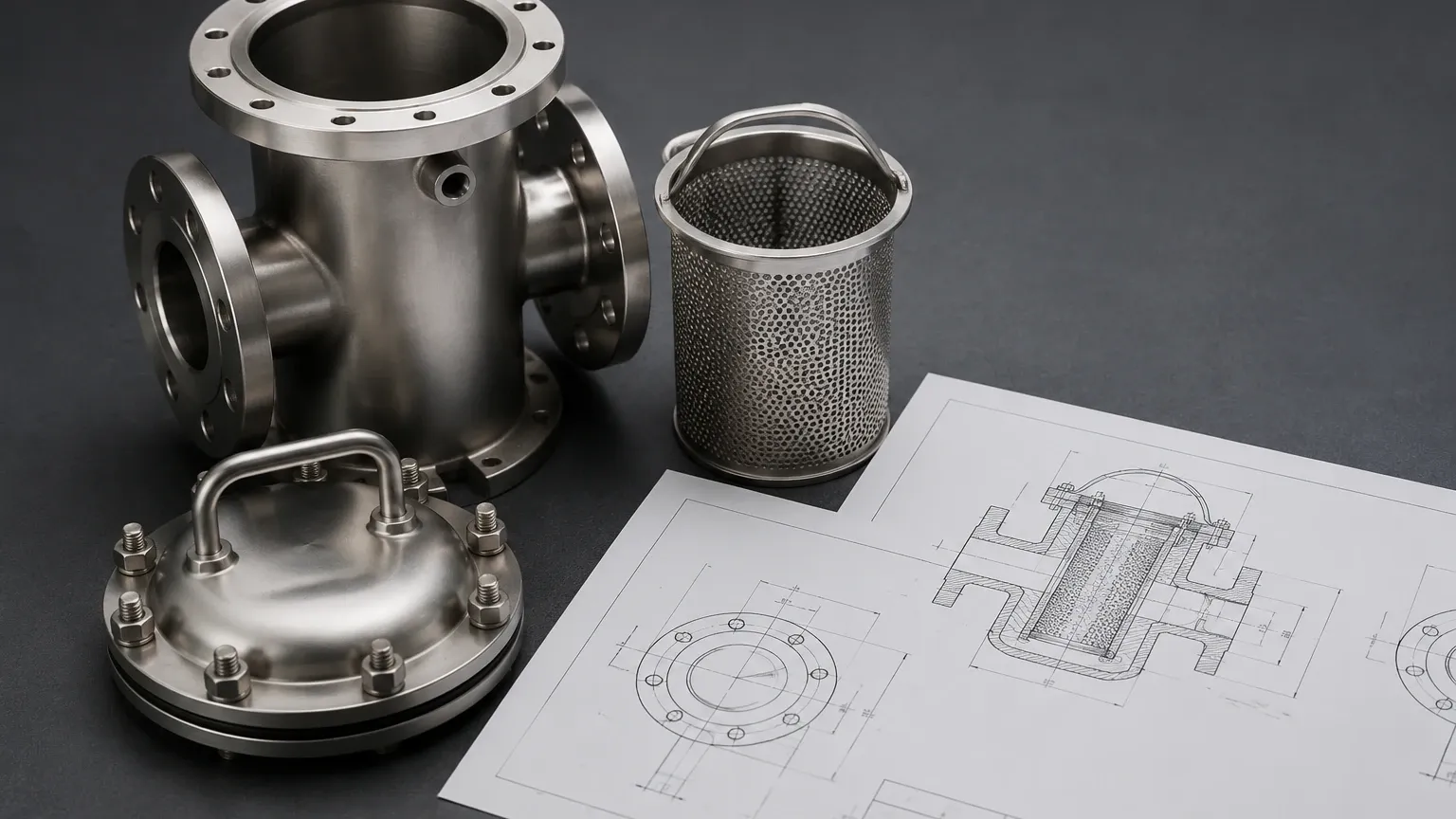
A CAD (Computer-Aided Design) block is a pre-defined set of objects that act as a single 2D or 3D element. In the context of industrial filtration, a basket strainer CAD block provides the exact dimensions of the strainer housing, the orientation of the inlet and outlet ports, and the spatial requirements for the basket removal process.
Spatial Accuracy and Clearance
One of the most common errors in piping design is failing to provide adequate "pull space" for the internal filter element. A basket strainer requires vertical or horizontal clearance—depending on the orientation—to remove the basket for cleaning. By using an accurate CAD block, engineers can simulate the maintenance cycle, ensuring that overhead pipes or structural beams do not obstruct the removal of the strainer basket.
Connection Alignment
Industrial systems utilize various flange standards, including ANSI, DIN, and JIS. The CAD block must accurately reflect the face-to-face dimensions of the strainer to ensure that the piping spools are fabricated to the correct length. Misalignment at this stage can lead to significant delays during site installation and increased mechanical stress on the flange bolts and gaskets.
Technical Specifications of Strainers & Baskets
When selecting a basket strainer for an industrial application, the physical dimensions represented in the CAD block are only one part of the equation. Engineers must evaluate the internal components and material properties to ensure compatibility with the process fluid.
Material Selection
Stainless steel is the industry standard for high-performance filtration due to its corrosion resistance and structural integrity. Kaifil specializes in custom stainless steel solutions, typically utilizing:
* SS304: Suitable for general industrial applications, water treatment, and mildly corrosive environments.
* SS316/316L: Preferred for chemical processing, pharmaceutical, and marine applications where resistance to pitting and chloride-induced stress corrosion cracking is required.
Filtration Media and Micron Ratings
The "basket" within the strainer is the functional heart of the unit. It is typically constructed from perforated metal or a combination of perforated metal and fine wire mesh. The selection of the micron rating depends on the size of the particles that need to be removed. Coarse strainers may use 1/8" perforations to protect large pumps, while precision applications may require mesh liners capable of capturing particles down to 20 microns.
Engineering Considerations for Integration
Integrating a basket strainer into a system requires a deep understanding of fluid dynamics and pressure management. When reviewing a basket strainer CAD block, engineers should consider the following factors:
Pressure Drop (Delta P)
Every filtration component introduces a degree of resistance to the flow. The "clean pressure drop" must be calculated to ensure the system pump has sufficient head to maintain the required flow rate. As the basket collects debris, the pressure drop increases. CAD designs often include ports for differential pressure gauges, which allow operators to monitor the clogging status of the basket in real-time.
Flow Velocity and Turbulence
The internal geometry of the strainer housing affects the flow velocity. High-velocity systems can cause turbulence inside the strainer, which may lead to premature wear of the mesh or vibration issues. Engineers must ensure that the nominal pipe size (NPS) of the strainer matches the flow requirements of the process line.
Seal and Gasket Compatibility
The top cover of a basket strainer must be sealed to prevent leaks, especially in high-pressure or hazardous chemical applications. Depending on the fluid, O-rings or flat gaskets made from EPDM, Viton (FKM), or PTFE are used. The CAD block should indicate the type of closure—whether it is a bolted cover for high-pressure stability or a quick-opening clamp for applications requiring frequent cleaning.
Customization and OEM Solutions
Standard off-the-shelf strainers often fail to meet the unique constraints of specialized industrial equipment. This is where custom manufacturing becomes essential. At Kaifil, we provide tailored solutions that go beyond standard dimensions.
Customized Housing Designs
In some instances, the standard inlet/outlet configuration does not fit the available footprint. Custom CAD blocks can be developed for offset nozzles, angled entries, or multi-basket configurations that allow for higher flow rates within a compact housing.
Specialized Basket Geometry
Not all debris is the same. Some applications involve fibrous materials that can clog standard mesh quickly, while others involve heavy sludge. Custom-designed baskets can feature reinforced handles, magnetic inserts to capture fine metallic particles, or pleated mesh designs to increase the total filtration surface area without increasing the footprint of the housing.
Selection Guide: From CAD to Installation
To ensure the successful procurement of a basket strainer, the following steps should be followed by the engineering and purchasing teams:
1. Define Process Parameters: Identify the fluid type, operating temperature, maximum pressure, and required flow rate.
2. Determine Filtration Level: Specify the particle size that must be captured to protect downstream equipment.
3. Review the CAD Block: Download or request the CAD file to verify that the unit fits within the physical constraints of the plant layout. Pay close attention to the drain port location and the vent valve orientation.
4. Confirm Material Compatibility: Ensure the housing and the basket material are chemically compatible with the process fluid to prevent premature failure.
5. Evaluate Maintenance Access: Confirm that there is enough room for an operator to safely remove and clean the basket.
Maintenance and Replacement Cycles
The longevity of a basket strainer depends heavily on the maintenance regime. Unlike disposable cartridge filters, stainless steel baskets are designed to be cleaned and reused. However, they are not indestructible.
Cleaning Procedures
Baskets should be cleaned when the differential pressure reaches a pre-determined limit (typically 10-15 psi above the clean pressure drop). Cleaning methods vary from simple water rinsing to ultrasonic cleaning for fine mesh elements that have become blinded by sticky particulates.
Inspection for Wear
During every cleaning cycle, the basket should be inspected for signs of mechanical fatigue, such as broken wires in the mesh or deformation of the perforated metal. Using high-quality Strainers & Baskets from a reputable manufacturer ensures that the components can withstand the stresses of repeated cleaning and high-pressure differentials.
Total Cost of Ownership (TCO)
While the initial cost of a custom stainless steel strainer may be higher than a plastic or cast-iron alternative, the TCO is often significantly lower. Stainless steel provides a longer service life, reduced downtime due to its durability, and the ability to handle a wider range of temperatures and pressures.
Conclusion
A basket strainer cad block is an essential tool for modern industrial engineering, bridging the gap between theoretical design and physical implementation. By selecting the right strainer configuration and ensuring its accurate representation in the system layout, engineers can prevent costly installation errors and operational bottlenecks.
Kaifil remains committed to providing high-performance, customized filtration solutions that meet the rigorous demands of the chemical, pharmaceutical, and food and beverage industries. Whether you require a standard component or a fully customized filtration assembly, focusing on technical precision and material quality is the key to long-term system reliability.
