


Basket Strainer Heavy Duty
In industrial fluid handling systems, the protection of downstream equipment such as pumps, valves, and heat exchangers is paramount. A basket strainer heavy duty is a specialized filtration component designed to remove unwanted solids from liquid streams while withstanding high pressures, high flow rates, and aggressive chemical environments. Unlike standard strainers, heavy-duty variants are engineered with reinforced structures and high-grade materials to ensure long-term reliability in demanding industrial applications.
For engineers and procurement teams, selecting the right filtration component involves more than just matching pipe sizes. It requires a deep understanding of fluid dynamics, material compatibility, and the structural integrity of the strainer basket itself. This guide explores the technical considerations, engineering requirements, and selection criteria for heavy-duty basket strainers, providing the factual foundation necessary for informed industrial decision-making.
Understanding the Role of Heavy-Duty Basket Strainers in Industrial Filtration
The primary function of a basket strainer is to capture debris that could otherwise cause mechanical failure or process contamination. In a heavy-duty context, these strainers are typically used in systems where the fluid velocity is high, the solids loading is significant, or the cost of downstream equipment failure is exceptionally high.
Heavy-duty designs differ from light-duty alternatives in several key areas:
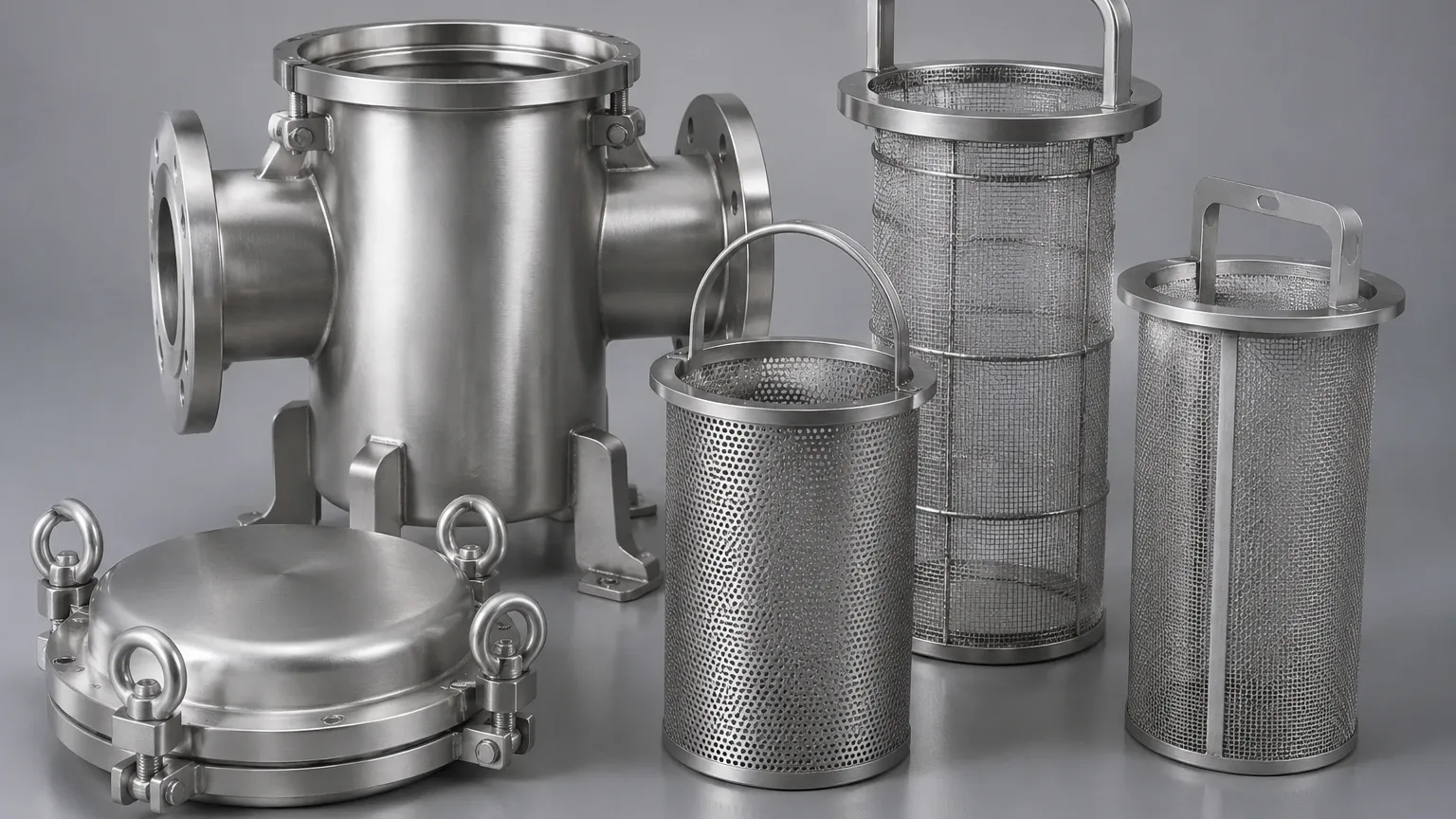
1. Structural Reinforcement: The baskets are often constructed with a heavy-gauge perforated metal backing to provide mechanical strength, often layered with a finer wire mesh for precise filtration.
2. Pressure Tolerance: These components are designed to maintain their shape and integrity under high differential pressures ($ΔP$), which occur as the basket fills with debris.
3. Durability: Materials are selected for their resistance to erosion and corrosion, ensuring that the strainer does not become a source of contamination itself.
When evaluating Strainers & Baskets, it is essential to consider the total cost of ownership, which includes not only the initial purchase price but also the maintenance frequency, the ease of cleaning, and the projected service life of the component.
Material Selection and Engineering for Durability
The performance of a basket strainer heavy duty is largely dictated by its metallurgy. Stainless steel is the industry standard due to its excellent mechanical properties and resistance to a wide range of process fluids.
Stainless Steel 304 vs. 316L
* Type 304 Stainless Steel: This is the most common material for industrial strainers. It provides good corrosion resistance and is suitable for water treatment, hydraulic oils, and many food-grade applications. It is cost-effective but may be susceptible to pitting in high-chloride environments.
* Type 316L Stainless Steel: For more aggressive environments, such as chemical processing or marine applications, 316L is preferred. The addition of molybdenum enhances its resistance to chloride-induced pitting and crevice corrosion. The "L" (low carbon) designation is critical if the strainer components require extensive welding, as it prevents carbide precipitation and maintains corrosion resistance at the weld zones.
Beyond Stainless Steel
In specific high-temperature or highly corrosive applications, engineers might specify exotic alloys like Monel, Hastelloy, or Duplex stainless steel. However, for the majority of heavy-duty industrial needs, high-grade stainless steel remains the most reliable and versatile choice.
Key Performance Metrics: Flow Rate and Pressure Drop
One of the most critical engineering considerations in filtration is the relationship between flow rate and pressure drop. A heavy-duty basket strainer must be sized correctly to ensure that the initial clean pressure drop is kept to a minimum, usually between 1 to 2 PSI.
Calculating the Open Area Ratio
An effective basket strainer heavy duty should have a high "open area ratio" (OAR). This is the ratio of the total open area of the basket (the holes or mesh openings) to the internal cross-sectional area of the inlet pipe. A common industry standard for heavy-duty applications is an OAR of at least 6:1. A higher ratio means the strainer can collect more debris before the pressure drop reaches a critical level, thereby extending the time between cleaning cycles.
Managing High-Velocity Fluids
In high-velocity systems, the fluid can exert significant force on the basket. If the basket is not sufficiently reinforced, the mesh can tear or the frame can collapse. Heavy-duty baskets utilize thick-walled perforated plate as a support structure to bridge the gap between high filtration accuracy and mechanical robustness.
Customization Options for Specific Industrial Requirements
Industrial processes are rarely one-size-fits-all, and filtration solutions must often be customized to meet specific spatial or performance constraints. Customization in heavy-duty basket strainers typically focuses on three areas: dimensions, filtration accuracy, and structural features.
Perforation and Mesh Combinations
For coarse filtration, a perforated plate with hole diameters ranging from 1/32" to 1/2" may be sufficient. However, when finer filtration is required, a fine wire mesh is sintered or spot-welded to the interior or exterior of the perforated basket. This "dual-layer" approach provides the fine filtration of a mesh with the structural support of the plate.
Handle and Lifting Designs
In large-scale industrial systems, a full basket can be heavy. Custom handle designs, such as heavy-duty bail handles or ergonomic grips, are essential for safe and efficient maintenance. Some designs also include specialized feet or mounting brackets to ensure the basket sits securely within the strainer housing, preventing fluid bypass.
Sealing Mechanisms
To ensure that 100% of the fluid passes through the filtration media, the seal between the basket and the housing must be absolute. Heavy-duty strainers often utilize machined flanges or specialized O-ring seals to prevent "bypass," which occurs when fluid leaks around the edges of the basket.
Application-Specific Considerations
Different industries impose different stresses on filtration equipment. A basket strainer heavy duty must be tailored to these specific environmental factors.
Chemical and Petrochemical Processing
In these sectors, chemical compatibility is the primary concern. The strainer must resist degradation from acids, bases, or hydrocarbons. Furthermore, these systems often operate at elevated temperatures, requiring the metal to maintain its tensile strength and resistance to thermal expansion stresses.
Food and Beverage Production
For food-grade applications, the focus shifts to hygiene and cleanability. Heavy-duty strainers in this sector must feature smooth surface finishes (often electropolished) and be free of crevices where bacteria could proliferate. The materials must also be compliant with FDA or equivalent international standards for food contact.
Hydraulic and Lubrication Systems
In hydraulic systems, the primary goal is protecting precision components like servo valves. The basket strainer must handle high-viscosity fluids and be capable of capturing fine metallic particles that could cause abrasive wear. Here, the structural integrity of the basket is vital to prevent any part of the strainer itself from breaking off and entering the fluid stream.
Maintenance Protocols and Service Life Extension
The longevity of a basket strainer heavy duty is directly linked to how it is maintained. Unlike disposable cartridge filters, stainless steel baskets are designed to be cleaned and reused, which significantly reduces the total cost of ownership over the life of the plant.
Cleaning Procedures
Cleaning should be performed whenever the differential pressure reaches a pre-determined limit (typically 10-15 PSI above the clean pressure drop). Methods include:
* Manual Cleaning: Removing the basket and using a high-pressure water jet or soft brush to remove debris. It is crucial to avoid abrasive tools that could damage the wire mesh.
* Ultrasonic Cleaning: For baskets with fine mesh that have become blinded by sticky or microscopic particles, ultrasonic baths can effectively dislodge contaminants without mechanical stress.
* Chemical Soaking: Used when the debris is chemically bonded to the metal, though care must be taken to ensure the cleaning agent is compatible with the stainless steel grade.
Inspection for Fatigue
During cleaning, the basket should be inspected for signs of mechanical fatigue, such as broken welds, distorted mesh, or thinning of the metal due to erosion. In heavy-duty applications, these signs of wear can lead to catastrophic failure if not addressed early.
Procurement Checklist: What Engineers Need to Confirm
Before finalizing a purchase for a basket strainer heavy duty, technical professionals should confirm the following details with the manufacturer:
* Micron Rating/Mesh Size: Ensure the filtration accuracy is sufficient to protect downstream equipment without causing excessive pressure drop.
* Maximum Operating Pressure: Confirm that the basket and housing are rated for the system's peak pressure, including potential pressure surges.
* Flow Rate (GPM/LPM): Verify that the strainer can handle the maximum flow rate while maintaining an acceptable OAR.
* Material Certification: Request mill test reports (MTRs) to verify the grade and quality of the stainless steel used.
* Dimensional Constraints: Ensure the basket dimensions and flange types are compatible with existing housing or piping layouts.
* Cleaning Compatibility: Confirm that the design allows for the intended cleaning method (e.g., backwashing or manual removal).
By focusing on these technical parameters, engineering teams can ensure they deploy a filtration solution that provides maximum protection and operational efficiency. A well-engineered basket strainer heavy duty is not just a commodity; it is a critical safeguard for industrial productivity.
