


Basket Strainers at Home Depot
When maintenance engineers or procurement officers begin a search for "basket strainers at home depot," the intent is often driven by the need for an immediate, off-the-shelf solution for a liquid handling system. While big-box retailers like Home Depot serve as excellent resources for residential plumbing and light commercial hardware, industrial filtration requirements often demand a level of technical precision, material certification, and structural integrity that exceeds consumer-grade specifications.
In industrial environments—ranging from chemical processing plants to food and beverage production lines—the selection of Strainers & Baskets is a critical engineering decision. Choosing between a standard consumer product and a custom-engineered industrial component involves evaluating pressure ratings, chemical compatibility, and precise filtration accuracy. This article explores the technical distinctions between retail-grade hardware and industrial filtration solutions, providing a framework for engineers to make informed purchasing decisions.
Residential vs. Industrial: Defining the Technical Gap
The primary difference between basket strainers at Home Depot and those manufactured for industrial use lies in their intended application. Residential strainers are designed for low-pressure gravity drainage or standard municipal water pressure, typically involving non-corrosive domestic waste.
In contrast, industrial strainers must withstand:
* High Differential Pressures: Industrial systems often operate under significant pump pressure. A strainer basket must be structurally reinforced to prevent collapsing or bypassing when the filter media becomes loaded with contaminants.
* Aggressive Chemical Environments: While a residential strainer might be made of chrome-plated brass or standard 304 stainless steel, industrial applications often require 316L stainless steel, Hastelloy, or specialized coatings to resist corrosion from acids, alkalis, or high-salinity fluids.
* Extreme Temperature Fluctuations: Industrial filtration components must maintain dimensional stability and seal integrity at temperatures far exceeding the limits of standard plumbing fixtures.
Engineering Considerations for Industrial Strainer Baskets
When moving beyond the scope of basket strainers at Home Depot, engineers must focus on specific performance metrics that define the efficiency and longevity of the filtration system.
1. Filtration Accuracy and Micron Ratings
Consumer-grade strainers generally utilize a standard perforation size intended to catch large debris like food waste or hair. Industrial filtration, however, is measured in microns. Depending on the process requirements, a basket may need to remove particles as small as 5 to 10 microns or as large as several millimeters.
Industrial manufacturers like Kaifil utilize various types of media to achieve these specs:
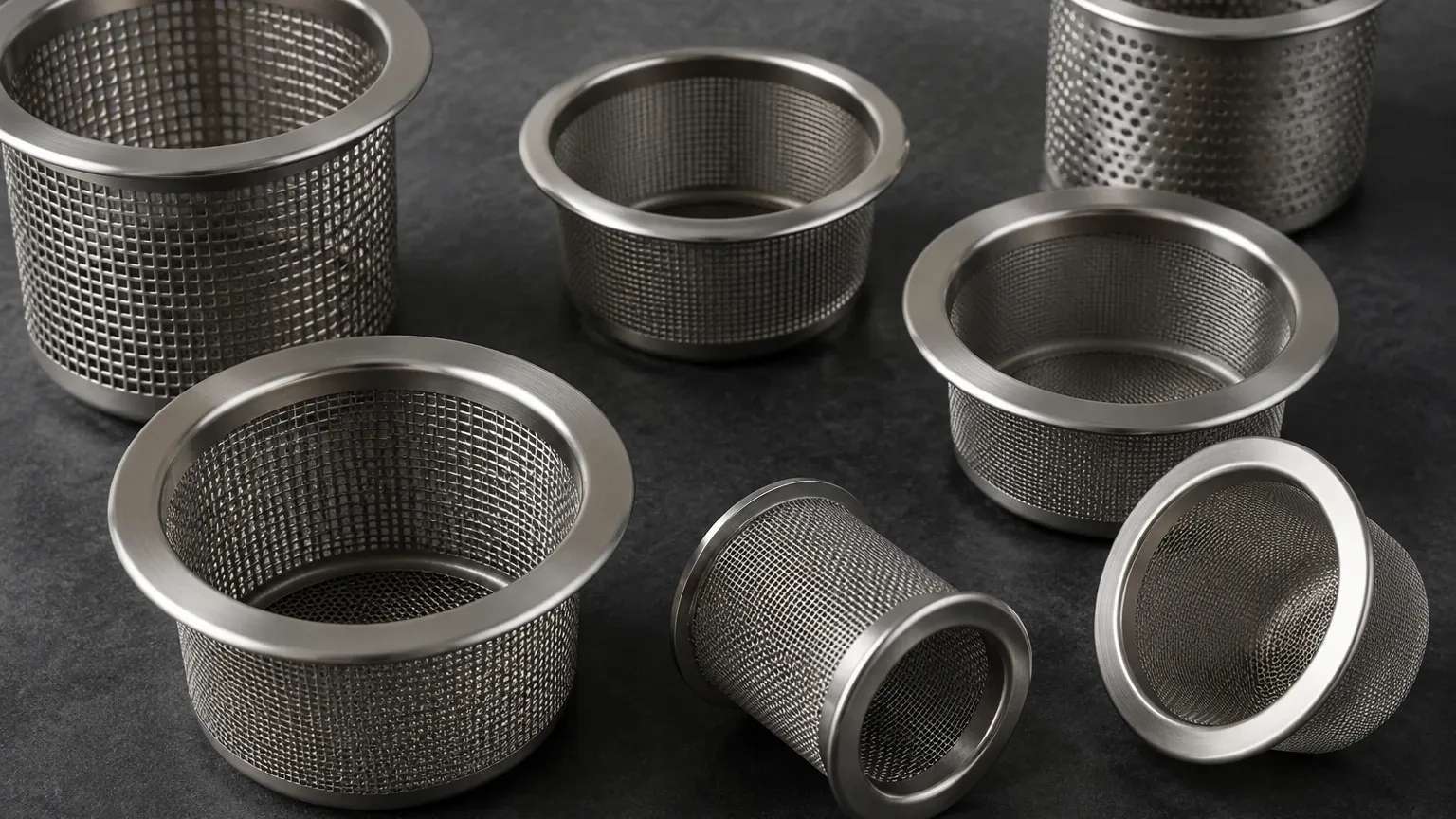
* Wire Mesh: Provides precise pore sizes and high open-area ratios for fine filtration.
* Perforated Metal: Offers superior structural strength and is often used as a support basket for finer mesh liners.
* Wedge Wire: Ideal for high-viscosity fluids and applications requiring easy backwashing or mechanical cleaning.
2. Effective Filtration Area (EFA)
One of the most overlooked aspects of strainer selection is the Effective Filtration Area. A higher EFA reduces the velocity of the fluid passing through the mesh, which in turn lowers the initial pressure drop (ΔP) and extends the time between cleaning cycles. Retail products are rarely optimized for EFA, whereas industrial Strainers & Baskets are engineered to maximize the surface area within the available housing volume.
Material Selection and Chemical Compatibility
For a purchasing team, the material of construction is the most significant factor in the total cost of ownership. While a search for basket strainers at Home Depot might yield products labeled as "stainless steel," the specific grade and manufacturing process are rarely documented to industrial standards.
Stainless Steel Grades
* Type 304: Suitable for water treatment and some food processing applications where corrosion risk is moderate.
* Type 316/316L: The industry standard for pharmaceutical, chemical, and marine applications. The addition of molybdenum provides superior resistance to pitting and crevice corrosion in chloride-rich environments.
* Specialty Alloys: For highly specialized chemical processes, materials like Monel or Inconel may be required to ensure the strainer does not become a point of failure in the system.
Manufacturing Integrity
Industrial baskets require high-quality welding techniques, such as TIG (Tungsten Inert Gas) or plasma welding, to ensure that there are no gaps or weak points where bypass could occur. In sanitary applications, such as food and beverage or pharmaceuticals, welds must be ground smooth and polished to prevent bacterial growth—a feature not found in retail-grade sink strainers.
Customization and OEM Solutions
A significant limitation of sourcing basket strainers at Home Depot is the lack of customization. Industrial systems are rarely "one size fits all." Custom filtration solutions allow for:
* Bespoke Dimensions: Fitting into existing housings without the need for expensive piping modifications.
* Reinforced Structures: Adding handles, support rings, or heavy-duty perforated backing to handle high-viscosity fluids or high-pressure surges.
* Multi-Stage Filtration: Designing baskets with multiple layers of different mesh sizes to capture a range of particle sizes in a single pass.
Kaifil specializes in these customized OEM designs, working closely with engineering teams to develop filtration components that meet the exact flow rates and particle retention needs of a specific process.
Total Cost of Ownership (TCO) vs. Initial Purchase Price
The low price point of basket strainers at Home Depot can be deceptive when applied to an industrial context. The Total Cost of Ownership (TCO) includes not just the purchase price, but also the costs associated with:
1. Maintenance Labor: How often does the basket need to be pulled and cleaned? An undersized or poorly designed basket will clog more frequently, increasing labor costs.
2. System Downtime: If a low-quality strainer fails and allows debris to reach sensitive downstream equipment like pumps or spray nozzles, the resulting downtime can cost thousands of dollars per hour.
3. Replacement Frequency: Industrial-grade stainless steel baskets are designed for years of service. A consumer-grade product may degrade or deform within months under industrial stress, necessitating frequent replacements.
4. Product Loss: In industries like chemical or food processing, inefficient filtration can lead to batches that do not meet quality standards, resulting in significant waste.
Application-Specific Selection Criteria
To help engineers move from a general search to a specific procurement plan, consider the following application-specific requirements:
Food and Beverage
Strainers used in this sector must comply with FDA or 3A sanitary standards. This means the Strainers & Baskets must be made of non-leaching materials and feature a surface finish that allows for Complete-In-Place (CIP) cleaning.
Hydraulic and Lube Oil Systems
In these applications, the primary goal is protecting high-precision components from wear particles. The strainer must handle high-viscosity fluids without creating an excessive pressure drop that could lead to pump cavitation.
Chemical Processing
Compatibility is the priority here. Engineers must verify that the mesh, the basket frame, and any gaskets or seals are compatible with the specific chemicals being processed at the operating temperature and concentration.
Conclusion: Making the Right Procurement Choice
While "basket strainers at home depot" may be a starting point for those unfamiliar with the complexities of fluid dynamics, professional industrial applications require a more rigorous approach to sourcing. By focusing on material certification, filtration accuracy, and structural reinforcement, engineers can ensure their systems operate efficiently and reliably.
When evaluating a supplier for industrial filtration components, it is essential to confirm their ability to provide technical documentation, material test reports (MTRs), and customization options. For those looking to optimize their filtration processes, reviewing specialized Strainers & Baskets options is the most effective way to move from a temporary fix to a long-term engineering solution.
By choosing a dedicated manufacturer like Kaifil, companies gain access to the engineering expertise required to solve complex filtration challenges, ensuring that every component—down to the smallest mesh basket—is fit for purpose in the demanding world of industrial processing.
