


Drain Strainers
In industrial fluid management, the integrity of a piping system often depends on the smallest components. Industrial drain strainers are essential mechanical tools designed to remove unwanted solids from liquid streams, protecting downstream equipment such as pumps, valves, and heat exchangers from damage and clogging. Unlike residential versions, industrial-grade drain strainers must withstand high flow rates, corrosive chemicals, and extreme temperatures while maintaining precise filtration efficiency.
For engineers and procurement professionals, selecting the correct strainer involves more than just matching a pipe diameter. It requires a deep understanding of fluid dynamics, material compatibility, and the specific debris load of the application. This guide examines the technical nuances of drain strainers within the broader category of Strainers & Baskets, providing the data necessary to optimize filtration performance in demanding environments.
The Functional Role of Drain Strainers in Industrial Systems
Drain strainers serve as the first line of defense in many industrial processes. Their primary function is to intercept macro-particulates—such as scale, rust, weld beads, and organic matter—before they can enter sensitive machinery or contaminate a final product. In gravity-fed or low-pressure drainage systems, these components ensure that effluent meets environmental standards or that recycled water is sufficiently clean for secondary use.
From an engineering perspective, a drain strainer is a sacrificial barrier. It is designed to be easily accessible, allowing for the removal of captured solids without requiring a full system teardown. By centralizing debris collection, these components significantly reduce maintenance costs and prevent unplanned downtime. Whether used in chemical processing, food and beverage production, or water treatment, the efficiency of the strainer directly impacts the total cost of ownership (TCO) of the entire fluid system.
Material Selection and Engineering Standards
The environment in which a drain strainer operates dictates its material composition. Because these components are frequently exposed to moisture, varying pH levels, and cleaning agents, stainless steel is the industry standard.
Stainless Steel 304 vs. 316L
* SS304: This is the most common material for general industrial applications. It offers excellent durability and good corrosion resistance for water-based systems and mild chemicals. It is a cost-effective choice for many standard drain applications.
* SS316L: For more aggressive environments, such as pharmaceutical manufacturing or chemical processing plants, SS316L is preferred. The addition of molybdenum provides superior resistance to chlorides and pitting. The "L" (low carbon) variant is particularly important if the strainer requires extensive welding during customization, as it prevents carbide precipitation and ensures long-term structural integrity.
Specialized Alloys
In extreme cases involving high-salinity seawater or highly acidic solutions, manufacturers like Kaifil may utilize specialized alloys. The goal is to ensure that the strainer does not become a source of contamination through corrosion or mechanical failure.
Technical Specifications: Mesh, Perforation, and Micron Ratings
The performance of drain strainers is defined by their filtration media. Industrial strainers typically utilize one of two types of media, or a combination of both:
1. Perforated Metal: This serves as the structural skeleton of the strainer. Perforated plates are ideal for high-flow applications where large debris needs to be captured. The hole size and "staggered" or "straight" patterns determine the initial filtration level.
2. Wire Mesh: For finer filtration, a layer of stainless steel wire mesh is bonded to the perforated metal. Mesh is defined by the number of openings per linear inch. A higher mesh count indicates finer filtration but also increases the resistance to flow.
Understanding Micron Ratings
Engineers must specify the micron rating based on the smallest particle that could potentially damage downstream equipment. However, there is a trade-off: a finer micron rating leads to faster clogging and higher pressure drops. A common engineering rule of thumb is to select a strainer with an open area at least four times the cross-sectional area of the inlet pipe to minimize initial pressure loss.
Design Configurations for Drain Strainers
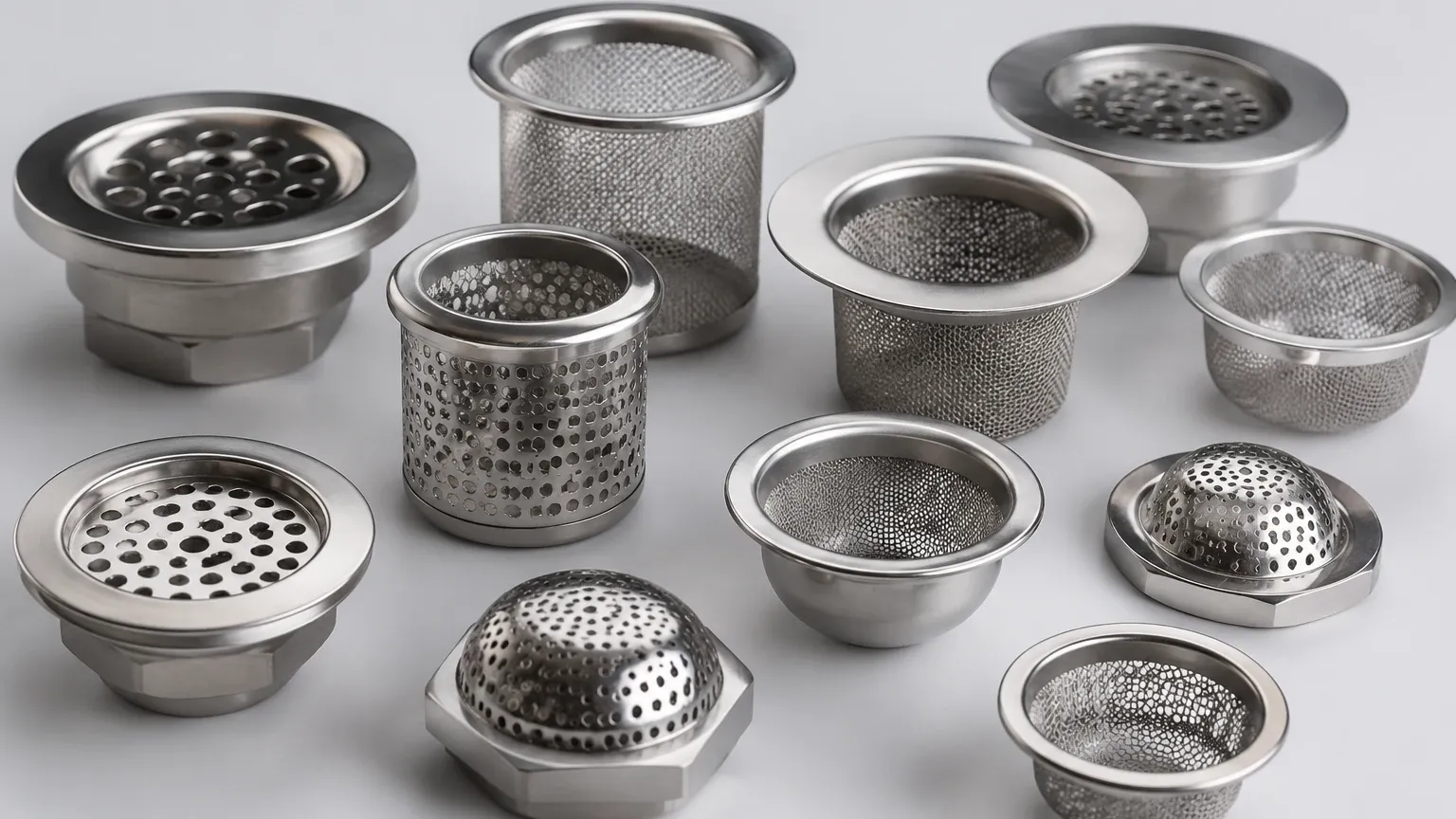
Drain strainers come in various geometries, each suited to specific installation constraints and flow characteristics. Within the portfolio of industrial Strainers & Baskets, several designs stand out:
Basket Strainers
Basket strainers feature a vertical cylinder with a handle, allowing for easy removal and cleaning. Because the "basket" has a large surface area, it can hold a significant volume of debris before requiring maintenance. This makes them ideal for systems with high solids loading.
Cone and Hat Strainers (Temporary Strainers)
Often used during system start-up, these are installed between flanges. While they are simple and low-cost, they have a smaller holding capacity and are generally replaced by permanent basket or duplex strainers once the initial system debris (weld slag, etc.) is cleared.
Flat and Disc Strainers
Used primarily in floor drains or at the end of discharge pipes, these prevent large objects from entering the drainage network. In industrial wash-down areas, these must be robust enough to handle heavy foot traffic or equipment loads while maintaining high flow rates to prevent flooding.
Calculating Pressure Drop and Flow Efficiency
One of the most critical engineering considerations for drain strainers is the pressure drop ($ΔP$). As fluid passes through the strainer media, energy is lost due to friction and the restriction of the flow path.
Factors Influencing $ΔP$:
* Viscosity: Thicker fluids (like oils or syrups) experience a much higher pressure drop than water through the same mesh size.
* Velocity: Pressure drop increases with the square of the flow velocity. If a system's flow rate doubles, the pressure drop across the strainer can quadruple.
* Open Area Ratio (OAR): This is the ratio of the total area of the holes in the strainer to the area of the inlet pipe. A higher OAR results in a lower initial pressure drop and longer intervals between cleanings.
Engineers should monitor the differential pressure across the strainer using gauges. A sudden increase in $ΔP$ indicates that the strainer is reaching its holding capacity and requires cleaning. Neglecting this can lead to screen collapse or pump cavitation.
Industry-Specific Applications
Different sectors have unique requirements that influence the design of drain strainers.
Food and Beverage
In this sector, sanitary design is paramount. Drain strainers must be manufactured with smooth, crevice-free welds to prevent bacterial growth. They often require polished surfaces (Ra < 0.8 µm) and must be compatible with Clean-in-Place (CIP) chemicals.
Chemical Processing
Here, chemical compatibility is the primary concern. The strainer must resist degradation from solvents, acids, or bases. Customization often involves selecting specific gasket materials (such as PTFE or Viton) to ensure a leak-proof seal at the strainer housing.
Water Treatment and Desalination
Large-scale water systems utilize drain strainers to protect membranes and high-pressure pumps. Given the continuous operation of these plants, durability and the ability to withstand high flow velocities are the most important factors.
Installation and Maintenance Best Practices
To ensure the longevity of industrial drain strainers, proper installation and a rigorous maintenance schedule are required.
1. Orientation: Ensure the strainer is installed in the correct flow direction, usually indicated by an arrow on the housing. For basket strainers, ensure there is sufficient overhead clearance to remove the basket for cleaning.
2. Gasket Integrity: During every cleaning cycle, inspect the gaskets or O-rings. A compromised seal can lead to "bypass," where unfiltered fluid leaks around the strainer element, defeating its purpose.
3. Cleaning Protocols: Never clean a stainless steel mesh with a carbon steel brush, as this can embed carbon particles into the stainless steel, leading to galvanic corrosion. Use stainless steel brushes or ultrasonic cleaning for fine meshes.
4. Spare Parts: Maintain an inventory of replacement baskets or mesh liners. In many industrial settings, the cost of a few hours of downtime far exceeds the cost of a spare strainer element.
Customization and OEM Solutions
Standard off-the-shelf strainers often fail to meet the specific spatial or performance requirements of complex industrial skids. This is where custom manufacturing becomes essential. Kaifil specializes in developing tailored filtration components that match exact engineering drawings.
Customization options include:
* Non-standard Dimensions: Fitting strainers into tight piping envelopes.
* Reinforced Structures: Adding internal supports to prevent basket deformation in high-pressure applications.
* Multi-layer Sintered Mesh: Combining multiple layers of mesh for high-strength, precision filtration that can withstand repeated backwashing.
Conclusion: Selecting the Right Partner
Industrial drain strainers are vital components that ensure the reliability and efficiency of fluid systems. By focusing on material quality, precise micron ratings, and robust mechanical design, engineers can protect their equipment and optimize process performance. When the application demands more than a standard solution, working with a manufacturer that understands the technical rigors of industrial filtration is key.
For those evaluating options for their next project, exploring the range of Strainers & Baskets provides a starting point for finding durable, high-performance filtration solutions. Whether you require a standard basket strainer or a fully customized OEM component, prioritizing engineering excellence ensures long-term operational success.
