


Industrial Basket Strainers
In industrial fluid handling, the integrity of downstream equipment is directly linked to the efficiency of the primary filtration stage. Industrial basket strainers serve as a critical line of defense, designed to remove oversized solids and debris from liquid streams. Unlike simple Y-strainers, basket strainers offer a larger surface area for contaminant collection, making them the preferred choice for high-flow applications where pressure drop must be minimized and cleaning intervals maximized.
For engineers and procurement teams, selecting the right Strainers & Baskets involves more than matching pipe sizes. It requires a deep understanding of fluid dynamics, material compatibility, and the specific mechanical demands of the process environment. As a specialist manufacturer, Kaifil provides custom stainless steel filtration solutions that address these technical nuances, ensuring that industrial basket strainers are optimized for both performance and longevity.
Understanding the Role of Industrial Basket Strainers in Fluid Systems
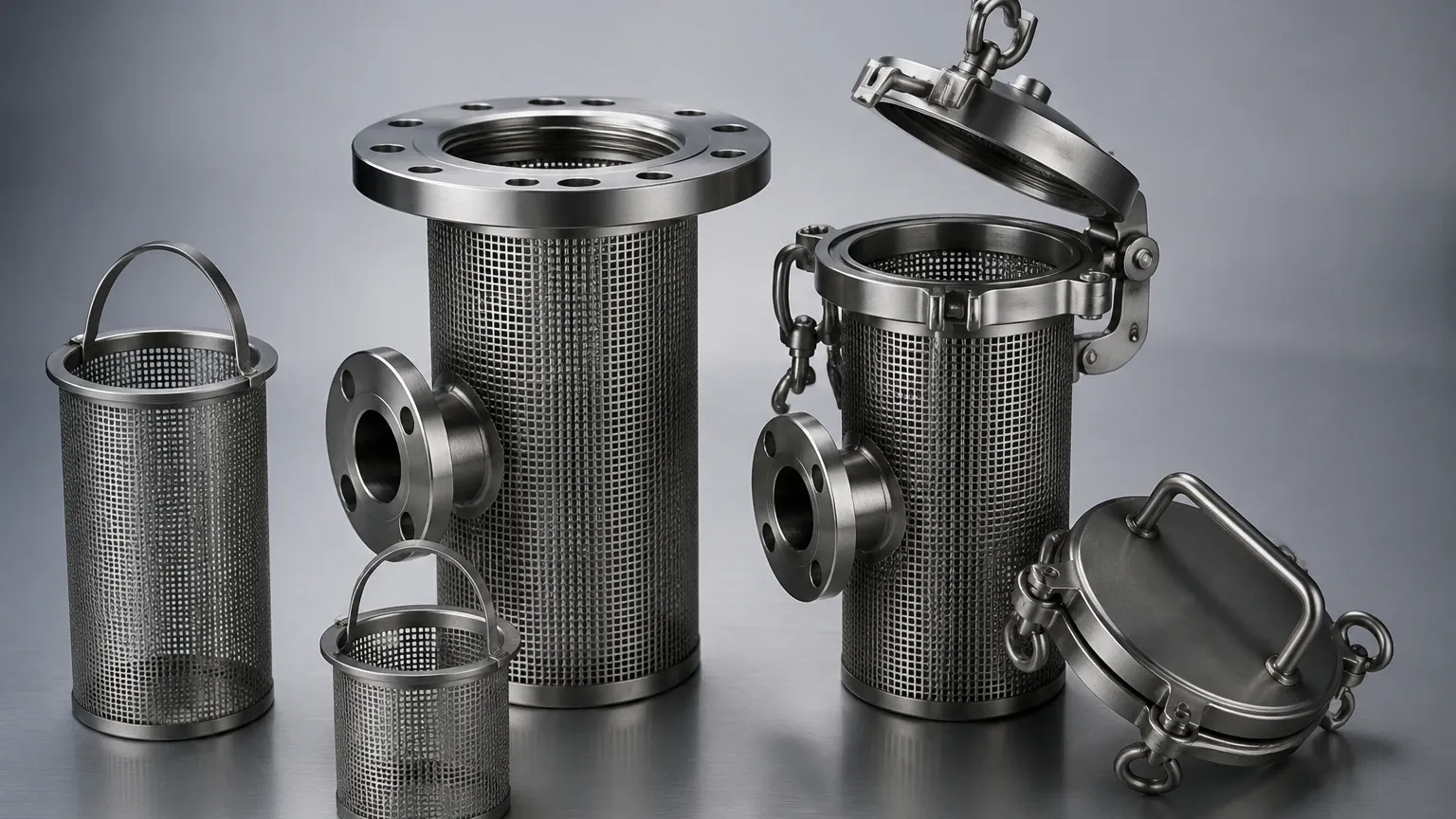
Industrial basket strainers are pressure vessels containing a removable, perforated or wire-mesh-lined basket. Their primary function is to protect sensitive components—such as pumps, flow meters, heat exchangers, and spray nozzles—from damage caused by particulate matter.
While the terms "filter" and "strainer" are often used interchangeably, there is a distinct engineering difference. A strainer is typically used to remove larger particles (usually 40 microns or larger) that are visible to the naked eye, whereas filters are designed for much finer separation. In many industrial systems, a basket strainer acts as a "pre-filter," removing the bulk of the solids to prevent the premature clogging of more expensive, high-precision downstream filtration media.
The design of the basket is the most critical element. Because the debris is collected inside the basket, it is easily removed when the system is shut down for maintenance. This design prevents the debris from falling back into the pipeline during the cleaning process, a common issue with simpler strainer designs.
Key Engineering Specifications for Material Selection
Material selection is the foundation of strainer performance, particularly in corrosive or high-temperature environments. Stainless steel is the industry standard for high-performance industrial basket strainers due to its mechanical strength and chemical resistance. At Kaifil, we focus on several key grades to meet diverse industrial requirements:
* Stainless Steel 304: The most common grade, offering excellent corrosion resistance and durability for water treatment, food processing, and general industrial applications.
* Stainless Steel 316: Contains molybdenum, which provides superior resistance to chlorides and marine environments, making it ideal for chemical processing and offshore applications.
* Stainless Steel 316L: A low-carbon version of 316 that minimizes carbide precipitation during welding, ensuring the structural integrity of the strainer in highly corrosive environments or where frequent thermal cycling occurs.
Beyond the housing material, the internal mesh or perforated plate must be carefully selected. Engineers must consider the electrochemical compatibility between the basket and the housing to prevent galvanic corrosion. In high-pressure applications, the basket may require reinforced structural ribs or a heavy-duty perforated metal backing to prevent the mesh from collapsing under the force of the fluid flow.
Evaluating Pressure Drop and Flow Dynamics
The efficiency of a basket strainer is often measured by its "Clean Pressure Drop" (ΔP). This represents the loss of pressure as the fluid passes through the clean strainer element. An ideal design maximizes the "Open Area Ratio" (OAR)—the ratio of the total open area of the basket to the cross-sectional area of the inlet pipe.
A common engineering benchmark for industrial basket strainers is an OAR of at least 6:1. A higher ratio ensures that the strainer can accumulate a significant amount of debris before the pressure drop reaches a critical level that might trigger a system shutdown or cause pump cavitation.
Several factors influence flow dynamics within the strainer:
1. Viscosity: Higher viscosity fluids (such as oils or syrups) require larger mesh openings or a larger strainer body to maintain an acceptable flow rate.
2. Velocity: High-velocity streams can cause turbulence within the strainer housing, potentially leading to erosion of the mesh or vibration-induced fatigue.
3. Specific Gravity: The density of the fluid affects the calculation of the pressure drop, requiring adjustments in the sizing of the unit.
Structural Design: Simplex vs. Duplex Configurations
The choice between a simplex and a duplex configuration depends entirely on the required system uptime.
Simplex Basket Strainers
Simplex strainers are used in batch processes or systems where the flow can be temporarily interrupted. When the basket becomes full, the system is depressurized, the cover is removed, and the basket is cleaned. These are cost-effective solutions for applications where maintenance can be scheduled during downtime.
Duplex Basket Strainers
For continuous operations—such as power generation, chemical refineries, or pharmaceutical manufacturing—duplex strainers are essential. A duplex system consists of two separate strainer chambers connected by a diverter valve. When one basket requires cleaning, the flow is switched to the other chamber without interrupting the process. This ensures constant protection and eliminates the need for system shutdowns.
Kaifil specializes in customizing these designs, offering various closure types (such as bolted covers for high pressure or quick-release swing bolts for rapid maintenance) to suit specific operational needs.
Filtration Accuracy: Perforations and Mesh Weaves
The "degree of filtration" is determined by the size of the openings in the basket. This is specified either by the diameter of the perforations (in inches or millimeters) or by the mesh count (the number of wires per linear inch).
* Perforated Plates: These are typically used for coarse straining, with hole sizes ranging from 1/32" to 1/2". They provide excellent structural rigidity.
* Wire Mesh Liners: For finer filtration, a wire mesh is lined inside the perforated basket. Mesh counts can range from 20 mesh (approx. 840 microns) to 400 mesh (approx. 37 microns).
Engineers must balance the need for fine filtration with the risk of rapid clogging. If the mesh is too fine for the application, the cleaning frequency will increase, leading to higher labor costs and potential production bottlenecks. Conversely, if the mesh is too coarse, harmful particles will pass through and damage downstream equipment. The selection of the weave type—such as plain weave for standard applications or Dutch weave for higher strength and finer filtration—is also a critical engineering decision.
Maintenance Protocols and Performance Longevity
The total cost of ownership for industrial basket strainers is heavily influenced by maintenance requirements. A well-designed strainer should allow for easy access and rapid cleaning.
Key maintenance considerations include:
* Differential Pressure Monitoring: Installing pressure gauges upstream and downstream of the strainer is the most effective way to monitor basket loading. A typical rule of thumb is to clean the basket when the pressure drop reaches 5-10 psi over the clean state.
* Gasket and Seal Integrity: Frequent opening of the strainer cover requires high-quality seals. Materials like Viton, EPDM, or PTFE must be selected based on the chemical nature and temperature of the fluid.
* Cleaning Procedures: Stainless steel baskets are typically cleaned using high-pressure water, steam, or ultrasonic baths. It is vital to inspect the mesh for signs of "blinding" (permanent clogging) or mechanical tears during every cleaning cycle.
In many cases, having a spare set of baskets on hand is a cost-effective strategy to minimize downtime. The dirty basket can be replaced immediately, allowing the cleaning process to happen offline without delaying the restart of the fluid system.
Industry-Specific Applications and Customization
Industrial basket strainers are not one-size-fits-all components. Different sectors have unique regulatory and functional requirements:
* Food and Beverage: Requires 316L stainless steel with high-polish finishes (Ra < 0.8 μm) to prevent bacterial growth and ensure compliance with hygienic standards.
* Chemical Processing: Focuses on chemical compatibility and the ability to handle aggressive solvents and acids. Custom coatings or specialized alloys may be required.
* Water Treatment: Often involves very high flow rates and large pipe diameters, requiring massive basket strainers with reinforced structural supports to handle heavy debris loads like sand and gravel.
* Pharmaceutical: Demands high precision, full material traceability (MTRs), and often ultra-fine mesh to ensure product purity.
Kaifil’s expertise in OEM and customized filtration allows us to modify the standard basket design to include features like magnetic inserts (for removing fine iron particles), specialized flange connections, or unique basket geometries to fit into tight spatial envelopes.
Conclusion: Optimizing Your Filtration Strategy
Selecting and implementing industrial basket strainers is a technical exercise that requires balancing flow requirements, filtration accuracy, and maintenance efficiency. By focusing on high-quality materials like stainless steel and ensuring the correct engineering sizing, facilities can significantly reduce equipment wear and operational costs.
When evaluating your next filtration project, consider the long-term benefits of a custom-engineered solution. A strainer that is perfectly matched to your flow velocity and particle distribution will outperform a generic off-the-shelf unit in both durability and protection. For technical consultation and to explore specific configurations, you can Review product options and application support to ensure your system is equipped with the most reliable filtration components available.
