


Industrial Strainers
In industrial fluid handling, the integrity of downstream equipment such as pumps, valves, flow meters, and heat exchangers depends heavily on the effective removal of solid contaminants. Industrial strainers serve as the primary line of defense in these systems, utilizing a mechanical screen or perforated element to arrest debris while allowing the fluid to pass through. Unlike fine filtration systems designed to remove microscopic particles, strainers are typically employed for coarser separation, protecting high-value components from catastrophic failure caused by scale, weld slag, or foreign objects.
Selecting the right Strainers & Baskets requires a deep understanding of fluid dynamics, material compatibility, and the specific operational requirements of the application. For engineers and procurement teams, the choice is rarely about a standard off-the-shelf component; it is about balancing pressure drop, retention efficiency, and maintenance intervals to ensure long-term system reliability.
The Functional Distinction: Strainers vs. Filters
While the terms are often used interchangeably in casual conversation, in a technical B2B context, the distinction between a strainer and a filter is defined by the particle size and the intent of the process. A strainer is generally used to remove larger particles—typically those visible to the naked eye—to protect equipment. Filtration, conversely, often focuses on removing much smaller particulates to improve the quality of the fluid itself.
Industrial strainers are designed for high-flow, low-pressure-drop applications. Because they are often the first point of contact for raw fluids in chemical processing or water treatment, they must be robust enough to withstand significant debris loading without collapsing. The design of the internal basket or screen is critical; it must provide sufficient surface area to prevent rapid clogging, which would otherwise lead to frequent downtime for cleaning.
Primary Types of Industrial Strainers and Their Applications
The geometry of a strainer dictates its suitability for specific piping configurations and debris loads. Engineering teams must evaluate the following common designs based on the physical constraints of the facility and the nature of the fluid.
Y-Strainers
Named for their shape, Y-strainers are typically used in pressurized lines, either liquid or gas, where the amount of debris to be removed is relatively small. Their compact design allows them to be installed in both horizontal and vertical positions, provided the "leg" of the Y points downward to collect debris. They are frequently found in steam applications and high-pressure hydraulic systems where space is at a premium.
Simplex Basket Strainers
Basket strainers feature a larger housing and a vertical cylinder (the basket) that holds significantly more debris than a Y-strainer. This design results in a lower pressure drop and longer intervals between cleanings. Because the basket is accessed from the top, maintenance is simplified, making them ideal for high-flow liquid applications in food and beverage or chemical processing. However, the system must be shut down or the flow bypassed to clean a simplex unit.
Duplex (Twin) Strainers
For critical processes that cannot be interrupted, duplex strainers are the standard. These units consist of two separate strainer chambers connected by a diverting valve. When one basket becomes loaded with debris, the operator can switch the flow to the clean chamber without stopping the process. This is essential in pharmaceutical manufacturing and continuous chemical production lines where downtime translates directly to lost revenue.
Engineering Considerations: Flow Rate, Velocity, and Pressure Drop
The most critical technical challenge when integrating industrial strainers is managing the differential pressure (ΔP). Every strainer introduces a restriction in the flow path, which results in a loss of pressure. If the strainer is undersized, the velocity through the mesh increases, which can lead to accelerated wear of the screen and a significant drop in downstream pressure.
Open Area Ratio (OAR)
Engineers must calculate the Open Area Ratio, which is the relationship between the internal cross-sectional area of the inlet pipe and the total open area of the holes in the strainer element. A common industry standard is an OAR of 4:1 or higher. A higher ratio ensures that even as the strainer begins to collect debris, there is still enough open area to maintain flow without a drastic increase in differential pressure. For highly viscous fluids, such as heavy oils or syrups, an even higher OAR may be required to compensate for the fluid's resistance to movement through the mesh.
Viscosity and Particle Retention
As fluid viscosity increases, the pressure drop across a given mesh size increases exponentially. When specifying Strainers & Baskets, it is vital to provide the manufacturer with the fluid's viscosity at operating temperature. A mesh that works perfectly for water treatment may cause a massive pressure bottleneck if used for thick chemical resins or hydraulic fluids.
Material Selection and Chemical Compatibility
In industrial environments, the durability of a strainer is determined by its resistance to corrosion and erosion. Kaifil specializes in stainless steel solutions because of the material's superior performance in demanding conditions.
1. 304 Stainless Steel: Suitable for most general industrial applications, providing excellent strength and basic corrosion resistance for water treatment and non-corrosive chemical lines.
2. 316/316L Stainless Steel: The industry standard for pharmaceutical, food and beverage, and marine applications. The addition of molybdenum provides enhanced resistance to chlorides and pitting corrosion, which is essential for CIP (Clean-in-Place) processes involving harsh sanitizers.
3. Specialty Alloys: For highly aggressive chemical processing, materials like Monel or Hastelloy may be required to prevent premature failure of the basket mesh.
Beyond the metal housing, the selection of gaskets and seals (EPDM, Viton, or PTFE) must be verified against the chemical profile of the process fluid to prevent leaks and contamination.
Customization and Precision Manufacturing
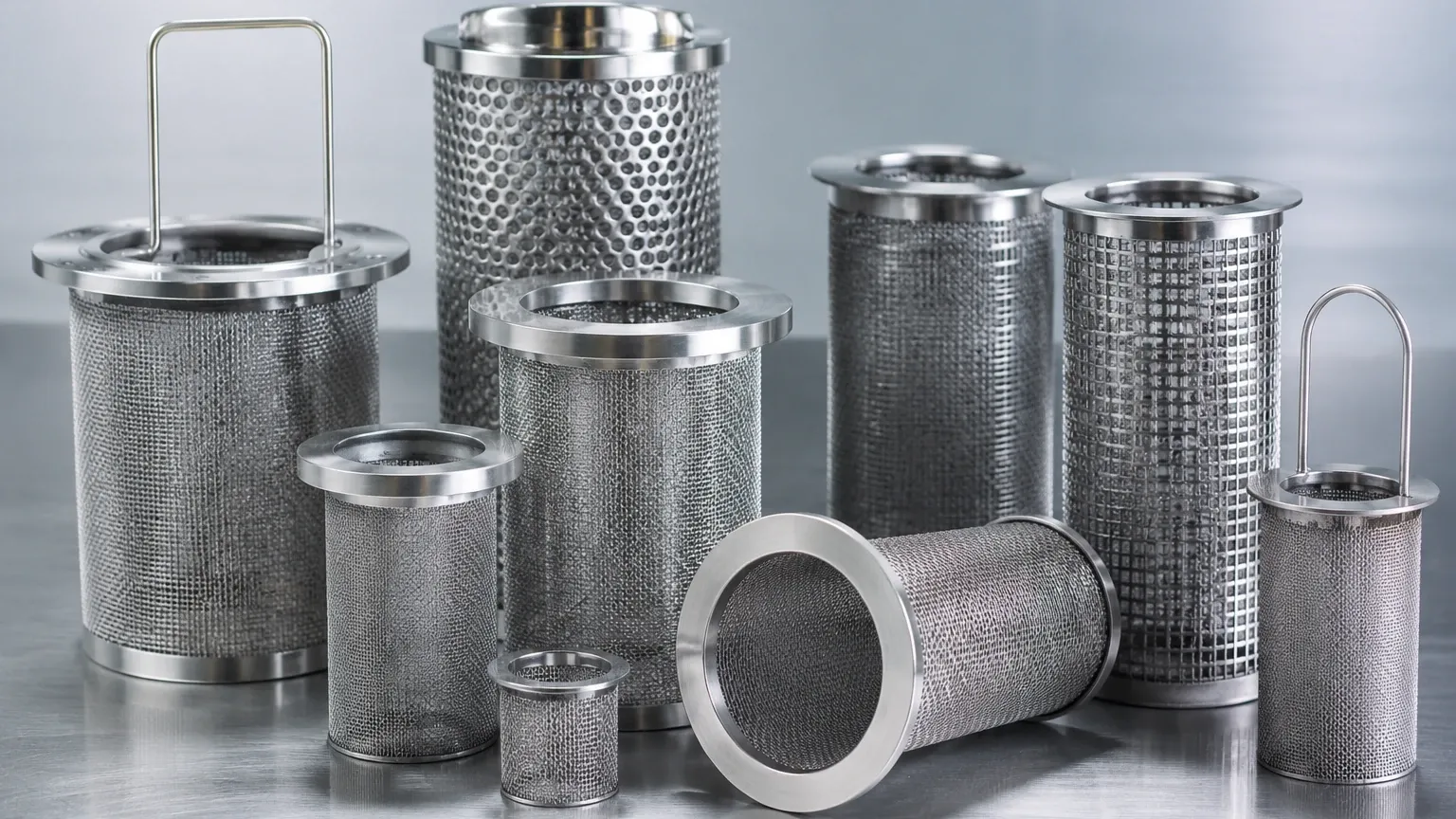
One size rarely fits all in industrial filtration. Customization is often necessary to meet specific micron ratings or to fit into existing piping footprints. Kaifil’s manufacturing capabilities allow for the production of precision metal filter components that meet exact engineering specifications.
Perforated vs. Wire Mesh Baskets
Industrial strainers often utilize a two-stage approach within the basket. A heavy-duty perforated metal plate provides the structural strength needed to withstand high pressure, while a finer inner lining of stainless steel wire mesh provides the actual filtration. The choice of mesh weave (plain, twilled, or dutch weave) determines the retention accuracy and the ease with which the basket can be cleaned.
Magnetic Inserts
In hydraulic systems and metalworking applications, ferrous particles can be particularly damaging. Custom strainers can be equipped with magnetic inserts within the basket to capture fine iron and steel particles that might otherwise pass through a standard mesh. This adds an extra layer of protection for sensitive downstream pumps and valves.
Maintenance and Total Cost of Ownership (TCO)
While the initial purchase price of industrial strainers is an important factor for procurement, the Total Cost of Ownership is driven by maintenance efficiency and durability. A cheaply made strainer with a low OAR will require more frequent cleaning, leading to higher labor costs and potential process interruptions.
Differential Pressure Monitoring
To optimize maintenance cycles, strainers should be equipped with differential pressure gauges. By monitoring the pressure drop across the unit, maintenance teams can clean the baskets exactly when needed—preventing both unnecessary labor (cleaning too early) and equipment damage (cleaning too late). If the ΔP exceeds the manufacturer’s recommended limit, the risk of the basket collapsing or "bursting" increases, which would release all collected debris into the downstream system.
Cleaning and Reusability
One of the primary advantages of stainless steel Strainers & Baskets is their cleanability. Unlike disposable filter cartridges, stainless steel baskets can be cleaned via backwashing, ultrasonic cleaning, or manual pressure washing and returned to service. This significantly reduces the long-term waste and replacement costs associated with industrial filtration.
Conclusion: Selection Checklist for Engineers
Before finalizing a purchase for industrial strainers, engineers and technical professionals should confirm the following data points to ensure the solution is fit for purpose:
* Fluid Properties: What is the chemical composition, temperature, and viscosity?
* Contaminant Profile: What is the expected debris load, and what is the target particle size for retention?
* Flow Dynamics: What is the maximum flow rate and the maximum allowable pressure drop (clean and dirty)?
* Operational Constraints: Does the process allow for shutdown (Simplex) or is continuous flow required (Duplex)?
* Material Standards: Does the application require food-grade (FDA) or pharmaceutical-grade (USP) compliance?
By addressing these factors during the design and procurement phase, industrial facilities can implement filtration solutions that protect their assets, reduce downtime, and maintain the highest standards of process integrity. Kaifil remains a committed partner in this process, providing the engineering expertise and manufacturing precision required for the world's most demanding industrial environments.
