


Japanese Strainers
In the landscape of industrial filtration, technical standards and precision manufacturing define the reliability of fluid handling systems. When engineers and procurement professionals discuss Japanese strainers, the conversation typically centers on components designed to meet the rigorous Japanese Industrial Standards (JIS) or those integrated into machinery manufactured by Japanese OEMs. These strainers are essential for protecting downstream equipment—such as pumps, valves, and heat exchangers—from particulate contamination in sectors ranging from chemical processing to food and beverage production.
Selecting the right filtration component requires a deep understanding of how regional standards like JIS interface with global operational requirements. Whether you are maintaining a facility equipped with Japanese-made hardware or seeking high-precision custom Strainers & Baskets that mirror the exacting tolerances of Japanese engineering, evaluating material integrity, flow dynamics, and structural design is paramount.
Understanding Technical Standards for Japanese Strainers
The primary differentiator for Japanese strainers in an industrial context is adherence to JIS (Japanese Industrial Standards). For engineers accustomed to ANSI (American National Standards Institute) or DIN (Deutsches Institut für Normung) specifications, transitioning to JIS-compliant components involves navigating different pressure ratings and flange dimensions.
Pressure Ratings and Flange Connectivity
JIS pressure ratings are typically denoted by a "K" suffix, such as 5K, 10K, 16K, or 20K. These indicate the nominal pressure the strainer can withstand at specific temperatures. For instance, a JIS 10K flange has distinct bolt circle diameters and hole counts compared to an ANSI 150lb flange, even if the nominal pipe size is similar. When sourcing replacement baskets or complete strainer assemblies for Japanese equipment, verifying these dimensions is the first step to ensuring a leak-proof installation.
Material Designations
JIS standards also use specific material codes. While the global market is familiar with AISI 304 and 316 stainless steel, Japanese specifications may refer to SUS304 or SUS316. While functionally equivalent in most applications, high-purity environments in the pharmaceutical or semiconductor industries may require strict adherence to the specific chemical compositions defined by the SUS standards to ensure corrosion resistance and longevity.
Material Selection and Durability in Precision Filtration
The efficacy of a strainer is largely determined by its material construction. In industrial environments, stainless steel remains the gold standard due to its mechanical strength and resistance to various forms of chemical attack. When evaluating Japanese strainers or their custom equivalents, the choice between different grades of stainless steel must be driven by the specific properties of the process fluid.
1. SUS304 (AISI 304): Suitable for general-purpose applications, including water treatment and standard food processing. It provides excellent strength and good corrosion resistance under moderate conditions.
2. SUS316/316L (AISI 316/316L): The addition of molybdenum makes these grades superior for chloride-rich environments or acidic chemical processing. The "L" variant (low carbon) is critical for components that require extensive welding, as it prevents intergranular corrosion in the heat-affected zones.
3. Specialty Alloys: For highly aggressive media, such as those found in specialized chemical plants, materials like Duplex stainless steel or Monel may be integrated into the basket design to provide the necessary service life.
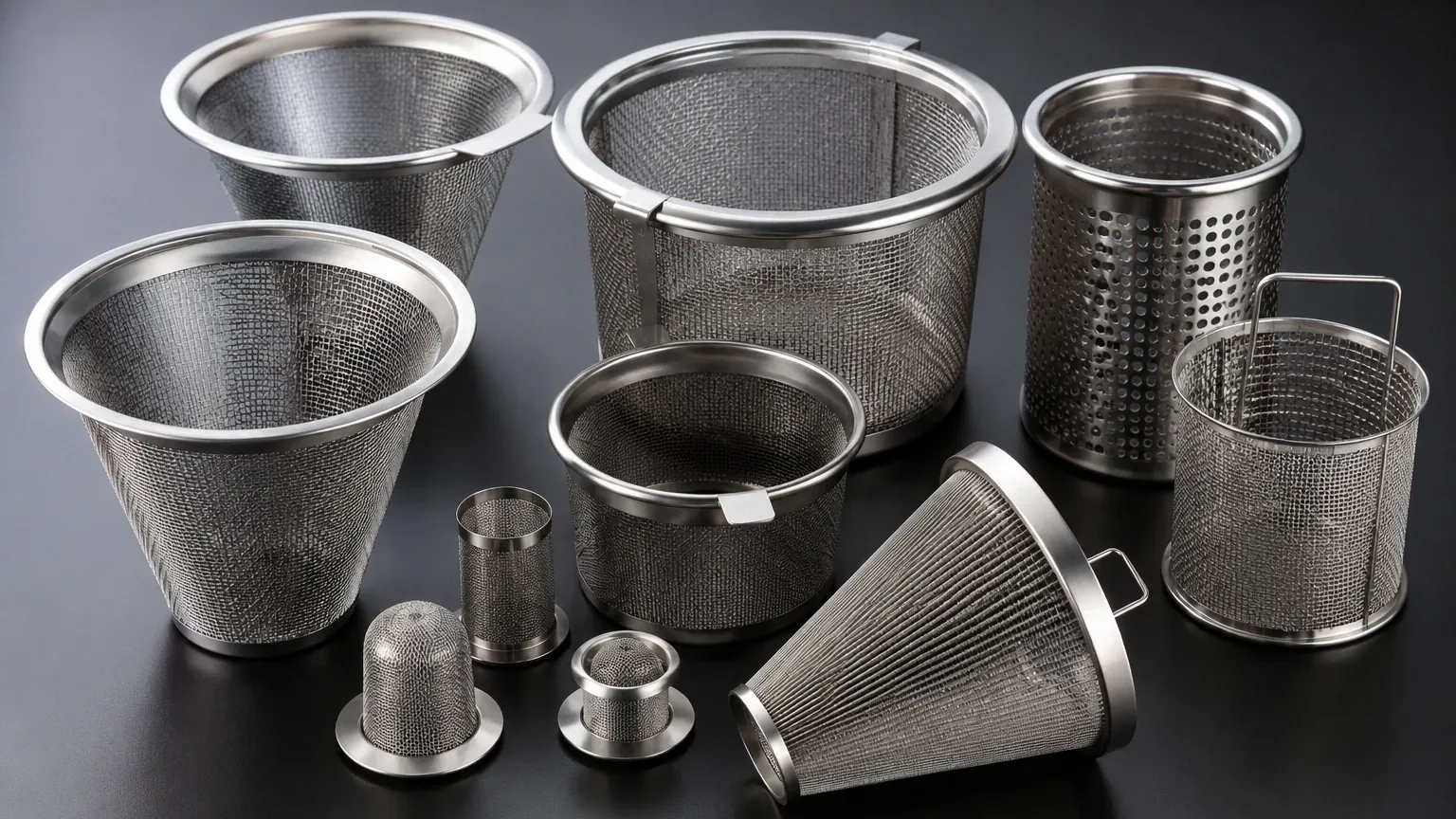
Beyond the alloy, the physical form of the filtration media—whether it is perforated plate, woven wire mesh, or wedge wire—must be selected based on the mechanical stresses of the application. High-pressure systems often utilize a heavy-duty perforated metal basket as a structural support, lined with a fine wire mesh to achieve the required filtration accuracy.
Design Variations in Strainers & Baskets for Specialized Applications
Industrial strainers are categorized by their housing geometry and the flow path of the fluid. Japanese engineering often emphasizes compact footprints and ease of maintenance, which is reflected in the common configurations found in Japanese-designed plants.
Y-Strainers
Named for their shape, Y-strainers are typically used for pressurized lines, both liquid and gas. They are favored for their compact design and are often installed where space is at a premium. In Japanese-spec systems, Y-strainers are frequently used in steam applications or high-pressure water lines.
Basket (Simplex and Duplex) Strainers
Basket strainers offer a larger surface area than Y-strainers, resulting in a lower pressure drop and longer intervals between cleanings.
* Simplex Strainers: Used in batch processes where the flow can be temporarily halted for basket cleaning.
* Duplex Strainers: These consist of two separate strainer chambers connected by a diversion valve. They are essential for continuous-flow operations, allowing one basket to be cleaned while the other remains in service. Japanese-engineered duplex systems are known for their precision valve mechanisms that ensure zero-leakage during changeovers.
Custom Basket Geometry
In many OEM scenarios, the internal basket of a strainer must be customized to fit specific housing dimensions. Custom-manufactured Strainers & Baskets allow for the optimization of the "open area ratio," which is the ratio of the total area of the holes in the basket to the cross-sectional area of the inlet pipe. A higher ratio (typically 4:1 or 6:1) ensures minimal flow restriction and reduces the frequency of maintenance.
Evaluating Filtration Performance: Mesh Count and Micron Ratings
The core function of any strainer is to remove particles of a specific size. This is defined by the filtration rating, often expressed in mesh count or microns. Understanding the relationship between these two units is critical for engineers specifying Japanese strainers.
* Mesh Count: Refers to the number of openings per linear inch. As the mesh count increases, the size of the openings decreases. For example, a 100-mesh screen has much smaller openings than a 20-mesh screen.
* Micron Rating: A more precise measurement indicating the diameter of the largest spherical particle that can pass through the mesh.
When dealing with Japanese specifications, it is common to see filtration requirements defined with extreme precision. In the electronics or fine chemical industries, a strainer might be required to capture particles as small as 50 microns. Achieving this requires high-quality wire mesh that maintains its structural integrity under the force of the fluid flow. If the mesh is too thin or poorly supported, "media migration" or bypass can occur, leading to downstream contamination.
Engineers must also consider the "percentage of open area." A fine mesh provides high filtration accuracy but can significantly restrict flow if the total open area is insufficient. Balancing these factors requires technical expertise in mesh selection and basket reinforcement techniques.
Engineering Considerations for Custom Replacement and OEM Integration
For many facilities, the challenge is not just finding a strainer, but finding a replacement for an existing Japanese strainer that is no longer easily available from the original manufacturer. In these cases, custom engineering becomes the most viable solution.
Reverse Engineering and Dimensional Accuracy
When a basket in a Japanese-made machine fails, the replacement must match the original dimensions exactly. This includes the flange thickness, the handle height, and the seating surface of the basket. Even a millimeter of deviation can prevent the basket from seating correctly, allowing fluid to bypass the filter media entirely.
Performance Upgrades
Custom manufacturing also provides an opportunity to upgrade the performance of the original component. For example, if the original Japanese strainer was prone to clogging, an engineer might specify a pleated mesh design for the replacement basket. Pleating significantly increases the surface area within the same physical footprint, extending the time between cleaning cycles and reducing the total cost of ownership.
Compatibility with Automated Systems
Modern industrial plants often utilize differential pressure sensors to monitor the status of strainers. When a basket becomes clogged, the pressure drop (Delta P) increases. Custom strainers can be designed with reinforced internal supports to withstand these higher pressure differentials, preventing the basket from collapsing before the cleaning cycle can be initiated.
Maintenance and Longevity: Optimizing Total Cost of Ownership
The initial purchase price of a strainer is only a fraction of its total cost. For Japanese strainers used in high-demand environments, the long-term value is found in durability and ease of maintenance.
Cleaning Protocols
Stainless steel strainers are designed to be cleaned and reused. The ease of cleaning depends on the mesh type. Plain square weave mesh is relatively easy to backwash or ultrasonic clean, while complex Dutch weaves may require more intensive procedures. In food-grade applications, the strainer must be designed with "clean-in-place" (CIP) capabilities, ensuring there are no dead spaces where bacteria can accumulate.
Gasket and Seal Selection
A common point of failure in strainer systems is the seal between the basket and the housing or the housing cover. When replacing components in a JIS-standard system, it is vital to use gaskets (such as EPDM, PTFE, or Viton) that are compatible with both the process fluid and the temperature, while matching the specific JIS flange dimensions.
Monitoring Wear and Tear
Regular inspection of the strainer basket is essential. Engineers should look for signs of wire fraying, corrosion pitting, or structural deformation of the perforated support. In high-velocity systems, erosion can occur at the inlet point of the basket. Specifying a "deflector plate" or a reinforced impact zone in a custom basket design can significantly extend the life of the component in these harsh conditions.
Conclusion: Selecting the Right Filtration Partner
Navigating the complexities of Japanese strainers requires a partner who understands both the technical nuances of JIS standards and the practical realities of industrial filtration. Whether you are looking for a direct OEM replacement or a custom-engineered solution to improve the efficiency of your process, the focus must always remain on precision, material quality, and application-specific design.
By prioritizing high-grade stainless steel construction and accurate filtration ratings, engineers can ensure their systems remain protected and operational. When the standard off-the-shelf options do not meet the unique demands of your equipment, exploring custom Strainers & Baskets provides the flexibility needed to maintain the high performance expected of Japanese-engineered systems. Before proceeding with a purchase, always confirm the specific pressure ratings, material certifications, and dimensional requirements to ensure a seamless integration into your industrial infrastructure.
