


Just Basket Strainer
In industrial fluid handling systems, the protection of downstream equipment—such as pumps, valves, and heat exchangers—is a critical engineering priority. While many filtration technologies exist, the selection of a just basket strainer often provides the most efficient balance between flow capacity, dirt-holding volume, and ease of maintenance. For engineers and procurement teams, understanding the technical nuances of these components is essential for ensuring system longevity and operational uptime.
At its core, a basket strainer is a closed vessel with a removable screen or basket that intercepts particulate matter. Unlike Y-strainers, which are typically used for smaller amounts of debris in high-pressure steam or gas lines, basket strainers are designed for liquid applications where high flow rates and significant solids loading are expected. When evaluating Strainers & Baskets, technical professionals must look beyond basic dimensions to consider material compatibility, pressure drop calculations, and specific filtration requirements.
Engineering Fundamentals of Basket Strainer Design
The primary advantage of a basket strainer lies in its geometry. The vertical orientation of the basket allows for a larger surface area compared to a standard Y-strainer. This increased surface area results in a lower initial pressure drop and a higher dirt-holding capacity, which directly translates to longer intervals between cleaning cycles.
Simplex vs. Duplex Configurations
For many applications, a simplex (or "just") basket strainer is sufficient. This design consists of a single chamber and basket. It is ideal for batch processes or systems where the flow can be temporarily shut down to remove and clean the basket. However, in continuous 24/7 operations where downtime is not an option, a duplex strainer—which uses two chambers and a diverter valve to switch flow between them—may be required.
Flow Dynamics and Pressure Drop
The performance of a basket strainer is measured by its "Open Area Ratio" (OAR). This is the ratio between the total open area of the strainer screen and the cross-sectional area of the inlet pipe. A high OAR (typically 6:1 or higher) ensures that even as the basket begins to fill with debris, the pressure drop (Delta P) across the unit remains within acceptable limits. Engineers must calculate the maximum allowable pressure drop to prevent cavitation in pumps or reduced efficiency in heat transfer equipment.
Material Selection and Industrial Durability
In industrial environments, the choice of material for both the housing and the internal basket is non-negotiable. Stainless steel remains the industry standard due to its mechanical strength and resistance to various forms of corrosion. Kaifil specializes in manufacturing these components using high-grade alloys to meet demanding chemical and thermal requirements.
Stainless Steel 304 vs. 316
* Type 304: This is the most common grade for general-purpose industrial filtration. It offers excellent durability and resistance to oxidation. It is widely used in food processing and general water treatment.
* Type 316: For environments involving chlorides, acids, or high-salinity fluids, Type 316 is the preferred choice. The addition of molybdenum provides superior pitting resistance, making it essential for chemical processing and pharmaceutical applications.
Gasket and Seal Compatibility
While the metal housing provides structural integrity, the seals ensure leak-proof operation. Depending on the fluid being filtered, engineers must specify the correct elastomer for the cover gasket. Common options include:
* Buna-N (Nitrile): Standard for water and oil.
* EPDM: Excellent for steam and polar solvents.
* Viton (FKM): Required for high temperatures and aggressive chemicals.
* PTFE: Used for extreme chemical resistance across a wide temperature range.
Determining Filtration Efficiency and Mesh Size
The effectiveness of a just basket strainer is defined by the size of the particles it can capture. This is determined by the perforations or the mesh lining of the basket. Selecting the correct micron rating is a balance between protecting equipment and avoiding excessive maintenance.
Perforated Baskets
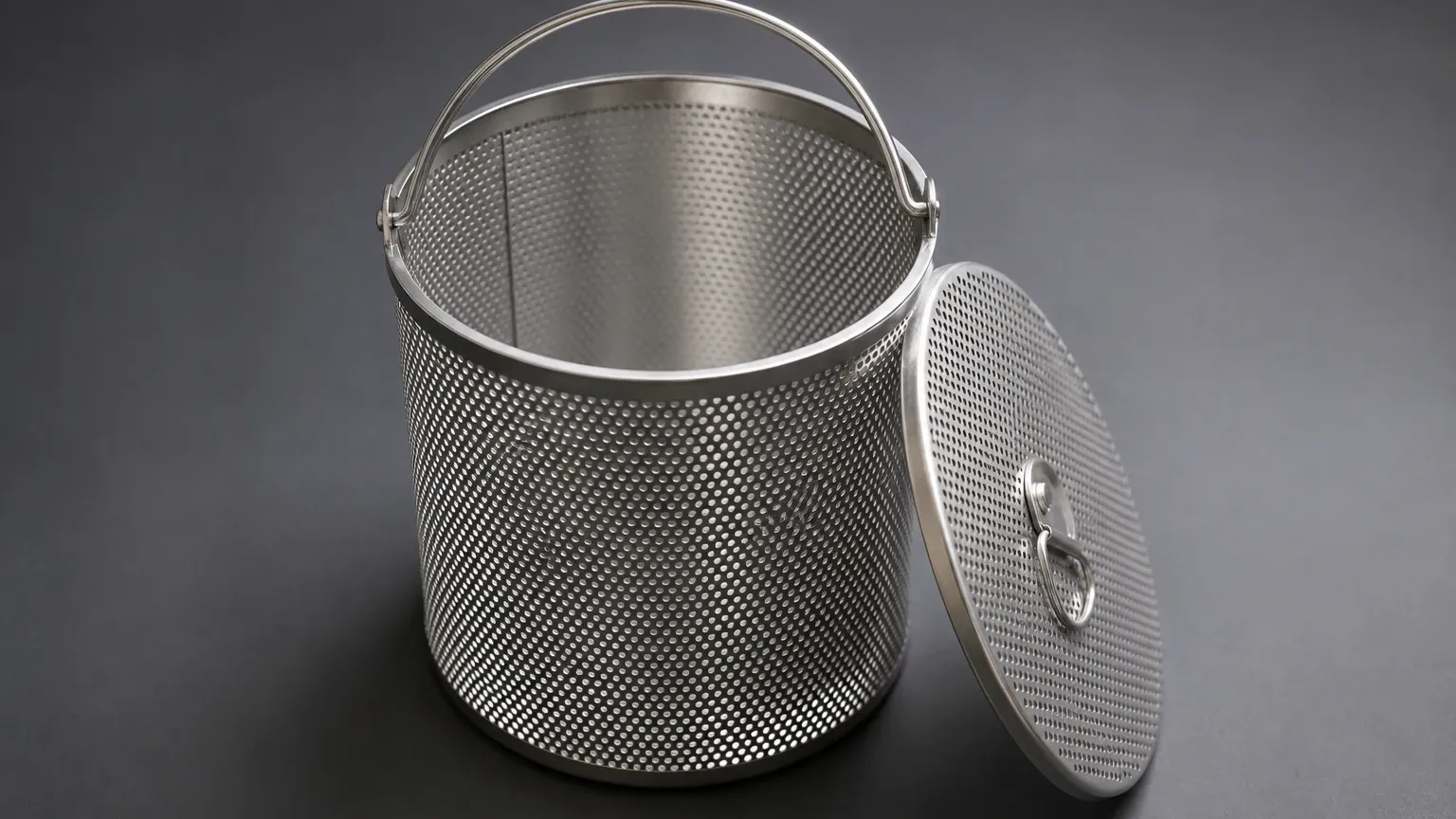
Perforated metal baskets are used for coarse filtration, typically removing particles larger than 1/32 of an inch. They serve as the structural support for finer mesh linings or can be used alone for "scalping" operations where only large debris is a concern.
Mesh Linings
For finer filtration, a stainless steel wire mesh is welded to the inside or outside of the perforated basket. Mesh sizes are often described by the number of openings per linear inch. For example, a 100-mesh screen has 100 openings per inch, capable of capturing particles down to approximately 150 microns. In high-precision applications, such as pharmaceutical or food and beverage production, the mesh must be carefully selected to ensure it does not shed fibers or fail under the mechanical stress of high-velocity flow.
The "Rule of Thumb" for Sizing
Engineers often follow the principle of selecting a screen that is slightly smaller than the smallest orifice in the downstream equipment. For instance, if a pump has an internal clearance of 500 microns, the strainer should be equipped with a 300 to 400-micron screen to provide a safety margin.
Operational Considerations and Maintenance Cycles
A common question from purchasing teams involves the total cost of ownership (TCO) rather than just the initial purchase price. The TCO of a basket strainer is largely dictated by how often it must be serviced.
Monitoring Differential Pressure
To maximize the life of the internal basket and ensure system efficiency, it is recommended to install differential pressure gauges on the inlet and outlet of the strainer housing. A clean basket will show a minimal pressure drop. As debris accumulates, the pressure drop increases. Most industrial systems are designed to trigger a cleaning cycle when the Delta P reaches 5 to 10 psi. Allowing the pressure drop to exceed this can lead to basket deformation or "blow-by," where the pressure forces particles through the mesh.
Cleaning and Reusability
One of the primary benefits of stainless steel Strainers & Baskets is their reusability. Unlike disposable cartridge filters, a basket can be removed, cleaned (via backwashing, ultrasonic cleaning, or manual scrubbing), and reinstalled. This significantly reduces long-term operational costs and waste. However, the cleaning process must be performed carefully to avoid damaging the fine wire mesh.
Customization Options for Specific Industrial Applications
Off-the-shelf solutions may not always meet the rigorous demands of specialized industrial processes. Customization is often necessary to accommodate unique piping layouts, flow rates, or chemical profiles. Kaifil provides tailored engineering support to ensure the filtration component integrates seamlessly into the existing infrastructure.
Custom Flange and Connection Types
Standard NPT or BSP threaded connections are common for smaller units, but larger industrial strainers often require ANSI or DIN flanges. Customizing the connection type and orientation (such as offset inlets or outlets) can simplify installation in tight mechanical rooms.
Specialized Coatings and Finishes
In the food and beverage industry, the internal and external surfaces of the strainer may require a specific Ra (Roughness Average) finish to prevent bacterial growth and facilitate Clean-in-Place (CIP) procedures. Electropolishing is a common post-production treatment used to achieve a mirror-like finish that enhances corrosion resistance and cleanability.
High-Capacity Baskets
For systems with exceptionally high solids loading, "extra-deep" baskets can be designed to increase the volume of debris the unit can hold before requiring service. This is particularly useful in raw water intake systems or wastewater treatment plants.
Common Risks and Technical Confirmation Points
Before finalizing the procurement of a just basket strainer, engineers should confirm several key data points to avoid common pitfalls:
1. Maximum Operating Pressure and Temperature: Ensure the housing and gaskets are rated for the system's peak conditions, including potential surges.
2. Fluid Velocity: High velocity can cause vibration and premature wear on the mesh. Generally, liquid velocity should be kept below 10 feet per second (fps).
3. Chemical Compatibility: Verify that every wetted part (housing, basket, and seals) is compatible with the process fluid, especially if the fluid is a solvent or a strong acid.
4. Bypass Prevention: Confirm that the basket seating surface is precision-machined to prevent "bypass," where fluid flows around the basket instead of through it.
5. Ease of Access: Ensure there is sufficient overhead clearance to remove the basket for cleaning. Some large strainers may require davit arms or hinged covers to assist with the weight of the lid.
By focusing on these technical parameters, engineering teams can select a filtration solution that provides reliable protection and optimized performance. Whether the application involves protecting a high-pressure pump in a chemical plant or ensuring the purity of a beverage line, the right basket strainer serves as a foundational component of industrial process integrity.
