


Kitchen Dish Strainers
In the context of commercial food service, industrial food processing, and large-scale hospitality operations, the term "kitchen dish strainers" refers to more than just a simple household sink accessory. For engineers, facility managers, and procurement professionals, these components represent the first line of defense in waste management and equipment protection. High-performance strainers and baskets are critical for maintaining hygiene standards, protecting plumbing infrastructure, and ensuring the efficient operation of industrial-scale dishwashing and food preparation systems.
When specifying filtration components for these demanding environments, the focus shifts from aesthetic appeal to structural integrity, material compatibility, and filtration precision. This guide explores the technical engineering considerations behind industrial-grade kitchen dish strainers and how professional-grade Strainers & Baskets contribute to the longevity and efficiency of commercial facilities.
The Role of High-Performance Strainers in Food Service and Processing
In an industrial or commercial kitchen, the volume of solid waste—ranging from food scraps to packaging debris—can quickly overwhelm standard drainage systems. Industrial kitchen dish strainers are engineered to handle high flow rates while capturing solids that could cause blockages or damage downstream pumps and grease traps.
Unlike residential versions, industrial strainers must withstand constant exposure to high-temperature water, aggressive cleaning agents, and physical impact. Their role extends beyond simple debris collection; they are integral to the facility's hydraulic balance. A poorly designed strainer can cause water backup, leading to slip hazards and sanitation violations. Conversely, a strainer with a mesh that is too coarse may allow particles through that eventually clog heat exchangers in commercial dishwashers or foul the sensitive components of a water recycling system.
Engineering Considerations for Industrial-Grade Dish and Sink Strainers
When selecting or designing strainers for commercial applications, several engineering parameters must be evaluated to ensure the component meets the specific needs of the facility.
Filtration Accuracy and Mesh Selection
The efficiency of a strainer is primarily determined by its filtration media. In industrial applications, this is typically either perforated metal or woven wire mesh.
- Perforated Metal: Offers superior structural strength and is ideal for capturing larger debris. It is often used as a primary stage or a support basket for finer mesh.
- Woven Wire Mesh: Provides much finer filtration. For kitchen applications, mesh counts are selected based on the specific type of waste generated. For instance, a facility processing fine grains or vegetable pulp requires a much tighter weave than one handling general plate waste.
Flow Rate and Open Area
An essential calculation for any engineer is the "Open Area Ratio." This is the ratio of the total area of the holes in the strainer to the total area of the strainer surface. A higher open area reduces the pressure drop across the strainer, allowing for faster drainage. However, increasing the open area often involves reducing the structural thickness of the material, which can lead to premature failure under heavy loads. Professional manufacturers balance these factors to provide a strainer that drains quickly without sacrificing durability.
Structural Integrity and Welding
Industrial kitchen dish strainers are often subjected to "shock loading"—the sudden dumping of large volumes of water or heavy waste. The construction method, such as TIG (Tungsten Inert Gas) welding or advanced spot welding, ensures that the mesh remains securely attached to the rim and base even under mechanical stress. Seamless construction is preferred in food-grade environments to eliminate crevices where bacteria can proliferate.
Material Selection: Why Stainless Steel is the Industry Standard
Material selection is perhaps the most critical factor in the lifecycle of a strainer. In the realm of industrial filtration, stainless steel is the undisputed leader due to its unique combination of mechanical properties and chemical resistance.
Grade 304 Stainless Steel
SS304 is the most common grade used for kitchen dish strainers. It provides excellent corrosion resistance against water and common organic acids found in food. It is highly formable, allowing for the creation of deep-drawn baskets and complex rim profiles that fit perfectly into commercial sink drains.
Grade 316 Stainless Steel
For environments involving high concentrations of salt (such as seafood processing) or highly acidic foods (like citrus or tomato processing), SS316 is often specified. The addition of molybdenum in SS316 provides superior resistance to pitting and crevice corrosion, ensuring the strainer does not degrade even in the most aggressive chemical environments. This grade is also more resistant to the harsh chloride-based sanitizers frequently used in industrial cleaning protocols.
Surface Finishes and Hygiene
Beyond the alloy itself, the surface finish plays a vital role in sanitation. Electropolishing is a common requirement for industrial food-grade strainers. This process removes a microscopic layer of material, smoothing out surface irregularities and leaving a high-luster finish that is easier to clean and highly resistant to bacterial adhesion.
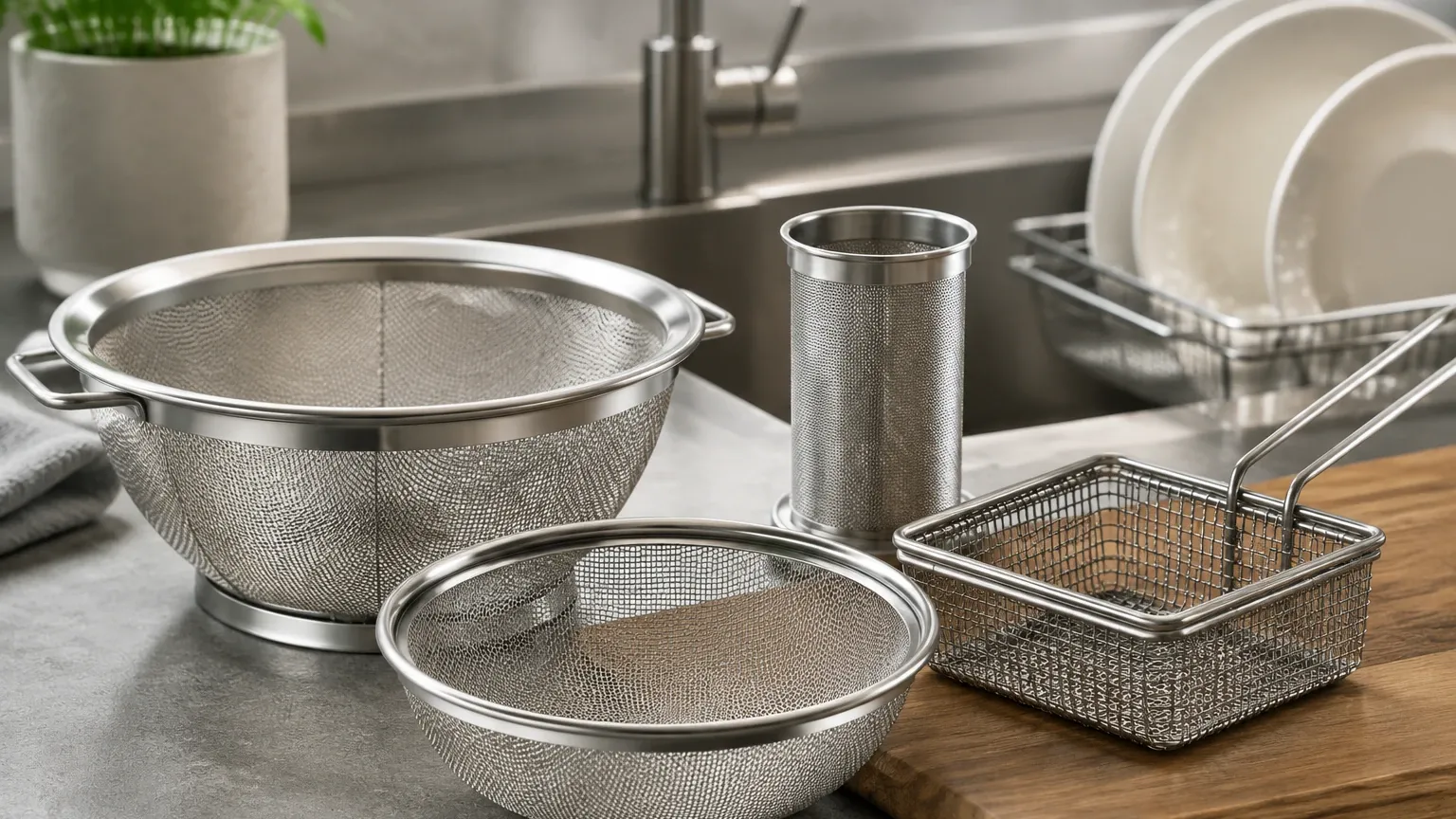
Customization Options for Commercial and Industrial Strainers & Baskets
Standard off-the-shelf solutions rarely meet the specific requirements of complex industrial systems. Customization allows engineers to tailor the strainer to the exact physical and functional needs of their application.
1. Custom Dimensions: Whether it is an oversized floor sink or a specialized pre-rinse station, custom-sized baskets ensure a bypass-free fit. Precise tolerances are necessary to prevent solids from escaping around the edges of the strainer.
2. Handle and Lift Configurations: In high-volume environments, ease of maintenance is key. Custom handles—such as fixed bars, drop handles, or extended reach bails—allow staff to remove and empty baskets quickly and safely, even when the sink is full of water.
3. Reinforced Bases: For strainers that hold significant weight, reinforced bases or double-bottom designs prevent the mesh from sagging or tearing over time.
4. Multi-Stage Filtration: Some applications benefit from a "basket-within-a-basket" design, where a coarse outer perforated basket protects a finer inner mesh liner. This extends the service life of the finer mesh and simplifies the cleaning process.
Maintenance and Longevity: Optimizing the Lifecycle of Filtration Components
The total cost of ownership for industrial strainers is determined not just by the purchase price, but by their durability and ease of maintenance. A well-engineered stainless steel strainer should last for years, provided it is maintained correctly.
Cleaning Protocols
In food service, the buildup of fats, oils, and greases (FOG) can blind the mesh of a strainer, significantly reducing flow rates. Regular cleaning with appropriate degreasers is essential. Because stainless steel is non-porous, it can withstand high-pressure washing and steam cleaning, which are often necessary to maintain hygiene standards.
Inspection for Wear
Engineers should implement a regular inspection schedule for all Strainers & Baskets. Key areas to check include the weld points between the mesh and the frame, as well as the integrity of the mesh itself. Small tears can lead to "bypass," where unfiltered water enters the drainage system, potentially causing expensive blockages further down the line.
Replacement Cycles
While high-quality stainless steel strainers are durable, they are considered wear parts. Having a standardized replacement cycle based on the intensity of the operation ensures that the filtration system never becomes the weak link in the facility's infrastructure. Purchasing from an OEM manufacturer allows for the procurement of exact replacements, ensuring consistent performance across all stations.
Selecting the Right Strainer for Your Application
Choosing the correct kitchen dish strainer for an industrial application requires a thorough understanding of the waste stream and the hydraulic requirements of the system. Procurement teams should work closely with engineering to answer the following questions before finalizing a specification:
- What is the minimum particle size that must be captured? This determines the mesh count or perforation size.
- What is the peak flow rate? The strainer must be able to handle the maximum expected volume without causing backup.
- What chemicals will the strainer be exposed to? This dictates whether SS304 or SS316 is required.
- Are there specific regulatory standards? Ensure the design complies with FDA, 3A, or local plumbing codes.
By focusing on these technical parameters rather than just price, organizations can reduce maintenance costs, prevent downtime, and ensure a more hygienic operation. Kaifil specializes in the manufacture of these precision components, offering the engineering expertise required to develop custom filtration solutions that stand up to the rigors of industrial use. Whether you need standard replacements or a completely custom-engineered basket, selecting the right partner is the first step toward optimized filtration performance.
