


Large Strainers for Cooking
In industrial food processing and large-scale commercial kitchens, the equipment used for separation and filtration must meet significantly higher standards than consumer-grade equivalents. Large strainers for cooking are essential components in processes ranging from pasta blanching and vegetable steaming to deep frying and stock production. For engineers and procurement teams, selecting the right filtration tool involves more than just sizing; it requires a deep understanding of material science, structural integrity, and hygiene compliance.
Industrial-grade Strainers & Baskets are designed to withstand the rigors of continuous operation, high temperatures, and corrosive cleaning agents. This guide examines the technical specifications and engineering considerations necessary for selecting high-performance straining solutions in a B2B context.
Understanding the Role of Industrial Strainers in Food Processing
In a commercial or industrial setting, the term "large strainers for cooking" refers to heavy-duty filtration units capable of handling high volumes of solids and liquids. These are not merely oversized kitchen tools but precision-engineered components integrated into larger production lines or used in high-capacity batch processing.
Their primary function is the separation of solid food particles from liquid media. This is critical for maintaining product consistency, protecting downstream equipment from debris, and ensuring the final quality of the food or beverage. In applications like industrial soup production or large-scale brewing, the strainer must manage high flow rates without significant pressure drops, while also being robust enough to support the weight of the saturated solids.
From an engineering perspective, the efficiency of a strainer is measured by its open area percentage—the ratio of the total area of the holes to the total area of the mesh or plate. A higher open area allows for faster drainage and less resistance, which is vital in high-speed production environments.
Material Excellence: Why Stainless Steel is Non-Negotiable
When specifying large strainers for cooking, the choice of material is the most critical factor for both safety and longevity. Stainless steel is the industry standard due to its non-reactive nature and resistance to corrosion at high temperatures.
304 Stainless Steel
Grade 304 is the most common stainless steel used in food applications. It offers excellent corrosion resistance to most oxidizing acids and is highly durable. It is suitable for most standard cooking applications where the environment is not excessively saline or acidic.
316 and 316L Stainless Steel
For environments involving high salt concentrations, acidic marinades, or aggressive cleaning chemicals, 316 stainless steel is preferred. The addition of molybdenum enhances its resistance to pitting and crevice corrosion. 316L (low carbon) is often used for components that require extensive welding, as it minimizes carbide precipitation that can lead to corrosion in the heat-affected zones of the weld.
Surface Finish and Hygiene
Beyond the alloy type, the surface finish of the strainer is vital. Industrial strainers often undergo electropolishing or mechanical polishing to achieve a smooth, burr-free surface. This reduces the risk of food particles adhering to the mesh, which prevents bacterial growth and facilitates easier cleaning. Compliance with FDA and other international food safety standards is a baseline requirement for these materials.
Structural Engineering of Large Strainers for Heavy-Duty Use
A common failure point for large strainers for cooking used in industrial environments is structural collapse under load. When a large basket is filled with hundreds of pounds of boiled product, the mechanical stress on the mesh and the frame is immense.
Reinforcement and Framing
To prevent deformation, industrial strainers are designed with reinforced frames. This often includes heavy-duty top rings, vertical support ribs, and cross-bracing at the base. The thickness of the wire or the gauge of the perforated metal must be calculated based on the maximum expected load and the frequency of use.
Handle and Attachment Design
In many B2B applications, these strainers are lifted by mechanical hoists or integrated into tilting kettles. The attachment points—whether they are bails, side handles, or specialized hooks—must be TIG welded or spot welded with high precision to ensure they do not shear off during operation. Ergonomics also play a role for manual handling, ensuring that handles are heat-resistant and positioned to distribute weight evenly.
Bottom Construction
The bottom of the strainer often bears the most stress. Designs may feature a solid metal plate at the base for added strength, or a reinforced mesh floor to maximize drainage. The transition between the side walls and the base must be seamless to avoid "dead zones" where food can become trapped.
Comparing Mesh Types and Filtration Accuracy
The choice between woven wire mesh, perforated metal, and wedge wire depends on the specific cooking application and the size of the particles being filtered.
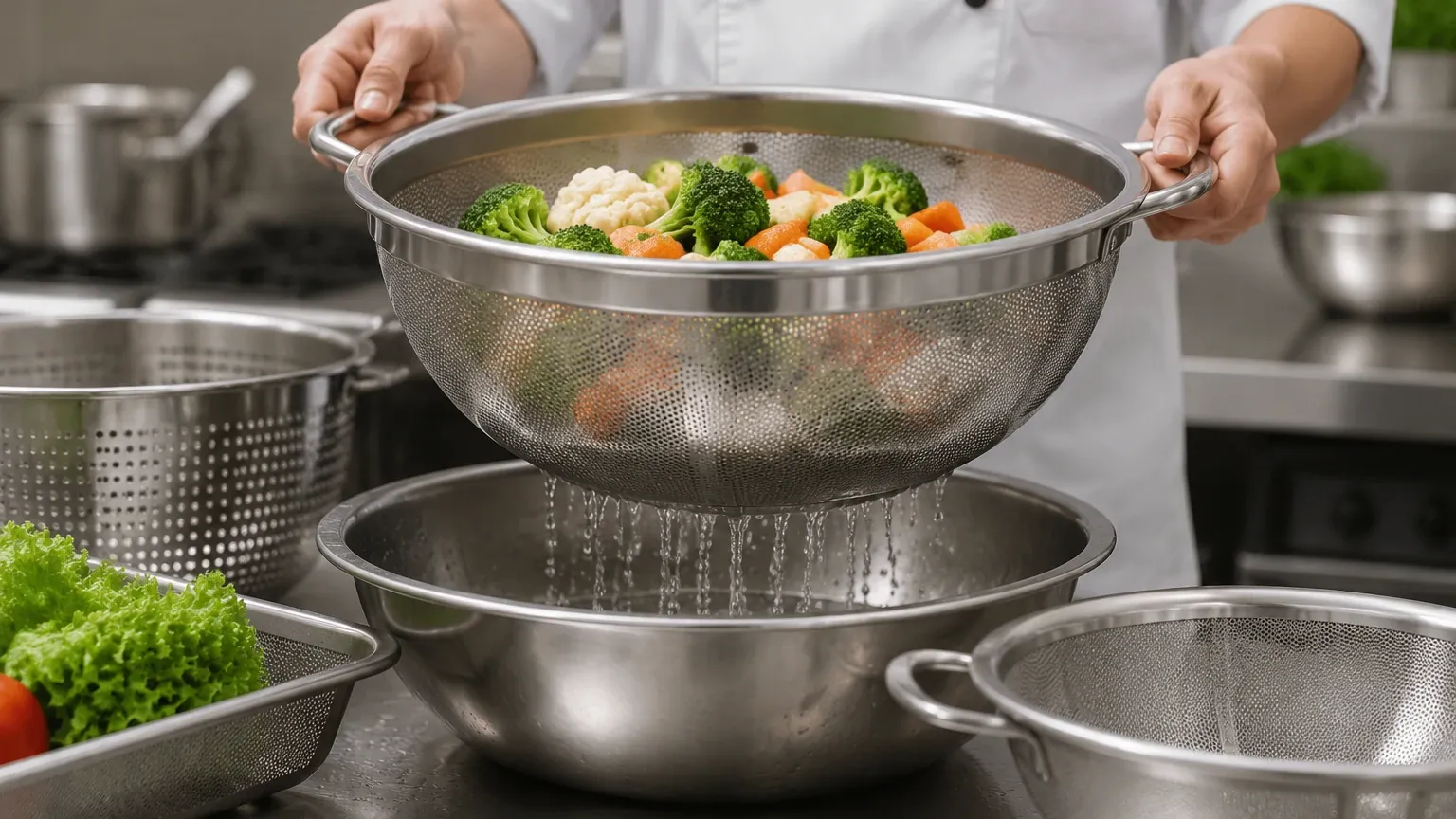
1. Woven Wire Mesh: This provides the highest open area and is ideal for fine filtration. It is commonly used in large strainers for cooking that require the removal of small seeds, herbs, or fine sediment. However, it is more susceptible to damage and may require a perforated metal backing for support.
2. Perforated Metal: This is much more robust than woven mesh. It is created by punching holes into a solid sheet of stainless steel. While the open area is typically lower than woven mesh, it is easier to clean and offers superior structural integrity. It is ideal for straining large items like pasta, bones, or whole vegetables.
3. Wedge Wire: Often used in industrial brewing or dairy processing, wedge wire consists of V-shaped profiles that are resistant to clogging (blinding). The continuous slots provide efficient drainage and high strength, making it suitable for heavy-duty separation tasks.
When selecting a mesh size or micron rating, engineers must balance the need for fine filtration with the requirement for rapid flow. A mesh that is too fine will clog quickly, leading to production delays and increased labor for cleaning.
Operational Longevity: Maintenance and Replacement Cycles
In a high-volume B2B environment, the total cost of ownership is determined by the durability and maintainability of the equipment. Large strainers for cooking are subject to thermal cycling (rapid heating and cooling), which can lead to metal fatigue over time.
Cleaning Protocols
To maintain hygiene and performance, strainers must be compatible with standard cleaning procedures, including Clean-in-Place (CIP) or manual scrubbing with caustic chemicals. The design should minimize crevices and sharp corners where organic matter can accumulate. Regular inspection for broken wires or cracked welds is essential to prevent foreign object contamination in the food supply chain.
Replacement Indicators
Signs that a strainer needs replacement include:
* Permanent Deformation: If the basket or frame has warped, it may no longer fit correctly in the cooking vessel, leading to bypass or safety hazards.
* Mesh Integrity: Broken wires in a woven mesh can break off and enter the food product, posing a significant safety risk.
* Corrosion: Any signs of rust or pitting, especially in 304 stainless steel, indicate that the material is no longer suitable for the chemical environment.
Establishing a proactive replacement cycle based on usage frequency helps prevent unexpected downtime and ensures consistent product quality.
Custom OEM Solutions for Specialized Cooking Applications
Many industrial food processes require unique filtration geometries that standard off-the-shelf products cannot provide. This is where custom manufacturing becomes essential. OEM providers like Kaifil specialize in developing Strainers & Baskets tailored to specific machinery and process requirements.
Customization options include:
* Dimensional Tailoring: Designing baskets to fit precisely within existing industrial kettles, fryers, or tanks to maximize volume and minimize bypass.
* Specialized Fittings: Integrating specific flanges, threaded connections, or mounting brackets for seamless integration into automated production lines.
* Hybrid Designs: Combining different filtration media, such as a coarse perforated outer layer for strength with a fine mesh inner liner for precision.
* Material Upgrades: Utilizing high-performance alloys for exceptionally harsh environments.
By working closely with a manufacturer during the design phase, engineers can ensure that the large strainers for cooking are optimized for the specific viscosity, temperature, and particle size of their application.
Conclusion: Selecting the Right Filtration Partner
Choosing large strainers for cooking in an industrial context requires a technical approach that prioritizes material grade, structural design, and filtration efficiency. Whether the application involves high-heat frying or delicate vegetable blanching, the equipment must be capable of performing reliably under heavy loads and strict hygiene standards.
Investing in high-quality stainless steel Strainers & Baskets reduces long-term costs by extending replacement cycles and protecting the integrity of the production process. For organizations looking to optimize their filtration performance, partnering with a manufacturer that offers technical expertise and customization capabilities is the most effective way to ensure operational success.
