


Metal Strainers
In industrial fluid handling and processing, the integrity of downstream equipment—such as pumps, valves, heat exchangers, and spray nozzles—depends heavily on the effective removal of particulate matter. Metal strainers serve as the primary mechanical barrier, designed to capture solids from liquids or gases to prevent clogging, erosion, and mechanical failure. Unlike disposable filters, industrial metal strainers are typically designed for durability, high flow rates, and repeated cleaning, making them a cornerstone of cost-effective process engineering.
Selecting the appropriate configuration of Strainers & Baskets requires a deep understanding of fluid dynamics, material science, and the specific mechanical requirements of the application. For engineers and procurement teams, the choice is not merely about size, but about ensuring the strainer can withstand the operational stresses of the environment while maintaining the required filtration accuracy.
The Role of Metal Strainers in Industrial Systems
Metal strainers are coarse filtration components used to remove large particles that could damage rotating equipment or contaminate a final product. In many industrial workflows, they are positioned at the intake of a system or immediately upstream of sensitive components. Because they are constructed from robust materials like stainless steel, they can handle significantly higher temperatures and pressures than polymer-based filtration media.
In the chemical processing industry, for instance, a metal strainer might be used to catch catalyst fines or scale from piping. In food and beverage production, they ensure that no foreign objects enter the bottling line. The primary goal is protection: by sacrificing a relatively inexpensive and cleanable strainer basket, the facility protects high-value assets that are much more costly to repair or replace.
Engineering Parameters for Effective Selection
When specifying metal strainers, engineers must look beyond the pipe diameter. Several technical factors dictate whether a strainer will perform reliably over its service life.
Filtration Accuracy and Micron Rating
Filtration accuracy is defined by the size of the openings in the straining element. This is achieved through perforated metal, woven wire mesh, or wedge wire. For coarse applications, perforated plate with holes ranging from 1/32" to 1/4" may be sufficient. However, for finer requirements, a wire mesh liner is often added to the interior of the basket. It is essential to confirm the "micron rating" or "mesh count" to ensure the strainer captures the specific particle sizes present in the process stream.
Open Area Ratio (OAR)
One of the most critical engineering metrics is the Open Area Ratio. This is the ratio between the total open area of the strainer holes and the cross-sectional area of the inlet pipe. A common industry standard is an OAR of 4:1 or 6:1. A higher OAR results in a lower initial pressure drop across the strainer and extends the time between cleaning cycles. If the OAR is too low, the fluid velocity through the mesh increases, which can lead to premature clogging and excessive mechanical stress on the basket.
Pressure Drop (Delta P)
Every strainer introduces a restriction to the flow, resulting in a pressure drop. Engineers must calculate the clean pressure drop to ensure the system’s pump capacity is sufficient. Furthermore, a maximum allowable pressure drop must be established; once the debris buildup reaches this limit, the strainer must be cleaned to prevent the basket from collapsing or the flow from stopping entirely.
Material Science: Choosing the Right Alloy
The longevity of metal strainers is dictated by their resistance to the fluid they are processing. Kaifil specializes in high-performance stainless steel solutions because of the material's versatility in demanding environments.
* Type 304 Stainless Steel: This is the standard choice for general industrial applications, including water treatment and some food processing. It offers excellent strength and basic corrosion resistance at a competitive price point.
* Type 316L Stainless Steel: For more aggressive environments, such as pharmaceutical manufacturing or chemical processing involving chlorides, 316L is preferred. The addition of molybdenum provides superior resistance to pitting and crevice corrosion. The "L" denotes low carbon content, which is vital for components that require welding, as it prevents carbide precipitation that can lead to intergranular corrosion.
* Specialty Alloys: In extreme cases involving high-salinity seawater or highly acidic chemicals, alloys like Monel, Hastelloy, or Duplex stainless steel may be required to prevent rapid material degradation.
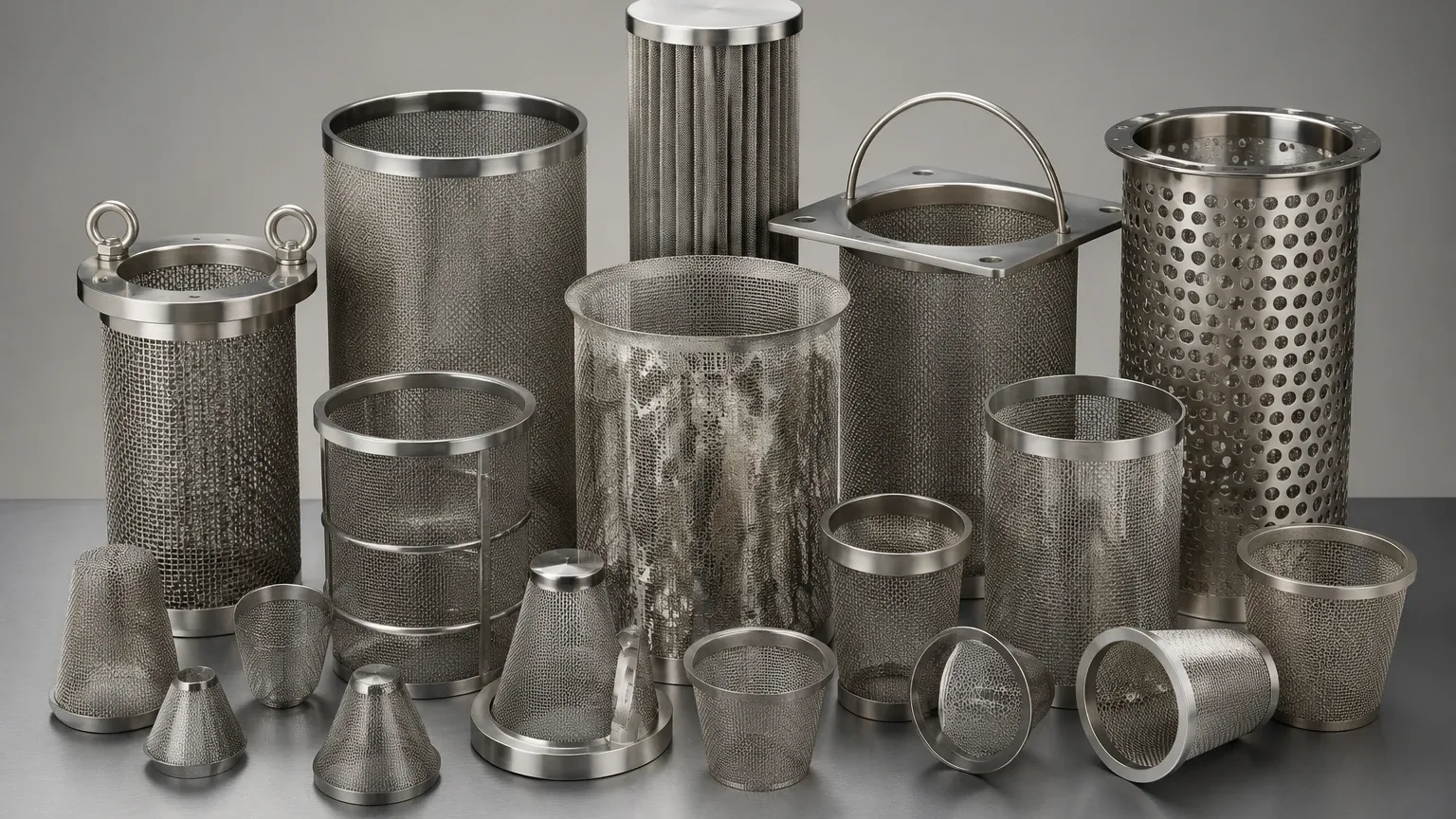
Structural Design of Strainers & Baskets
The physical configuration of the straining element determines how easily it can be maintained and how much debris it can hold. There are several common designs utilized in industrial settings:
Perforated Baskets
These are the most robust straining elements, typically made from heavy-gauge stainless steel sheets with punched holes. They are ideal for high-velocity flows where the primary concern is large debris. They often serve as the structural support (the "cage") for finer wire mesh liners.
Mesh-Lined Baskets
When finer filtration is required, a woven wire mesh is sintered or spot-welded to a perforated metal support. This combination provides the precision of fine mesh with the structural integrity of the perforated plate. These are common in the hydraulic and oil industries where fine particulates can cause significant wear on precision components.
Wedge Wire Elements
Wedge wire, or "V-wire," consists of surface wires that are resistance-welded onto support rods. This design is particularly effective for sticky or fibrous materials because the V-shaped profile of the wire creates a widening gap that minimizes the risk of particles becoming wedged in the openings. It is also highly effective for backwashing systems.
Customization and OEM Solutions
Standard off-the-shelf strainers often fail to meet the specific spatial or performance constraints of complex industrial machinery. This is where custom manufacturing becomes essential. Kaifil provides OEM services that allow engineers to specify exact dimensions, flange types, and reinforcement structures.
Customization options often include:
* Reinforced Handles: For large baskets that collect heavy debris, reinforced lifting handles are necessary for safe manual or mechanical removal.
* Magnetic Inserts: In metalworking or machining applications, magnetic rods can be suspended within the strainer basket to capture fine ferrous particles that might otherwise pass through the mesh.
* Multi-Layer Construction: Sintering multiple layers of mesh together can create a filter element that is exceptionally strong and capable of depth filtration, which is not possible with a single layer of woven wire.
Maintenance and Operational Longevity
The total cost of ownership for metal strainers is determined by their durability and the ease of maintenance. A well-engineered strainer should be easy to access, clean, and reinstall without specialized tools.
Cleaning Protocols
Most industrial metal strainers are designed for manual cleaning. When the differential pressure gauges indicate a clog, the flow is diverted (in duplex systems) or stopped (in simplex systems), and the basket is removed. For stainless steel elements, cleaning can involve ultrasonic baths, high-pressure water jets, or chemical cleaning, depending on the nature of the contaminant.
Preventing Basket Failure
The most common cause of strainer failure is neglecting the cleaning cycle. If the pressure drop becomes too high, the mechanical force of the fluid can cause the basket to deform or "blow out." Specifying a heavy-duty support cage or a thicker perforated base can mitigate this risk in high-pressure systems.
Conclusion: Confirming Requirements Before Purchase
Before finalizing a purchase order for industrial strainers, technical teams should confirm several key details with the manufacturer to ensure the component is fit for purpose:
1. Fluid Compatibility: Is the alloy resistant to the specific chemical composition and temperature of the process fluid?
2. Flow Characteristics: What is the maximum flow rate, and what is the calculated pressure drop at that rate?
3. Debris Loading: How much solid material is expected? This determines the required basket volume and the frequency of cleaning.
4. Seal Integrity: Does the strainer housing require specific gasket materials (e.g., Viton, EPDM, or PTFE) to prevent bypass leakage?
By focusing on these technical benchmarks, engineers can ensure that their choice of metal strainers provides reliable, long-term protection for their industrial infrastructure. For more detailed specifications on custom filtration components, engineers can Review product options and application support to find the optimal solution for their specific operational needs.
