


Monkey Strainers
In the complex landscape of industrial fluid handling, the protection of downstream equipment is a primary engineering concern. Among the various mechanical separation tools utilized to ensure system integrity, monkey strainers—often categorized alongside suction baskets and temporary start-up strainers—play a pivotal role. These components are designed to capture large-scale debris, scale, and foreign particulates that could otherwise cause catastrophic failure in pumps, valves, and heat exchangers.
For engineers and procurement professionals, selecting the correct filtration component requires a deep understanding of fluid dynamics, material compatibility, and the specific mechanical stresses of the application. While the term "monkey strainer" is frequently used colloquially in piping and maintenance sectors, it refers to a robust class of Strainers & Baskets engineered for high-flow, low-pressure-drop environments. This article explores the technical nuances, engineering considerations, and selection criteria essential for integrating these components into industrial systems.
Understanding the Role of Monkey Strainers in Industrial Filtration
Monkey strainers are essentially specialized suction-side filtration elements. Their primary function is "coarse filtration," acting as the first line of defense in a piping system. Unlike fine micron-rated cartridges that target microscopic particles, these strainers are built to handle high-volume flow while trapping larger solids.
In many industrial contexts, monkey strainers are deployed during the commissioning or "start-up" phase of a plant. During construction, piping systems often accumulate welding slag, rust, and construction debris. If a pump is activated without a strainer in place, these materials can lead to impeller damage or seal failure. However, their utility extends beyond start-up; many hydraulic and water treatment systems utilize them as permanent fixtures to protect against intermittent debris ingress.
From an engineering perspective, the placement of a monkey strainer is critical. Positioned on the suction side of a pump, the strainer must offer minimal resistance to flow. Excessive pressure drop (delta P) at the suction inlet can lead to cavitation—a phenomenon where vapor bubbles form and collapse, causing physical erosion of pump components. Therefore, the open area ratio of the strainer is a primary design metric.
Design Variations and Material Selection
The efficacy of monkey strainers depends heavily on their physical construction and the materials used. As a manufacturer specializing in stainless steel solutions, Kaifil emphasizes the importance of selecting alloys that match the chemical and thermal profile of the process fluid.
Material Integrity
Stainless steel is the industry standard for industrial strainers due to its mechanical strength and corrosion resistance.
- Grade 304: Suitable for general-purpose applications, including water treatment and mild chemical environments.
- Grade 316/316L: Preferred for pharmaceutical, food and beverage, and aggressive chemical processing due to its superior resistance to pitting and chloride-induced corrosion.
- Specialty Alloys: In highly corrosive environments or high-temperature steam applications, duplex stainless steels or high-nickel alloys may be required to prevent stress corrosion cracking.
Structural Configurations
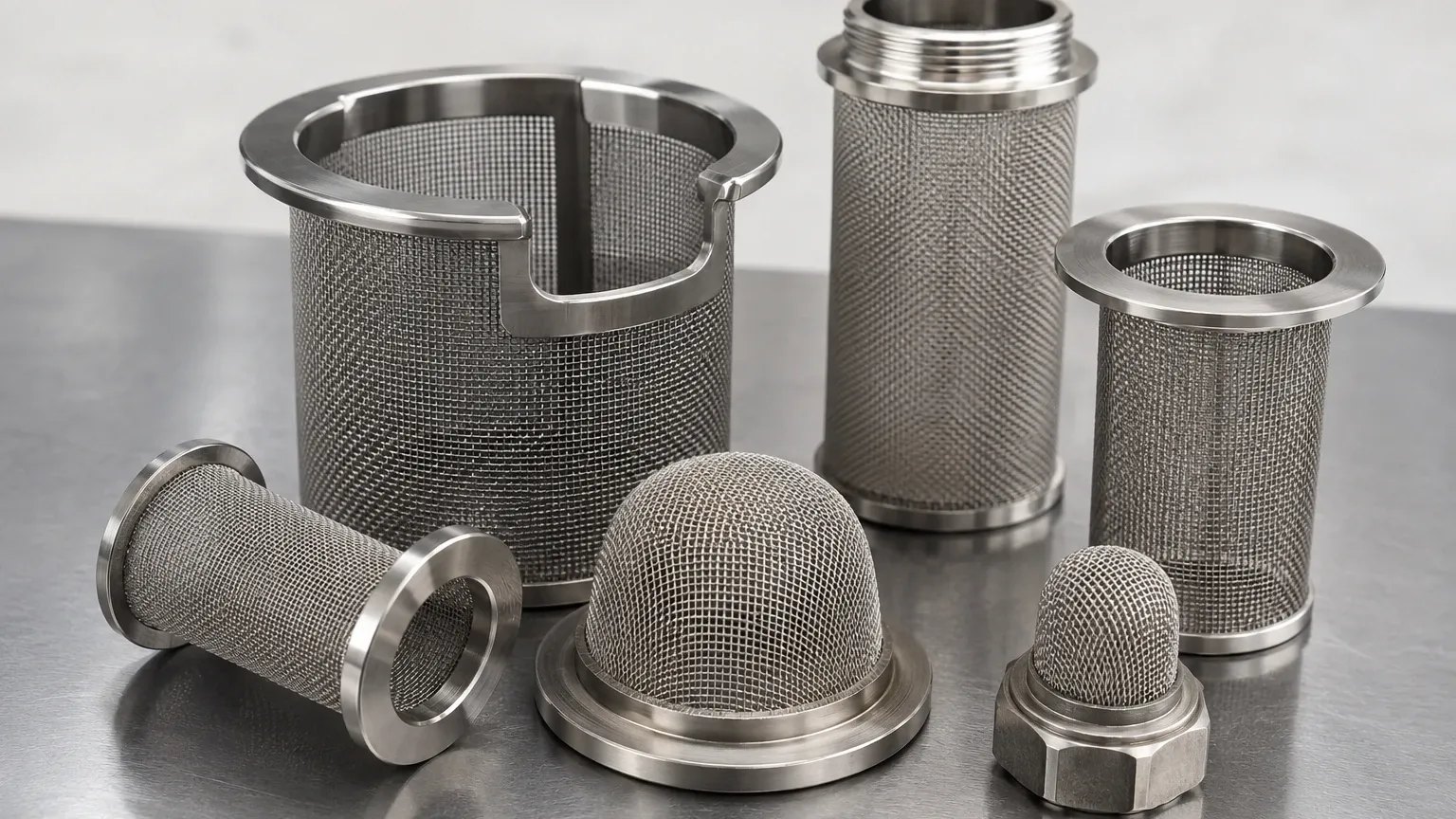
Monkey strainers typically utilize a combination of perforated metal and wire mesh. The perforated metal provides the structural "skeleton," enabling the strainer to withstand the differential pressure across the element. The wire mesh, layered over or inside the perforated core, determines the actual filtration rating.
Common designs include:
- Conical (Witch’s Hat) Strainers: Often used for temporary start-up applications due to their ease of installation between flanges.
- Basket Strainers: Designed for permanent installation, offering a larger surface area and easier cleaning access.
- Flat Plate Strainers: Used in space-constrained environments where only very coarse filtration is required.
Technical Specifications and Performance Metrics
When specifying monkey strainers, engineers must look beyond simple dimensions. The performance of the strainer is dictated by several interlocking technical variables.
Open Area Ratio (OAR)
The OAR is the ratio of the total area of the holes in the strainer to the cross-sectional area of the inlet pipe. A common engineering benchmark is an OAR of 300% to 400%. This ensure that even as the strainer begins to collect debris, there remains enough open path for the fluid to pass through without causing a significant pressure spike or flow restriction.
Filtration Accuracy (Mesh vs. Micron)
While monkey strainers are for coarse filtration, the "mesh size" must be carefully chosen. Using a mesh that is too fine will lead to rapid clogging and frequent maintenance shutdowns. Conversely, a mesh that is too coarse will allow harmful particles to pass through. Engineers must balance the "allowable particle size" of the downstream equipment with the expected contaminant load of the fluid.
Pressure Drop Calculations
Manufacturers provide flow coefficient (Cv) values for their strainers. Using these values, engineers can calculate the expected pressure drop at various flow velocities. It is essential to account for the viscosity of the fluid; high-viscosity oils will experience a much higher pressure drop through the same mesh size than water will.
Customization for Specific Industrial Applications
Off-the-shelf solutions rarely meet the exacting needs of specialized industrial processes. Customization is often required to address unique flow patterns, mounting requirements, or environmental constraints.
Chemical and Petrochemical Processing
In these sectors, monkey strainers must often comply with ASME B31.3 piping codes. Custom-fabricated strainers can include reinforced handles for easy removal, specialized gaskets for chemical compatibility, and heavy-duty mesh to withstand high-velocity turbulent flow common in refinery bypass lines.
Food and Beverage Compliance
For applications involving consumable products, the strainers must meet sanitary standards (such as 3-A or EHEDG). This involves utilizing 316L stainless steel with specific surface finishes (Ra values) to prevent bacterial growth and ensure that the component can withstand Clean-in-Place (CIP) cycles.
Hydraulic and Cooling Systems
In large-scale hydraulic power units, monkey strainers protect the reservoir return lines. Customizing the basket depth and diameter allows for maximum filtration area within the constraints of the reservoir tank, extending the service life of finer downstream filters.
Installation and Maintenance Best Practices
The longevity and effectiveness of monkey strainers are significantly influenced by how they are installed and maintained. Even the highest quality stainless steel component can fail if subjected to improper mechanical stress.
Proper Orientation
For basket-style monkey strainers, the flow direction is typically from the inside to the out. This ensures that debris is captured within the basket, making it easier to remove during cleaning. If installed in reverse, debris can become trapped between the strainer and the housing, making maintenance difficult and potentially damaging the mesh.
Monitoring Differential Pressure
The most effective way to manage maintenance is through the use of differential pressure gauges. By monitoring the pressure drop across the strainer, operators can identify exactly when the basket is reaching its holding capacity. Cleaning should be performed before the pressure drop reaches a critical threshold that could compromise flow or damage the strainer structure.
Cleaning Protocols
Stainless steel strainers are designed for reuse. Cleaning typically involves high-pressure water washing or ultrasonic cleaning, depending on the nature of the contaminant. It is vital to inspect the mesh for signs of "blinding" (where particles become permanently lodged in the mesh) or mechanical tearing. A compromised mesh effectively renders the strainer useless, as it allows a bypass path for debris.
Evaluating Total Cost of Ownership (TCO) and Procurement
For procurement teams, the initial purchase price of a monkey strainer is only one component of the total cost. A low-cost, poorly manufactured strainer can lead to significantly higher costs in the form of pump repairs, unplanned downtime, and frequent replacements.
Durability vs. Initial Cost
A high-quality stainless steel strainer from an experienced manufacturer like Kaifil offers a longer service life and better resistance to mechanical fatigue. When evaluating quotes, technical professionals should confirm the gauge of the metal, the quality of the welds (TIG welding is preferred for filtration components), and the origin of the raw materials.
OEM and Technical Support
Working with an OEM (Original Equipment Manufacturer) allows for direct communication regarding technical requirements. Engineers should confirm that the supplier can provide material test reports (MTRs), pressure test certifications, and detailed CAD drawings. This documentation is essential for quality assurance and future maintenance planning.
Lead Times and Customization Flexibility
In maintenance and repair (MRO) situations, lead time is often the most critical factor. However, for new projects, the ability to customize the design to fit specific piping layouts can save thousands of dollars in installation labor. Selecting a partner who combines manufacturing speed with engineering depth ensures that the final product meets both the timeline and the technical specifications of the project.
Conclusion
Monkey strainers are indispensable components in the preservation of industrial infrastructure. By understanding the engineering principles behind their design—from open area ratios to material selection—professionals can ensure their systems operate efficiently and without interruption. Whether utilized as a temporary safeguard during plant start-up or as a permanent fixture in a hydraulic circuit, these Strainers & Baskets provide the essential mechanical separation required to protect high-value downstream assets. When selecting a filtration partner, focusing on technical expertise, material quality, and customization capabilities will yield the best long-term results for any industrial application.
