


Nylon Mesh Strainers
In the landscape of industrial filtration, the selection of the correct filter media is a critical decision that impacts process efficiency, product purity, and equipment longevity. While stainless steel is often the default choice for high-pressure and high-temperature environments, nylon mesh strainers represent a vital category of synthetic filtration solutions. These components are widely utilized across the chemical, food and beverage, and water treatment industries due to their unique physical properties, cost-effectiveness, and precise filtration capabilities.
Nylon, a synthetic polymer known as polyamide (PA), offers a combination of mechanical strength and chemical stability that makes it an ideal candidate for specific straining applications. Understanding the technical nuances of nylon mesh—ranging from its weave patterns to its thermal limits—is essential for engineers and procurement teams tasked with optimizing filtration systems. This guide examines the engineering considerations, application advantages, and selection criteria for nylon mesh strainers within the broader context of industrial Strainers & Baskets.
Technical Characteristics of Nylon Mesh
Nylon mesh strainers are typically constructed from monofilament or multifilament yarns. In industrial settings, monofilament nylon is generally preferred due to its high precision and consistent pore size. Because each strand is a single, solid filament, the mesh maintains a smooth surface that reduces the likelihood of particle entrapment within the fibers themselves, facilitating easier cleaning and more predictable flow rates.
Chemical and Thermal Stability
One of the primary reasons engineers specify nylon is its excellent resistance to alkaline environments. Unlike some metals that may corrode or other synthetics that degrade in high-pH conditions, nylon remains stable. However, it is sensitive to strong acids and oxidizing agents, which can weaken the polymer chains over time. From a thermal perspective, nylon mesh typically operates effectively at temperatures up to 100°C (212°F) to 120°C (248°F), depending on the specific grade and the duration of exposure. Beyond these limits, the material may lose its dimensional stability or begin to soften, which can lead to pore deformation and a loss of filtration accuracy.
Mechanical Properties
Nylon is characterized by high tensile strength and excellent abrasion resistance. It possesses a degree of elasticity that allows it to withstand hydraulic surges better than more brittle materials. This flexibility is particularly useful in basket strainers where the mesh may be subjected to fluctuating pressures. However, this same elasticity means that nylon mesh often requires a rigid support structure—such as a perforated stainless steel basket—to prevent the mesh from distending under high differential pressure ($ΔP$).
Design and Construction of Nylon Strainers
The performance of a nylon mesh strainer is not solely dependent on the material but also on the weave geometry and the integration into the housing. Most industrial nylon strainers utilize a plain weave or a twill weave pattern.
Weave Patterns and Open Area
* Plain Weave: This is the most common construction, where each warp thread crosses over and under each weft thread. It provides the most accurate pore sizes and is used for fine filtration.
* Twill Weave: In this pattern, threads cross over two or more threads, allowing for a heavier mesh that can support higher loads, though often at the cost of slightly less precise aperture control.
The "Open Area" is a critical metric for engineers. It refers to the percentage of the total surface area that consists of openings. A higher open area results in a lower initial pressure drop and higher flow capacity. However, a high open area often means thinner filaments, which can reduce the mechanical durability of the strainer. Balancing these factors is a key part of the design process for custom Strainers & Baskets.
Integration with Metal Components
In many B2B industrial applications, nylon mesh is not used as a standalone structural component. Instead, it is integrated into a metal frame or used as a liner within a stainless steel basket. This hybrid approach combines the chemical specificities and precision of nylon with the structural integrity of stainless steel. Common methods for joining nylon mesh to metal frames include ultrasonic welding, over-molding, or mechanical clamping, ensuring a leak-proof seal that prevents fluid bypass.
Engineering Considerations for Selection
When selecting nylon mesh strainers for an industrial process, engineers must evaluate several variables to ensure the component meets the required performance specifications.
Micron Rating and Filtration Efficiency
Nylon mesh is available in a wide range of micron ratings, often from as large as 1000 microns down to as fine as 5 microns. Because the filaments are manufactured to tight tolerances, the aperture size is highly consistent. When specifying a micron rating, it is important to distinguish between nominal and absolute filtration. Nylon monofilament mesh typically provides near-absolute filtration for particles larger than the pore size, making it excellent for removing specific contaminants from a process stream.
Flow Rate and Pressure Drop
The flow rate through a strainer is influenced by the viscosity of the fluid, the percentage of open area, and the accumulated cake of solids on the mesh surface. Engineers use the $C_v$ (flow coefficient) to calculate the expected pressure drop across the strainer. It is vital to size the strainer so that the initial pressure drop is minimized, providing a sufficient "dirt-holding capacity" before the system requires cleaning or the mesh needs replacement.
Compatibility with Process Fluids
Before finalizing a nylon mesh specification, a thorough chemical compatibility check is mandatory. While nylon is excellent for oils, fuels, and many organic solvents, it can absorb water (hydroscopic), which may lead to slight swelling and changes in pore size in aqueous applications. If dimensional stability in water is a critical requirement, engineers might consider alternative synthetics or specialized stainless steel meshes.
Applications in Key Industries
Nylon mesh strainers are versatile components found in numerous sectors where precision and material compatibility are paramount.
Food and Beverage Processing
In the food industry, nylon is frequently used because it can be manufactured to meet FDA and EU food-contact regulations. It is used for straining juices, honey, and dairy products. The smooth surface of the monofilament nylon prevents bacteria from harboring in the fibers, and the mesh can be easily sanitized using standard CIP (Clean-in-Place) chemicals, provided they are compatible with the polymer.
Chemical and Petrochemical Sectors
Nylon's resistance to hydrocarbons makes it a staple in the filtration of fuels, lubricants, and various solvents. In these applications, nylon strainers are often used as pre-filters to protect downstream precision instruments or high-pressure pumps from particulate damage. They are also used in the production of paints and coatings, where they remove agglomerates and impurities to ensure a smooth finish.
Water Treatment and Irrigation
In large-scale water treatment, nylon mesh is often used in the initial stages of filtration to remove sand, algae, and organic debris. Its resistance to the alkaline nature of many hard water sources makes it more durable than certain metallic options that might suffer from localized pitting or galvanic corrosion in saline environments.
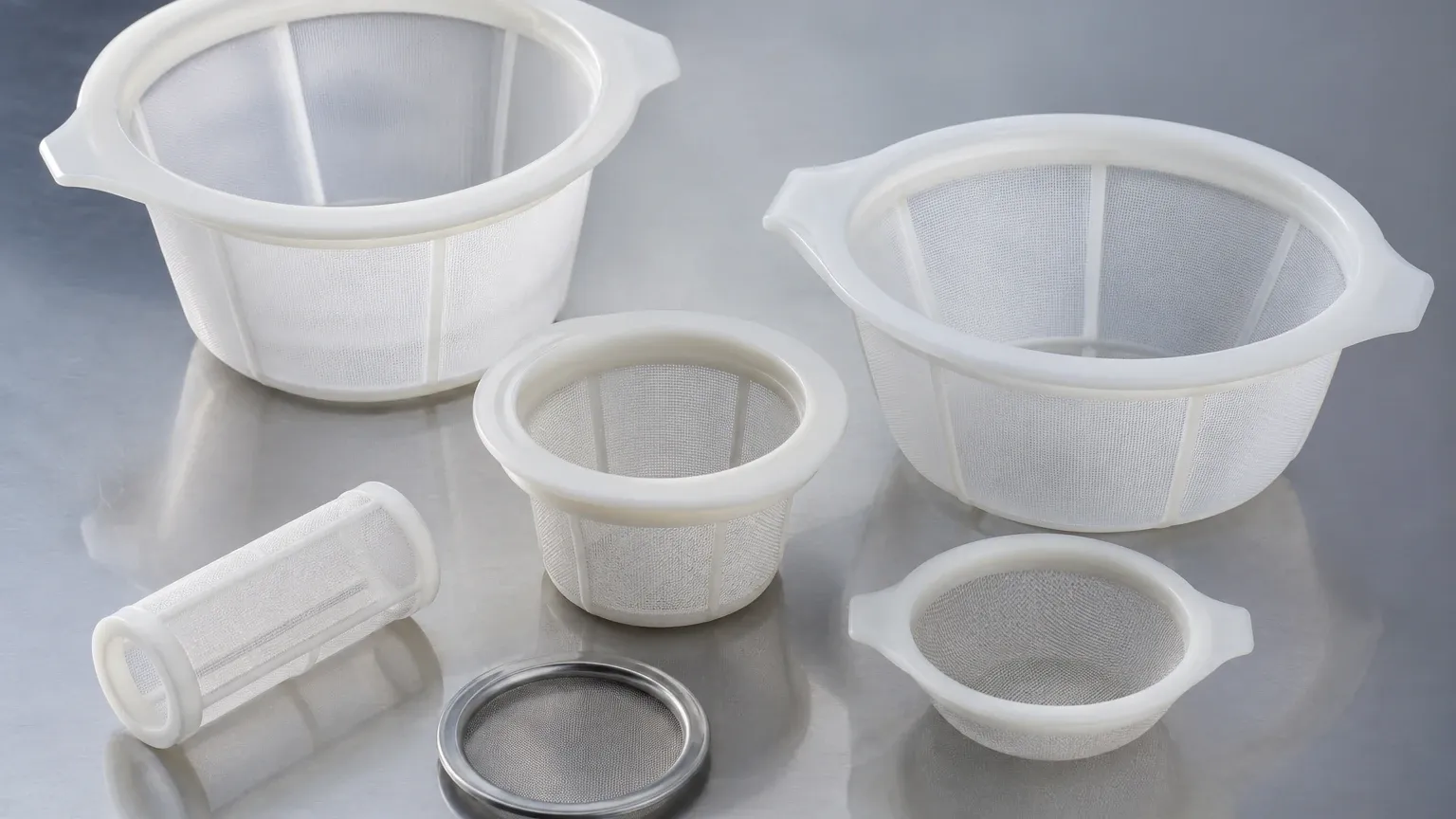
Comparison: Nylon vs. Stainless Steel Strainers
While Kaifil specializes in high-performance stainless steel solutions, it is important to understand when nylon is a viable or even superior alternative to metal mesh within Strainers & Baskets.
1. Weight and Handling: Nylon is significantly lighter than stainless steel. For large basket strainers that require frequent manual removal for cleaning, the reduced weight of a nylon-lined basket can improve workplace safety and ease of maintenance.
2. Cost-Effectiveness: For applications where the temperature and pressure are moderate, nylon mesh offers a lower capital expenditure compared to high-grade stainless steel (like 316L) or exotic alloys (like Monel or Hastelloy).
3. Corrosion Resistance: In environments involving high concentrations of chlorides or certain salts, even stainless steel can succumb to stress corrosion cracking. Nylon is entirely immune to these types of metallic corrosion.
4. Flexibility vs. Rigidity: Stainless steel is rigid and maintains its shape under extreme pressure. Nylon is flexible, which can be an advantage in absorbing vibrations but a disadvantage if the mesh is not properly supported, leading to "ballooning" and potential rupture.
Maintenance and Replacement Cycles
To maintain the efficiency of an industrial filtration system, a structured maintenance schedule is required. Nylon mesh strainers, while durable, have different wear characteristics than metal filters.
Cleaning Procedures
Nylon mesh should be cleaned using soft brushes or low-pressure spray systems. Abrasive cleaning tools or high-pressure power washers can fray the filaments or distort the weave, effectively changing the micron rating of the filter. If the strainer is used for hazardous chemicals, the cleaning process must also account for the potential of the polymer to retain trace amounts of the fluid due to its slight porosity.
Indicators for Replacement
The primary indicator for replacement is a persistent high pressure drop even after cleaning. This usually indicates that fine particles have become deeply embedded in the mesh (blinding) or that the material has undergone thermal or chemical degradation. In high-stakes industrial environments, it is often more cost-effective to replace a nylon mesh liner periodically than to risk a process failure or downstream contamination.
Conclusion: Selecting the Right Solution
Choosing between various types of Strainers & Baskets involves a complex evaluation of the operating environment, the nature of the contaminants, and the desired purity levels. Nylon mesh strainers provide a highly precise, chemically specific, and cost-effective solution for a wide range of B2B applications, particularly where alkaline resistance and food-grade compliance are necessary.
For engineers and procurement professionals, the key is to partner with a manufacturer that understands these technical boundaries. Whether a process requires the extreme durability of custom-engineered stainless steel or the specific advantages of synthetic mesh integration, selecting the right filtration component is the foundation of operational excellence. By considering micron ratings, flow dynamics, and material compatibility, organizations can ensure their filtration systems deliver consistent performance and long-term value.
