


Over the Sink Dish Strainers
In professional environments ranging from commercial kitchens and food processing facilities to laboratory cleanrooms and industrial parts-washing stations, the management of solid waste and fluid flow is a critical operational requirement. While the term "over the sink dish strainers" often evokes domestic imagery, the industrial application of these components involves sophisticated engineering, precise material selection, and rigorous manufacturing standards. For engineers and facility managers, selecting the right Strainers & Baskets is not merely about convenience; it is about protecting downstream plumbing, ensuring hygiene compliance, and optimizing workflow efficiency.
Industrial-grade over the sink dish strainers serve as the first line of defense in manual washing and rinsing processes. Unlike consumer-grade alternatives, these components must withstand constant exposure to corrosive cleaning agents, high-temperature water, and heavy mechanical loads. This guide explores the technical specifications, engineering considerations, and selection criteria for professional-grade straining solutions.
Engineering Foundations of Industrial Strainers
The primary function of an over the sink strainer in a B2B context is the separation of solids from liquid effluent. This process, while seemingly simple, requires a deep understanding of fluid dynamics and material science to ensure the component does not become a bottleneck in the production or cleaning line.
Material Selection: Beyond Basic Stainless Steel
In industrial applications, the choice of material is paramount. While many retail products use low-grade alloys or plated metals, professional Strainers & Baskets are typically constructed from high-quality stainless steel, such as Type 304 or Type 316L.
* Type 304 Stainless Steel: This is the standard for most food service and general industrial applications. It offers excellent corrosion resistance to most oxidizing acids and is highly durable for daily use.
* Type 316L Stainless Steel: For environments involving high salt concentrations (brine), heavy chlorides, or aggressive chemical cleaners, 316L is preferred. The addition of molybdenum provides superior pitting resistance, making it essential for pharmaceutical and marine-adjacent food processing.
Structural Integrity and Load Bearing
Industrial over the sink dish strainers are often required to hold heavy loads, such as large metal components, heavy-duty cookware, or bulk quantities of processed ingredients. Engineering these baskets involves calculating the wire diameter and the reinforcement of the frame. A professional strainer typically features a heavy-gauge perimeter wire and cross-bracing to prevent sagging or deformation under load. TIG (Tungsten Inert Gas) welding or advanced spot welding techniques are used to ensure that the mesh remains securely bonded to the frame, even under thermal cycling.
Filtration Performance and Mesh Specifications
The efficiency of a strainer is defined by its ability to capture specific particle sizes while maintaining a high flow rate. In the design of over the sink dish strainers, two main factors dictate performance: the micron rating (or mesh count) and the percentage of open area.
Micron Rating and Mesh Count
For general dishwashing and rinsing, a coarser mesh (e.g., 10 to 20 mesh) is often sufficient to capture food debris or large metal shavings. However, in laboratory or precision manufacturing settings, a much finer mesh may be required to prevent microscopic contaminants from entering the drainage system. Engineers must specify the target particle size to be retained to select the appropriate weave.
Open Area and Flow Rates
The "open area" refers to the ratio of the area of the holes to the total area of the mesh. A higher open area results in faster drainage, which is critical in high-volume environments. However, increasing the open area often requires using thinner wires, which can compromise the structural strength of the basket. Industrial manufacturers like Kaifil balance these requirements by using high-tensile strength wire that allows for a greater open area without sacrificing the durability of the Strainers & Baskets.
Design Variations for Professional Applications
Not all sinks are created equal, and industrial workstations often feature non-standard dimensions. Customization is a key differentiator in the B2B market for over the sink dish strainers.
Adjustable and Fixed-Frame Designs
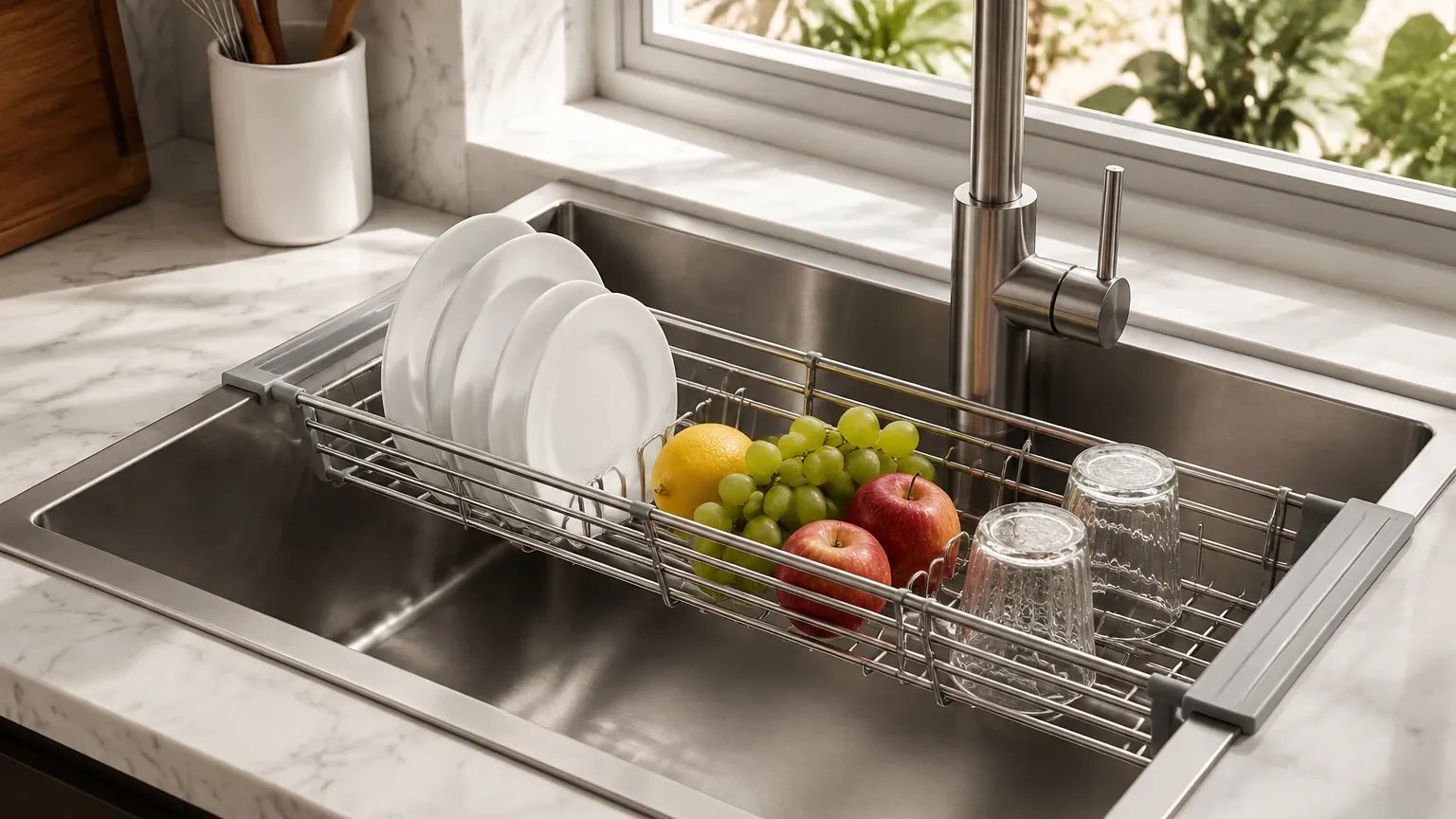
While adjustable "one-size-fits-all" strainers are common in retail, they often possess mechanical weak points at the sliding joints. In a high-intensity industrial environment, fixed-frame strainers custom-sized to the specific sink dimensions are generally preferred. This eliminates moving parts that can trap bacteria or fail under mechanical stress.
Handle and Support Configurations
The ergonomics of the strainer are vital for worker safety and efficiency. Industrial designs may include:
* Rubber-Coated Grips: To prevent the strainer from slipping on wet stainless steel surfaces.
* Extended Flanges: To allow the strainer to sit securely across deep-well industrial sinks.
* Integrated Feet: Allowing the basket to be placed on a flat surface (like a countertop) without the mesh touching the ground, which is essential for maintaining hygiene standards.
Perforated Metal vs. Wire Mesh
Depending on the application, a strainer may use perforated metal sheets or woven wire mesh. Perforated metal is generally easier to clean and offers higher rigidity, making it ideal for heavy parts. Wire mesh, conversely, offers a much higher open area and is better suited for rapid drainage and fine particle retention.
Industry-Specific Applications
The requirements for over the sink dish strainers vary significantly across different sectors. Understanding these nuances is essential for procurement teams.
Food and Beverage Processing
In this sector, hygiene is the top priority. Strainers must be designed with "clean-in-place" (CIP) principles in mind, meaning they should lack sharp internal corners or crevices where organic matter can accumulate. Electrolytic polishing is often applied to the stainless steel to create a microscopically smooth surface that resists bacterial adhesion and simplifies the sanitization process.
Pharmaceutical and Laboratory Settings
In labs, strainers are often used for rinsing delicate glassware or straining chemical precipitates. These units must be compatible with autoclaving (high-pressure steam sterilization). The use of 316L stainless steel is standard here to prevent any metallic contamination of sensitive samples.
Industrial Parts Washing
In automotive or aerospace manufacturing, over the sink strainers are used to rinse machined parts. These baskets must be resistant to oils, coolants, and solvents. The mechanical design must account for the high density of metal parts, often requiring reinforced mesh and heavy-duty handles.
Maintenance, Longevity, and Total Cost of Ownership
When evaluating Strainers & Baskets for purchase, engineers should look beyond the initial unit price and consider the Total Cost of Ownership (TCO). A low-cost strainer that requires replacement every few months due to corrosion or broken welds is significantly more expensive over time than a high-quality industrial component.
Cleaning and Sanitization
To extend the life of an industrial strainer, a regular cleaning schedule is necessary. In food service, this involves daily degreasing and sanitizing. In industrial settings, it may involve ultrasonic cleaning to remove embedded particles from the mesh. Because Kaifil utilizes high-grade stainless steel, these components can withstand aggressive cleaning cycles without losing structural integrity.
Replacement Cycles
Even the most durable industrial strainer will eventually show signs of wear. Common indicators that a replacement is needed include:
* Frayed Wire Mesh: Broken wires can become a safety hazard for workers and can contaminate the products being rinsed.
* Permanent Deformation: If the frame is bent, it may no longer sit securely over the sink, leading to potential spills or accidents.
* Crevice Corrosion: If the welds begin to show signs of rust, the structural integrity of the basket is compromised, and it may no longer meet hygiene standards.
Selection Criteria for Purchasing Teams
Before placing an order for over the sink dish strainers, technical professionals should confirm the following specifications with their supplier:
1. Exact Dimensions: Measure the inner and outer lip of the sink to ensure a flush fit.
2. Material Grade: Specify 304 for general use or 316L for corrosive environments.
3. Load Requirements: Estimate the maximum weight the basket will hold during a single cycle.
4. Mesh/Perforation Size: Define the smallest particle that needs to be captured.
5. Compliance Standards: Ensure the product meets relevant FDA, NSF, or ISO standards for your specific industry.
Conclusion
Over the sink dish strainers are vital components in the fluid management and sanitation infrastructure of any professional facility. By moving away from consumer-grade products and investing in engineered Strainers & Baskets, businesses can ensure higher levels of hygiene, better protection for their plumbing systems, and a more efficient workflow.
Kaifil’s expertise in custom stainless steel filtration allows for the production of strainers that meet the most demanding industrial specifications. Whether you require a standard configuration for a commercial kitchen or a highly specialized, reinforced basket for an industrial parts-washing line, focusing on material quality, structural engineering, and precise filtration performance is the key to long-term operational success.
