


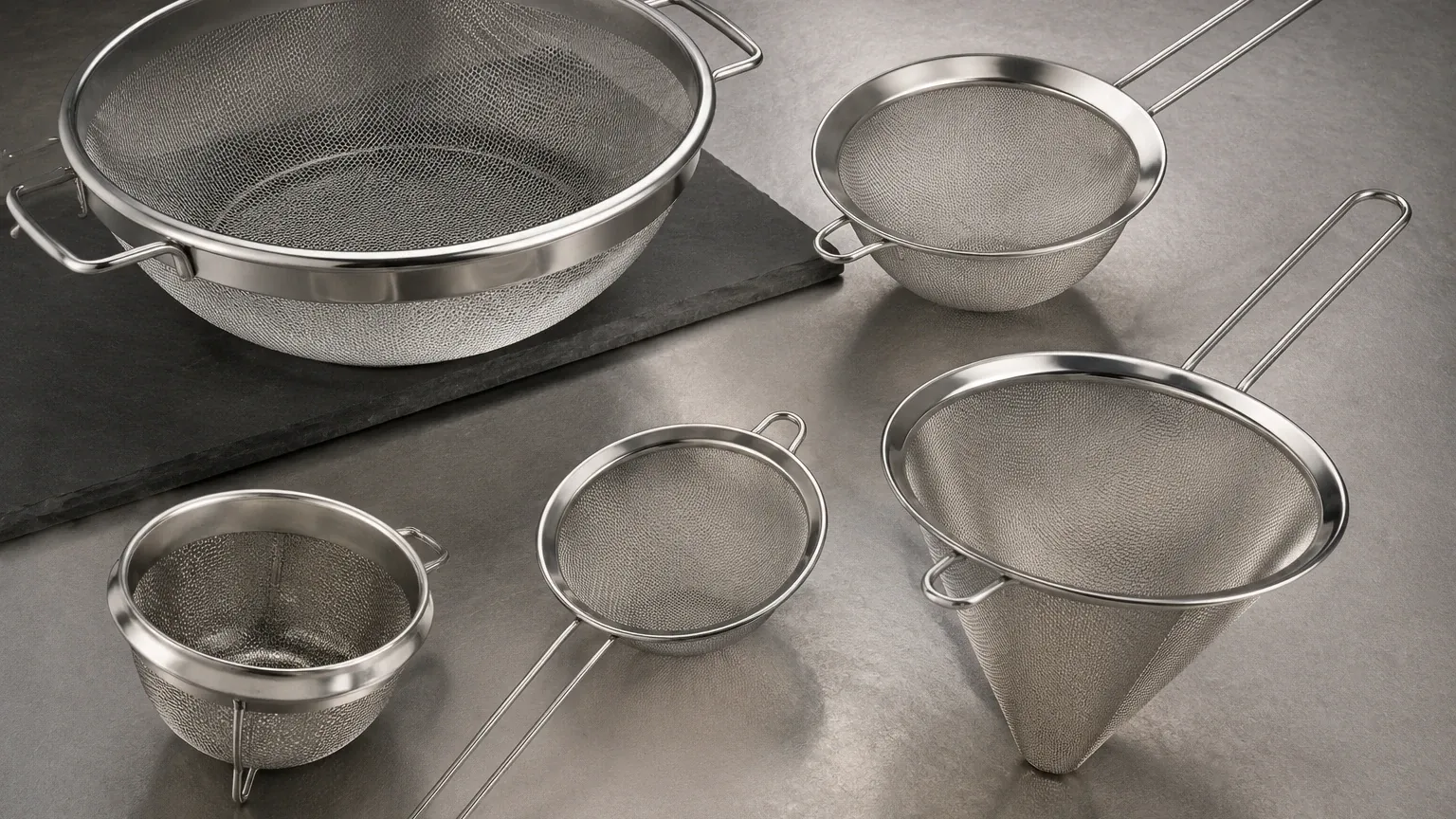
Rosle Strainers
In both commercial culinary environments and precision industrial processing, the efficiency of liquid-solid separation depends heavily on the quality of the filtration media. While many technical professionals are familiar with the high standards set by Rosle strainers in the professional kitchen and light commercial sectors, the transition to heavy industrial applications requires a deeper understanding of engineering specifications. Selecting the right stainless steel filtration component involves evaluating material grades, mesh geometry, and structural reinforcement to ensure long-term reliability under pressure.
For engineers and procurement teams, the choice between a standardized commercial strainer and a custom-engineered industrial solution is often dictated by the specific demands of the fluid dynamics, chemical compatibility, and the required micron rating. Understanding the technical nuances of these components is essential for optimizing process flow and protecting downstream equipment.
The Engineering Behind High-Quality Stainless Steel Strainers
High-performance strainers, such as those produced by Rosle, are recognized for their use of 18/10 stainless steel and robust construction. In a B2B context, the "18/10" designation refers to a composition of 18% chromium and 10% nickel, which provides excellent corrosion resistance and structural rigidity. However, in industrial filtration, these specifications are often translated into AISI 304 or 316L standards.
When evaluating Strainers & Baskets, technical buyers must look beyond surface aesthetics. The integrity of the bond between the wire mesh and the support frame is critical. In industrial settings, high-frequency welding or plasma welding is preferred over standard mechanical crimping to prevent bypass and ensure the unit can withstand the mechanical stresses of high-flow environments. The precision of the aperture (the opening size in the mesh) must be consistent across the entire surface area to maintain the integrity of the filtration process.
Comparing Commercial Standards and Industrial Requirements
While Rosle strainers are designed for manual use and durability in food preparation, industrial-grade baskets are engineered for integration into pressurized piping systems or large-scale tanks. The primary differences lie in the following areas:
* Pressure Thresholds: Commercial strainers are rarely subjected to significant differential pressure (Delta P). In contrast, industrial baskets must be designed to resist collapse or deformation when solids accumulate and pressure builds up.
* Filtration Accuracy: Commercial tools typically utilize a standard fine mesh. Industrial solutions offer a spectrum of filtration degrees, ranging from coarse perforated metal (measured in millimeters) to ultra-fine Dutch weave wire cloth (measured in microns).
* Flow Capacity: Industrial baskets are often designed with a specific Effective Filtration Area (EFA) to minimize pressure drop. This involves calculating the ratio of the open area of the mesh to the total surface area of the basket.
For applications involving chemical processing or high-temperature steam, the material requirements often exceed the capabilities of standard commercial alloys, necessitating the use of 316L stainless steel or Hastelloy for superior pitting resistance.
Technical Specifications of Industrial Strainers & Baskets
When specifying filtration components for industrial use, engineers must define several critical parameters to ensure the component performs as expected within the system. These specifications go far beyond what is typically listed for consumer-facing products like Rosle strainers.
Mesh Weave and Aperture Precision
The type of weave determines both the strength and the filtration characteristics of the basket. Plain weave is common for general-purpose straining, providing a high open area. For finer filtration and higher mechanical strength, Twill or Dutch weaves are utilized. The wire diameter is also a critical factor; thicker wires increase the lifespan of the basket but reduce the total open area, which can lead to higher initial pressure drops.
Structural Reinforcement
Unlike manual strainers, industrial baskets often feature a multi-layer construction. This may include a fine inner mesh for filtration, supported by a coarser middle mesh, and an outer perforated metal cylinder for structural rigidity. This "sandwich" construction allows the unit to handle high-viscosity fluids and backwashing cycles without losing its shape.
Connection and Sealing Interfaces
Industrial filtration units must integrate seamlessly with housing units. This requires precision-machined flanges, O-ring grooves, or specialized handle designs that ensure a tight seal. Any leakage around the edges of the strainer—known as bypass—can compromise the entire downstream process, leading to contamination or equipment damage.
Material Selection for Demanding Environments
Stainless steel is the material of choice for both Rosle strainers and industrial filtration components due to its hygienic properties and resistance to oxidation. However, the specific grade of stainless steel must be matched to the operating environment.
1. AISI 304: Suitable for most food and beverage applications and general water treatment where the environment is not highly corrosive.
2. AISI 316/316L: Contains molybdenum, which provides enhanced resistance to chlorides and acids. This is the standard for pharmaceutical, chemical, and marine applications.
3. Specialty Alloys: In extreme cases involving highly aggressive chemicals or temperatures exceeding 500°C, materials like Monel or Inconel may be required.
Surface finish is another technical consideration. While a polished finish on a Rosle strainer is primarily for ease of cleaning and aesthetics, in a pharmaceutical or biotech environment, an electropolished surface is often required to reduce the risk of bacterial growth and to ensure that the component can be fully sterilized via CIP (Clean-in-Place) protocols.
Customization and OEM Capabilities in B2B Filtration
One of the limitations of off-the-shelf products, including high-end commercial strainers, is the lack of dimensional flexibility. Industrial applications frequently require bespoke designs to fit existing housings or to meet unique flow requirements.
Custom manufacturing allows for the adjustment of every variable, from the height and diameter of the basket to the specific mesh count and the addition of magnetic inserts for capturing ferrous particles. For OEM manufacturers, the ability to source consistent, high-quality Strainers & Baskets that meet exact engineering drawings is vital for maintaining the performance of their own machinery.
When working with a professional manufacturer, engineers can request prototypes and technical drawings to verify fitment and flow calculations before proceeding to full-scale production. This collaborative approach ensures that the filtration component is an asset to the system rather than a bottleneck.
Maintenance and Lifecycle Considerations
The total cost of ownership for a filtration component is determined by its durability and ease of maintenance. While a Rosle strainer is designed for a long life in a kitchen, industrial baskets are subject to much harsher conditions, including abrasive particles and chemical cleaning agents.
Cleaning Protocols
Industrial baskets are often designed for reuse. Depending on the type of contaminant, cleaning may involve ultrasonic baths, high-pressure water jets, or chemical dissolution. The mesh must be robust enough to withstand these cleaning processes without tearing or enlarging the apertures.
Replacement Cycles
Predicting the replacement cycle is essential for maintenance planning. Factors that influence the lifespan of a strainer include the concentration of solids in the feed, the frequency of cleaning, and the presence of corrosive elements. By monitoring the pressure differential across the strainer, operators can determine the optimal time for cleaning or replacement, preventing catastrophic failure of the mesh.
Conclusion for Technical Buyers
Whether you are sourcing high-quality tools for a commercial kitchen or precision components for a chemical refinery, the principles of quality stainless steel construction remain the same. However, the transition to industrial-scale operations demands a rigorous focus on engineering data, material certifications, and structural integrity.
While Rosle strainers represent a pinnacle of commercial design, industrial Strainers & Baskets provide the specialized performance required for complex fluid handling systems. By understanding the technical requirements of your specific application—from micron ratings to alloy selection—you can ensure that your filtration solution provides reliable, cost-effective performance throughout its service life.
