


Sieves and Strainers
In industrial fluid handling and solids processing, the terms sieves and strainers are often used interchangeably, yet they represent distinct engineering approaches to mechanical separation. For engineers and procurement specialists, understanding the nuances between these components is critical for optimizing process efficiency, protecting downstream equipment, and ensuring product purity. Whether the application involves removing oversized particulates from a chemical batch or protecting a high-pressure pump from debris, the selection of the correct filtration media determines the long-term reliability of the system.
Industrial filtration relies on the principle of size exclusion. By utilizing stainless steel wire mesh, perforated plate, or wedge wire, sieves and strainers act as a physical barrier to contaminants. This guide explores the technical considerations, material science, and design parameters necessary for selecting high-performance filtration components in demanding B2B environments.
Defining Sieves and Strainers in Industrial Systems
While both components perform the task of separating solids from fluids (or solids from other solids), their mechanical implementation typically differs based on the state of the media and the system pressure.
Industrial Sieves
Sieves are primarily associated with the classification of dry bulk solids or the batch filtration of liquids under gravity or low-pressure conditions. In a processing line, a sieve is often used to ensure particle size uniformity. In liquid applications, sieving might occur at the point of discharge to catch any incidental agglomerates before packaging. Technical sieving often requires high precision in the mesh opening to meet strict quality control standards, such as those found in the pharmaceutical or powder metallurgy industries.
Industrial Strainers
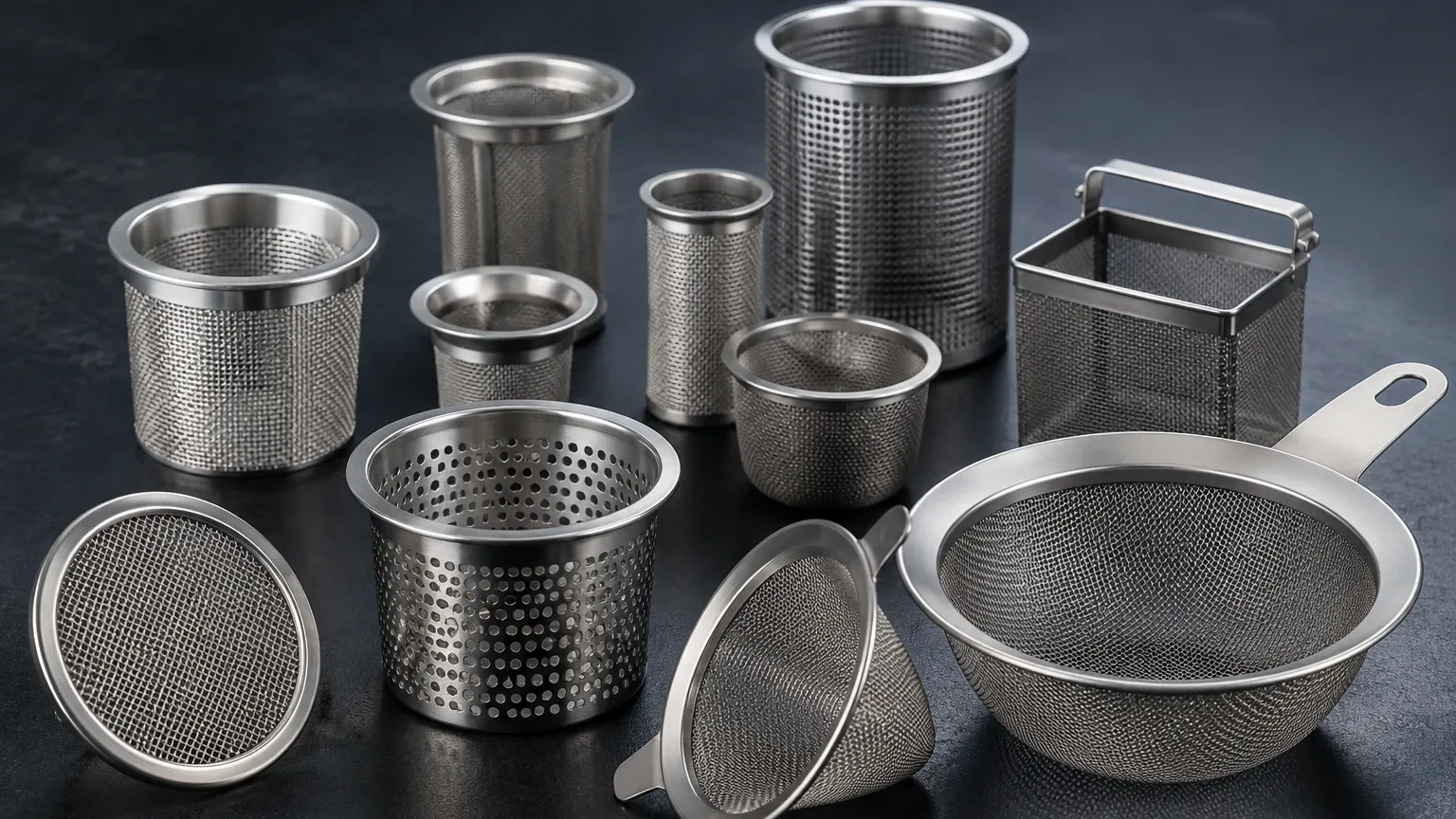
Strainers are engineered for integration into pressurized piping systems. Their primary function is "sacrificial" or protective—removing relatively large particles that could damage valves, pumps, or spray nozzles. Unlike a fine filter, which may target sub-micron particles and require frequent replacement, a strainer is designed for high flow rates with minimal pressure drop. Common configurations include Y-strainers, T-strainers, and Strainers & Baskets designed for heavy-duty industrial service.
Material Engineering: Why Stainless Steel Dominates
The choice of material for sieves and strainers is dictated by the chemical compatibility of the process fluid, the operating temperature, and the required mechanical strength. Stainless steel is the industry standard due to its versatility and durability.
1. Grade 304 Stainless Steel: The most common grade, offering excellent strength and basic corrosion resistance. It is suitable for water treatment, food processing, and general industrial applications where highly corrosive chemicals are not present.
2. Grade 316/316L Stainless Steel: Contains molybdenum, which provides superior resistance to chlorides and acids. The "L" (low carbon) version is preferred for welded components to prevent intergranular corrosion. This is the standard for pharmaceutical and marine environments.
3. Specialty Alloys: For extreme environments involving high-concentration acids or high temperatures, alloys like Monel, Hastelloy, or Duplex stainless steel may be utilized to prevent premature failure of the mesh or housing.
Mechanical Design and Construction
The performance of sieves and strainers is not merely a function of the material, but of the structural design of the filtration element. Industrial applications often require a multi-layered approach to balance filtration fineness with structural integrity.
Mesh Selection
Wire mesh is defined by its weave type and mesh count.
* Plain Weave: The simplest and most common, where wires cross over and under each other. It provides a high open area.
* Dutch Weave: Uses heavier warp wires and finer shute wires, resulting in a dense, strong mesh capable of finer filtration and higher pressure resistance.
* Twill Weave: Allows for heavier wires in a given mesh count, increasing the durability of the sieve.
Perforated Support
In high-pressure strainer applications, the fine wire mesh is often supported by a perforated metal basket. This internal or external skeleton prevents the mesh from collapsing or deforming under the force of the fluid flow. The ratio of the perforated area to the mesh area is a critical calculation for engineers to ensure that the support does not significantly increase the total pressure drop (Delta P).
Critical Engineering Parameters for Selection
When specifying sieves and strainers for a new or existing system, engineers must evaluate several quantitative factors to ensure the component performs as intended without becoming a bottleneck.
1. Micron Rating vs. Mesh Count
Mesh count refers to the number of openings per linear inch. However, the actual filtration capability is determined by the micron rating, which measures the physical distance between wires. It is essential to distinguish between "nominal" and "absolute" ratings. A nominal rating indicates the ability to retain the majority of particles of a certain size, while an absolute rating indicates the size of the largest particle that can pass through the mesh.
2. Open Area Ratio
For strainers integrated into pipelines, the "Open Area Ratio" (OAR) is paramount. This is the ratio of the total area of the holes in the strainer element to the cross-sectional area of the inlet pipe. A common engineering standard is a 4:1 ratio. A higher OAR allows for longer intervals between cleanings and reduces the velocity of the fluid passing through the mesh, which minimizes wear and pressure loss.
3. Flow Rate and Viscosity
High-viscosity fluids, such as resins or heavy oils, require larger mesh openings or increased surface area to maintain flow. As viscosity increases, the pressure drop across the sieve or strainer increases exponentially. Engineers must size the basket or sieve housing to accommodate these rheological properties.
Common Risks and Operational Challenges
Failure to correctly specify or maintain sieves and strainers can lead to significant operational downtime.
* Differential Pressure (Delta P) Spikes: As the strainer collects debris, the available open area decreases, causing pressure to build up upstream. If the differential pressure exceeds the structural limits of the basket, the element may burst, sending both the debris and fragments of the mesh downstream into sensitive equipment.
* Corrosion and Erosion: In high-velocity systems, abrasive particles can erode the wires of a sieve, gradually enlarging the openings and compromising filtration accuracy. Similarly, chemical incompatibility can lead to pitting corrosion, which weakens the metal fabric.
* Bypass Leakage: In poorly manufactured strainers, fluid may bypass the filtration media through gaps in the seating or seals. Ensuring precision tolerances in the manufacturing of the basket flange and the housing seat is critical for high-purity applications.
Industry Applications and Requirements
Different sectors have unique demands for their sieving and straining solutions:
* Food and Beverage: Requires hygienic designs with smooth surface finishes (low Ra values) to prevent bacterial growth. Components must be easily removable for Clean-in-Place (CIP) or manual cleaning.
* Chemical Processing: Focuses on material compatibility. Strainers must withstand aggressive solvents and varying pH levels while maintaining structural integrity at elevated temperatures.
* Water Treatment: Often utilizes large-scale basket strainers to remove sand, scale, and organic debris from source water before it reaches membrane filtration systems or cooling towers.
* Pharmaceuticals: Demands high-precision sieves for particle size distribution (PSD) control in powder processing, often requiring material traceability and certification (e.g., 3.1 mill certificates).
Confirming Specifications for Procurement
Before finalizing a purchase or custom manufacturing order, technical teams should confirm the following data points with their supplier:
1. Operating Pressure and Temperature: What are the maximum and continuous operating conditions?
2. Particle Characteristics: What is the nature of the contaminant? Is it hard, fibrous, or deformable?
3. Cleaning Protocol: Will the strainer be cleaned manually, or is a backwashable/automatic system required?
4. Connection Standards: Does the housing require flanged (ANSI, DIN), NPT, or sanitary tri-clamp connections?
5. Customization Requirements: Are there space constraints that require a custom-shaped basket or a specific orientation of the inlet/outlet?
Conclusion
Sieves and strainers are fundamental components that ensure the longevity and efficiency of industrial processes. By focusing on material science, mechanical design, and precise engineering parameters like the open area ratio and micron rating, organizations can significantly reduce maintenance costs and prevent catastrophic equipment failure. For complex applications, partnering with a manufacturer capable of providing customized stainless steel solutions ensures that the filtration media is perfectly matched to the specific demands of the environment. Investing in high-quality, precision-engineered filtration components is not just a maintenance task—it is a strategic decision to protect the integrity of the entire production line.
