


Sink Strainers for Kitchen Sink
In commercial kitchens, food processing facilities, and industrial laboratories, the drainage system is a critical infrastructure component that requires robust protection. While a residential sink strainer may seem like a simple hardware item, the engineering requirements for industrial-grade sink strainers for kitchen sink applications are significantly more complex. These components serve as the primary mechanical barrier, preventing solids from entering the wastewater stream, protecting downstream plumbing, and ensuring compliance with local environmental regulations regarding grease and solid waste management.
For engineers and procurement professionals, selecting the correct Strainers & Baskets involves more than matching a diameter. It requires a technical understanding of material compatibility, filtration precision, and flow dynamics to ensure long-term operational efficiency and minimal maintenance downtime.
The Engineering Role of Sink Strainers in Industrial Environments
In a high-volume setting, sink strainers for kitchen sink use are designed to handle far more than food scraps. They must withstand thermal shock from boiling liquids, chemical exposure from industrial cleaning agents, and physical impact from heavy utensils or equipment. The primary function is to provide effective solid-liquid separation while maintaining a high flow rate to prevent sink backup.
From a technical perspective, the efficiency of a strainer is determined by its "open area ratio." This is the ratio of the total area of the holes or mesh openings to the total surface area of the strainer basket. A higher open area ratio allows for faster drainage but may reduce the structural integrity of the basket if not engineered correctly. Industrial manufacturers like Kaifil optimize these designs using high-strength stainless steel to balance filtration accuracy with mechanical durability.
Material Science: Why Stainless Steel is Mandatory
When specifying sink strainers for kitchen sink applications in a B2B context, material selection is the most critical factor influencing the component's lifespan. While plastic or thin-gauge chrome-plated brass may suffice for home use, industrial environments demand stainless steel.
304 Stainless Steel
Grade 304 is the most common material used for industrial filtration components. It offers excellent corrosion resistance to most oxidizing acids and is highly durable. In standard kitchen environments where the primary exposure is to water and organic waste, 304 stainless steel provides a cost-effective and reliable solution.
316 Stainless Steel
For environments involving high salinity, acidic food processing (such as citrus or tomato processing), or harsh chemical disinfectants, 316 stainless steel is preferred. The addition of molybdenum in the 316 alloy significantly enhances its resistance to pitting and crevice corrosion in chloride-rich environments. For facilities focusing on pharmaceutical-grade cleanliness or heavy-duty chemical processing, 316 stainless steel Strainers & Baskets are the industry standard.
Design Variations and Filtration Precision
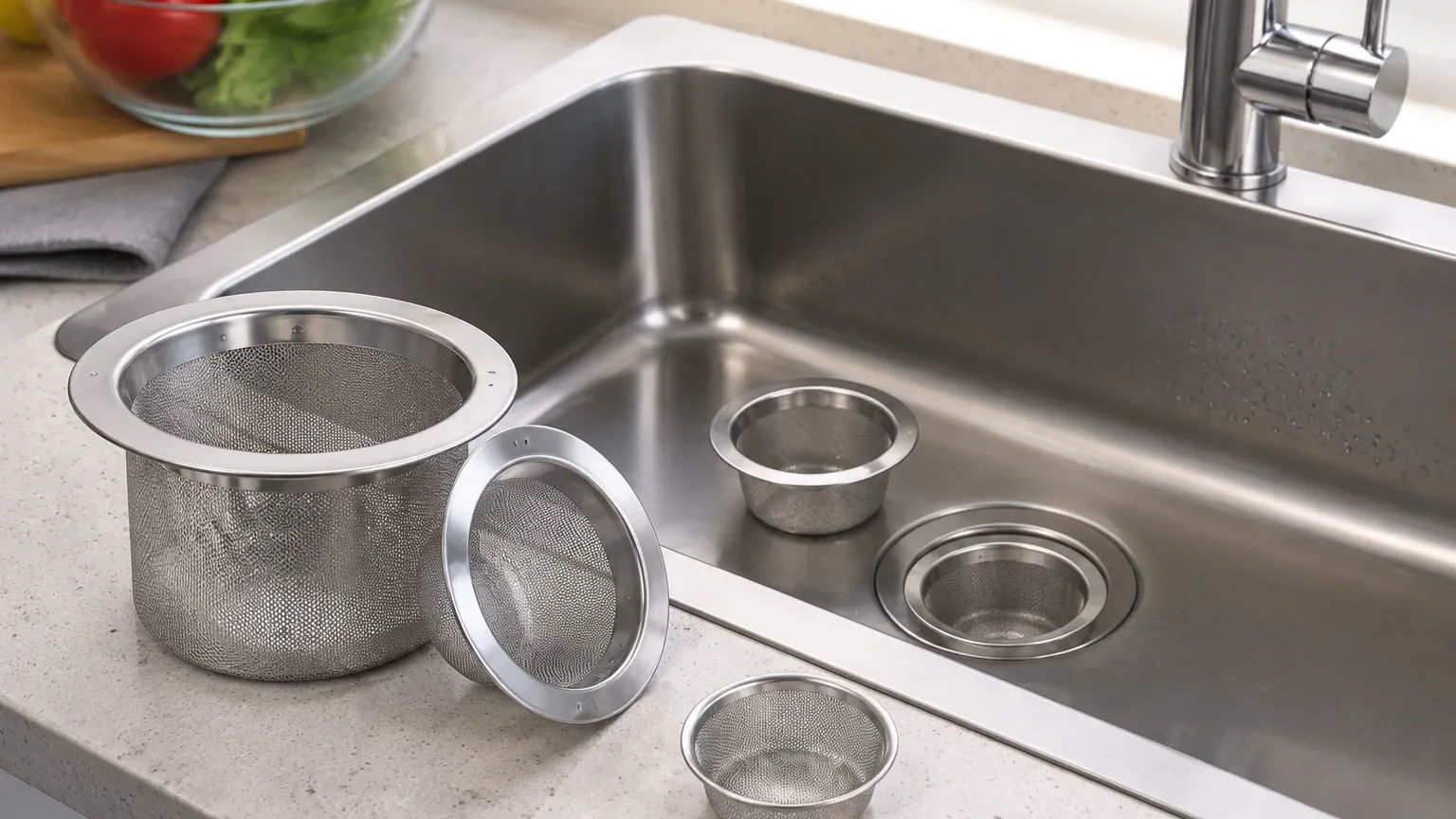
Not all sink strainers for kitchen sink applications are created equal. The internal geometry and the type of filtration media used—whether perforated metal or woven wire mesh—determine the types of particles the system can capture.
Perforated Metal Baskets
Perforated baskets are typically used for coarse filtration. They are constructed from a solid sheet of stainless steel with punched holes. These are exceptionally durable and easy to clean, making them ideal for capturing large food debris, bones, and packaging waste. The hole sizes usually range from 1/8 inch to 1/2 inch, depending on the specific drainage requirements.
Woven Wire Mesh Liners
In applications where fine particulates must be captured—such as coffee grounds, silt, or fine organic fibers—a woven wire mesh is often integrated into the basket design. Wire mesh allows for much higher filtration precision, measured in microns. However, because mesh is more delicate than perforated metal, it is often used as a secondary lining within a reinforced perforated frame to provide both strength and fine filtration.
Key Evaluation Criteria for Procurement Teams
When evaluating suppliers for sink strainers for kitchen sink projects, engineering and purchasing teams should confirm several technical specifications to ensure the product meets the application's demands.
1. Dimensional Accuracy: Ensure the flange diameter, basket depth, and thread specifications (if applicable) match the existing plumbing standards (e.g., NPT or BSP). Custom dimensions are often required for specialized industrial sinks.
2. Flow Rate Capacity: The strainer must be able to handle the peak discharge volume of the connected equipment without causing overflow. This is particularly important for sinks connected to high-pressure pre-rinse stations.
3. Ease of Sanitization: In food and beverage sectors, the strainer must be designed without "dead zones" where bacteria can accumulate. Smooth welds and polished surfaces (such as electropolishing) are preferred for hygienic applications.
4. Seal Integrity: For strainers that also function as stoppers, the quality of the gasket material (Buna-N, EPDM, or Viton) must be compatible with the temperature and chemicals used in the facility.
Common Risks and Failure Points
Failure to specify the correct industrial-grade sink strainers for kitchen sink use can lead to several operational risks:
* Bypass Leakage: If the strainer does not fit the housing precisely, solids can bypass the filtration media, leading to clogged pipes and expensive hydro-jetting services.
* Structural Collapse: Thin-gauge baskets can deform under the weight of heavy waste or during aggressive cleaning, rendering the filtration ineffective.
* Chemical Degradation: Using low-grade metals in the presence of caustic cleaners can lead to rapid corrosion, contaminating the wastewater and potentially violating health codes.
* Reduced Flow Rates: Over-specifying the filtration (using a mesh that is too fine for the application) can lead to premature clogging and frequent drainage backups, slowing down production lines.
Customization and OEM Capabilities
Many industrial applications require bespoke solutions that off-the-shelf products cannot provide. Manufacturers like Kaifil specialize in providing customized Strainers & Baskets tailored to specific OEM equipment or unique facility layouts. Customization options often include:
* Variable Mesh Sizes: Selecting specific wire diameters and weave patterns to target specific particle sizes.
* Reinforced Structures: Adding support ribs or double-walled construction for high-load environments.
* Specialized Coatings: Applying non-stick or antimicrobial coatings to improve waste release and hygiene.
* Integrated Handles: Designing ergonomic handles for easy removal and cleaning in fast-paced commercial environments.
Maintenance and Total Cost of Ownership (TCO)
While the initial purchase price of a high-quality stainless steel sink strainer is higher than consumer alternatives, the Total Cost of Ownership (TCO) is significantly lower. A professional-grade strainer reduces the frequency of plumbing repairs, minimizes the risk of regulatory fines due to waste discharge violations, and lasts for years rather than months.
Maintenance protocols should include a daily inspection of the strainer basket for signs of wear or deformation. In high-grease environments, the baskets should be cleaned with degreasers that are compatible with the stainless steel grade to prevent the buildup of biofilm and scale, which can restrict flow over time.
Conclusion
Selecting the right sink strainers for kitchen sink applications in an industrial or commercial context is a matter of balancing filtration performance with mechanical durability. By focusing on high-grade materials like 304 or 316 stainless steel and ensuring the design matches the specific flow and particle retention needs of the facility, engineers can protect their infrastructure and maintain operational continuity.
For those seeking reliable, high-performance filtration components, exploring the range of Strainers & Baskets from a specialized manufacturer like Kaifil ensures that every component is engineered to withstand the rigors of demanding industrial environments. Whether you require standard sizes or fully customized OEM solutions, prioritizing technical excellence in your filtration selection is a critical step in efficient facility management.
