


Strainer 3 Inch
In industrial fluid handling, the 3-inch pipeline size represents a common standard for medium-flow applications across various sectors, including chemical processing, water treatment, and food production. Selecting a strainer 3 inch is a critical engineering decision that directly impacts the protection of downstream equipment such as pumps, flow meters, and control valves. These components, often categorized under Strainers & Baskets, serve as the primary defense against particulate contamination, ensuring process integrity and reducing unplanned downtime.
This technical guide explores the engineering considerations, material requirements, and selection criteria necessary for identifying the optimal 3-inch filtration solution for demanding industrial environments.
Understanding the Role of a 3-Inch Strainer in Industrial Systems
A strainer 3 inch is designed to remove unwanted solids from liquid or gas streams via a perforated plate or wire mesh filtering element. At this specific diameter, the flow dynamics require a balance between high throughput and efficient particle capture. Unlike smaller diameter filters, a 3-inch system often handles significant volumes, making the structural integrity of the strainer housing and the internal basket paramount.
The primary function is mechanical separation. As fluid enters the strainer body, it is directed through the filtering element. Particles larger than the mesh openings are trapped, while the clean fluid continues through the outlet. For engineers, the goal is to maximize the "open area ratio"—the ratio of the total area of the holes in the screen to the cross-sectional area of the pipe—to minimize pressure drop while maintaining filtration accuracy.
Key Types of Strainers & Baskets for 3-Inch Pipelines
When specifying a strainer 3 inch, the choice of configuration depends on the system's flow orientation, the nature of the contaminants, and whether the process can be halted for cleaning.
1. Y-Strainers
Named for their shape, Y-strainers are typically used in applications where the amount of solids to be removed is relatively small. They are compact and can be installed in either horizontal or vertical orientations (provided the "leg" points downward). In a 3-inch configuration, Y-strainers are often preferred for steam, gas, or high-pressure liquid lines where space is limited.
2. Simplex Basket Strainers
Basket strainers feature a larger internal volume compared to Y-strainers, allowing them to hold more debris before requiring cleaning. A 3-inch basket strainer is ideal for liquid applications with higher dirt loading. The basket design allows for easy removal and cleaning, often through a top-access cover. These are strictly for horizontal piping runs.
3. Duplex (Twin) Strainers
For processes that cannot be shut down, duplex strainers consist of two separate strainer chambers connected by a diverting valve. When one side becomes clogged, the flow is diverted to the clean chamber, allowing the operator to service the first basket without interrupting the flow. This is a common requirement in 3-inch hydraulic and lubrication systems.
Engineering Specifications and Performance Metrics
To ensure a strainer 3 inch performs as expected, technical professionals must evaluate several key performance metrics during the procurement phase.
Flow Rate and Pressure Drop (Delta P)
The relationship between flow rate and pressure drop is the most critical factor in strainer selection. Every strainer introduces some resistance to flow. As the mesh becomes clogged with debris, the pressure drop increases. Engineers must consult CV (flow coefficient) charts to ensure that the initial pressure drop at the required flow rate (e.g., 150-250 GPM for a typical 3-inch water line) stays within acceptable limits, usually under 2 PSI for a clean element.
Filtration Accuracy: Mesh vs. Perforation
The internal element of a strainer 3 inch can be a perforated metal sheet or a fine wire mesh supported by a perforated backing.
- Perforated Plate: Typically used for coarser filtration (1/32" to 1/4" holes). It provides high structural strength.
- Wire Mesh: Used for finer filtration (20 mesh to 400 mesh). For 3-inch applications, a 40-mesh or 80-mesh screen is common for protecting sensitive equipment from fine grit.
Pressure and Temperature Ratings
Industrial strainers must comply with ASME B16.34 or similar standards. A 3-inch strainer might be rated for Class 150, 300, or 600, depending on the wall thickness and flange design. Temperature compatibility is determined not only by the housing material but also by the seals and gaskets (e.g., Viton, EPDM, or PTFE).
Material Selection: Why Stainless Steel Dominates 3-Inch Applications
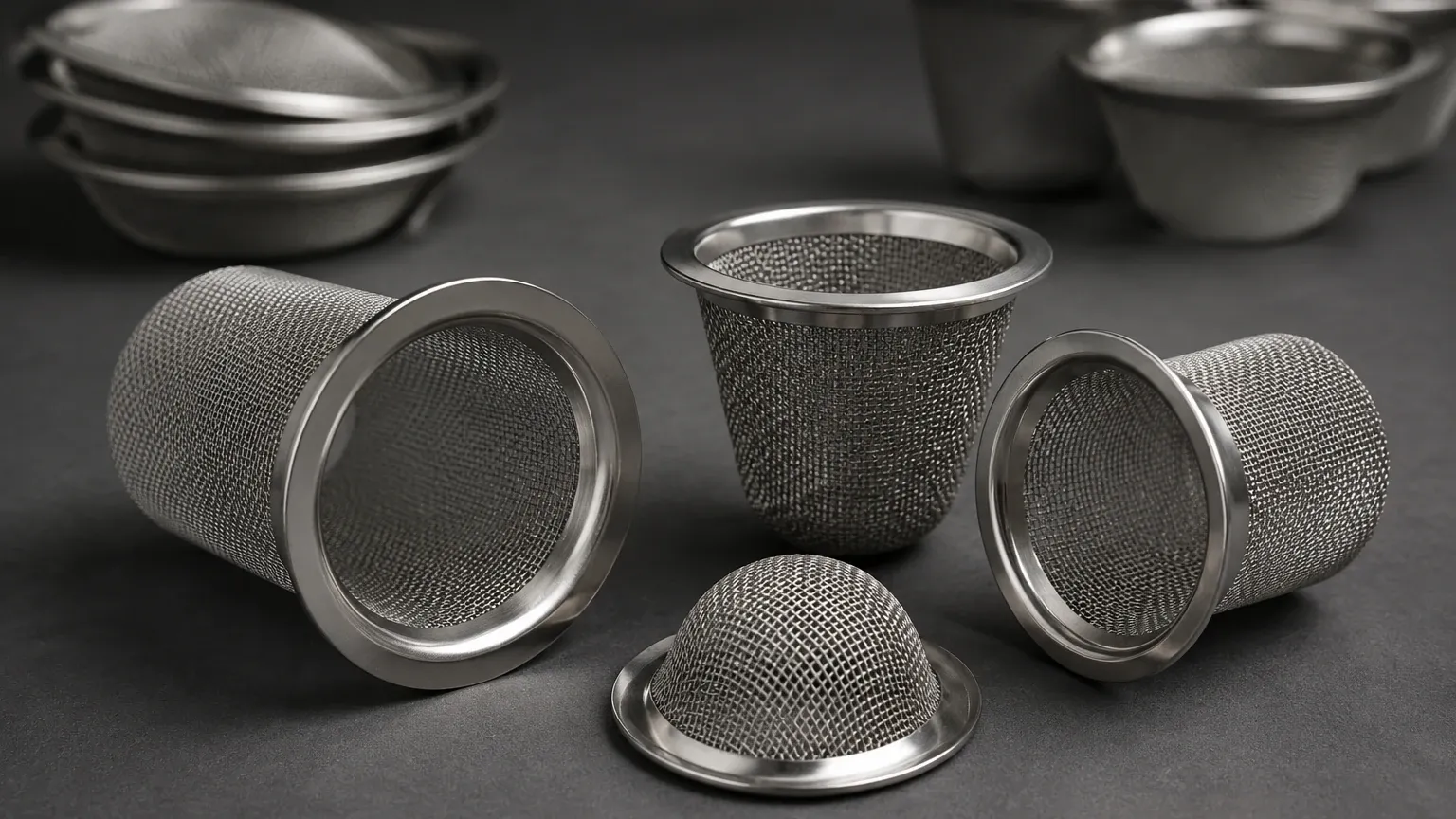
While strainers can be manufactured from cast iron, carbon steel, or bronze, stainless steel remains the gold standard for high-performance industrial applications. As a specialist in custom stainless steel filtration, Kaifil emphasizes the use of Grade 304 and Grade 316 stainless steel for several reasons:
1. Corrosion Resistance: Grade 316 stainless steel, containing molybdenum, offers superior resistance to chlorides and acidic environments, making it essential for chemical processing and marine applications.
2. Durability: Stainless steel maintains its structural integrity at both cryogenic and high temperatures, preventing the warping or cracking that can occur with lesser materials in a 3-inch line.
3. Hygiene: In food, beverage, and pharmaceutical sectors, stainless steel is required for its non-porous surface, which resists bacterial growth and can withstand rigorous Clean-In-Place (CIP) cycles.
4. Strength-to-Weight Ratio: Stainless steel allows for thinner-walled, lighter-weight designs that still meet high-pressure requirements, simplifying the installation of a strainer 3 inch.
Critical Selection Criteria for Engineers and Purchasing Teams
Before finalizing a purchase order for a strainer 3 inch, technical teams should confirm the following details to avoid compatibility issues:
* Connection Type: Does the system require RF (Raised Face) flanges, NPT (National Pipe Thread), or butt-weld connections? For 3-inch lines, flanged connections are the industry standard for ease of maintenance.
* Fluid Properties: What is the viscosity of the fluid? Highly viscous liquids (like heavy oils or syrups) require larger mesh openings and larger strainer bodies to prevent excessive pressure drop.
* Contaminant Load: Is the contamination continuous or slug-loading? This determines the required basket capacity and the frequency of cleaning cycles.
* Seal Compatibility: Ensure the gasket material is compatible with the process fluid to prevent leaks. For example, EPDM is excellent for water but fails quickly in the presence of oils.
* Total Cost of Ownership (TCO): Look beyond the initial price. Consider the cost of replacement elements, the ease of cleaning (labor costs), and the potential cost of downstream equipment failure if a low-quality strainer bypasses contaminants.
Installation Best Practices and Maintenance Protocols
Proper installation of a strainer 3 inch is as important as the selection of the unit itself. Incorrect orientation can lead to air pockets, inadequate filtration, or difficult maintenance.
Installation Guidelines
* Orientation: Ensure the flow arrow on the strainer body matches the actual fluid flow. For basket strainers, ensure there is sufficient overhead clearance to remove the basket.
* Support: A 3-inch strainer, especially when filled with fluid and debris, can be heavy. Ensure the piping is properly supported to prevent stress on the flanges.
* Isolation: Install isolation valves upstream and downstream of the strainer. This allows the unit to be serviced without draining the entire piping system.
Maintenance and Cleaning
The primary maintenance task for any strainer 3 inch is cleaning the basket or screen.
- Differential Pressure Monitoring: The most effective way to determine when a strainer needs cleaning is by installing pressure gauges on both sides. A significant increase in differential pressure indicates a clogged element.
- Cleaning Procedure: Once isolated and depressurized, the cover can be removed. The basket should be cleaned with a soft brush or high-pressure water/steam. Avoid using hard tools that could damage the fine wire mesh.
- Spare Parts: Always keep a set of spare gaskets and at least one replacement basket on-site to minimize downtime during cleaning cycles.
Customization and OEM Solutions for Specialized Filtration
Standard off-the-shelf strainers do not always meet the specific needs of complex industrial processes. This is where custom manufacturing becomes essential. For a strainer 3 inch, customization options might include:
* Specialized Mesh Liners: Combining different layers of wire mesh to achieve specific micron ratings while maintaining high flow capacity.
* Magnetic Inserts: Adding magnetic rods to the basket to capture fine ferrous particles that might otherwise pass through the mesh.
* Custom Dimensions: Adjusting the face-to-face dimensions of the strainer to fit into existing piping footprints during a retrofit.
* Advanced Coatings: Applying specialized coatings for extreme chemical resistance or to reduce friction loss.
Kaifil specializes in these types of tailored solutions, working closely with engineering teams to develop Strainers & Baskets that meet precise application requirements. Whether the challenge involves high-viscosity fluids in food processing or aggressive chemicals in a refinery, a custom-engineered 3-inch strainer ensures the highest level of system protection.
Conclusion
The selection of a strainer 3 inch is a fundamental step in designing a reliable and efficient industrial piping system. By understanding the nuances of flow rates, material compatibility, and filtration accuracy, engineers can protect their infrastructure from the damaging effects of particulate contamination. Prioritizing high-quality stainless steel construction and considering the total cost of ownership will lead to longer service lives and reduced maintenance overhead. When standard solutions fall short, seeking a manufacturer with OEM and customization expertise ensures that even the most demanding filtration challenges are met with precision.
