


Strainer Basket Container
In industrial fluid handling and processing, the integrity of downstream equipment often depends on the efficiency of primary filtration components. A strainer basket container is a critical hardware assembly designed to remove coarse solids from liquids, protecting pumps, valves, heat exchangers, and spray nozzles from mechanical damage and clogging. Unlike fine-grade filters that may require frequent disposable cartridge changes, these containers utilize robust, cleanable baskets that offer a balance between high flow rates and effective debris retention.
For engineers and procurement professionals, selecting a Strainers & Baskets solution requires a deep understanding of fluid dynamics, material compatibility, and the specific mechanical stresses of the application. This guide examines the technical specifications, design variations, and operational considerations of the strainer basket container in industrial environments.
Understanding the Role of a Strainer Basket Container
A strainer basket container typically refers to the entire assembly—the outer housing (vessel) and the internal perforated or mesh basket. Its primary function is the mechanical separation of solids from a fluid stream. While the term "filter" is often used interchangeably, "straining" technically refers to the removal of larger particles, usually ranging from 25 microns up to several millimeters.
In a standard configuration, fluid enters the container through an inlet port, passes through the walls of the internal basket, and exits through the outlet. The basket captures the debris on its interior surface. Because the basket has a significantly larger surface area than the cross-section of the pipe, it can accumulate a substantial amount of material before the pressure drop (differential pressure) necessitates cleaning. This makes the strainer basket container an ideal choice for high-volume applications where downtime must be minimized.
Material Selection and Engineering Specifications
The performance and longevity of a strainer basket container are dictated by the materials used in its construction. Industrial applications demand materials that can withstand corrosive fluids, high temperatures, and mechanical erosion.
Stainless Steel Alloys
Stainless steel is the industry standard for most heavy-duty applications. Kaifil specializes in manufacturing these components using high-grade alloys:
* SS304/SS304L: Suitable for general industrial use, water treatment, and mildly corrosive environments. It offers excellent structural strength and cost-effectiveness.
* SS316/SS316L: The preferred choice for chemical processing, marine environments, and the food and beverage industry. The addition of molybdenum provides superior resistance to pitting and chloride-induced corrosion.
* Specialty Alloys: For highly aggressive chemical environments, materials like Hastelloy or Duplex stainless steel may be required to prevent premature failure of the container or the internal basket.
Media Types: Perforated vs. Wire Mesh
The internal element of the strainer basket container can be constructed in several ways depending on the required filtration accuracy:
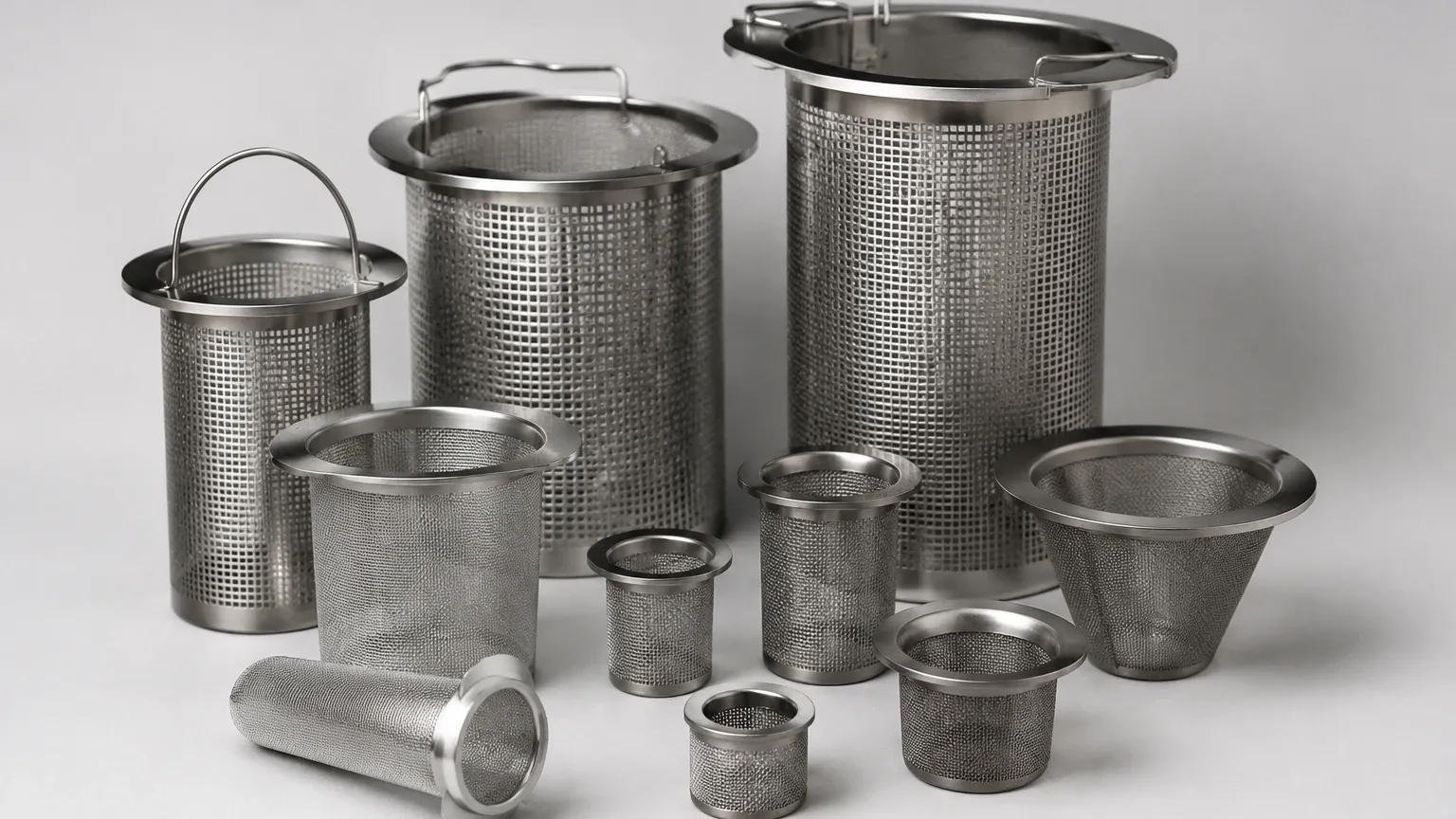
* Perforated Plate: Used for coarse straining. The hole size and staggered pattern determine the percentage of open area. It provides the highest structural rigidity.
* Wire Mesh Liners: For finer filtration, a stainless steel wire mesh is often sintered or welded to a perforated metal backup for support. This allows for precise micron ratings while maintaining the strength needed to resist high differential pressures.
* Wedge Wire: In applications involving heavy solids loading or sticky materials, wedge wire (V-wire) baskets offer a non-clogging surface that is easier to backwash or clean manually.
Key Performance Metrics: Pressure Drop and Flow Capacity
One of the most critical engineering considerations when specifying a strainer basket container is the "Clean Pressure Drop." This represents the resistance to flow when the basket is empty. An optimized design ensures that the pressure drop is kept to a minimum to reduce the energy requirements of the system's pumps.
The Open Area Ratio (OAR)
The Open Area Ratio is the relationship between the total open area of the strainer basket and the cross-sectional area of the inlet pipe. A well-engineered strainer basket container should ideally have an OAR of at least 6:1 or 8:1. A higher ratio means:
1. Lower Initial Pressure Drop: Reduced turbulence and resistance.
2. Longer Service Cycles: The container can hold more debris before the pressure drop reaches the critical threshold for cleaning.
3. Reduced Velocity: Slower fluid velocity through the mesh reduces the risk of particle "breakthrough" and minimizes erosion of the basket material.
Differential Pressure Monitoring
Engineers must monitor the differential pressure (ΔP) across the container. Most industrial systems include gauges or sensors that trigger an alarm when the ΔP reaches a specific limit (typically 5–10 psi over the clean pressure drop). Exceeding the recommended ΔP can lead to the collapse of the internal basket or the bypassing of unfiltered fluid if seals are compromised.
Structural Design and Customization Options
Strainer basket containers are not one-size-fits-all components. Depending on the installation site and the nature of the fluid, different configurations are utilized:
Simplex vs. Duplex Systems
* Simplex Strainers: These consist of a single container. They are used in systems where the flow can be shut down temporarily to remove and clean the basket. They are common in batch processing or systems with redundant piping loops.
* Duplex (Twin) Strainers: These consist of two containers connected by a diverting valve. When one basket becomes clogged, the flow is switched to the second container without interrupting the process. This is essential for continuous operations like power generation or cooling water systems.
Entry and Closure Designs
The method of accessing the basket affects maintenance speed. Options include:
* Bolted Covers: High-pressure rated but require more time to open.
* Quick-Opening/Swing Bolt Covers: Designed for rapid access without the need for specialized tools, reducing maintenance labor costs.
* Top-Entry vs. Side-Entry: Top-entry designs allow the basket to be lifted straight up, minimizing fluid spill and making it easier to handle heavy, debris-laden baskets.
Customization for OEM Applications
Many industrial systems require a bespoke strainer basket container to fit within tight spatial constraints or to meet specific flow characteristics. Customization options often include specialized flange types (ANSI, DIN, JIS), integrated drain valves, vent plugs, and magnetic inserts to capture fine ferrous particles that might otherwise pass through the mesh.
Maintenance, Cleaning, and Replacement Cycles
The durability of a stainless steel strainer basket container makes it a cost-effective long-term solution, but its performance is dependent on a proper maintenance regimen. Unlike disposable filters, the baskets are designed for reuse.
Cleaning Procedures
When the differential pressure indicates a clogged basket, it must be removed and cleaned. For standard debris, high-pressure water or steam cleaning is usually sufficient. In the chemical or food industries, ultrasonic cleaning or chemical soaking may be required to remove stubborn scales or organic buildup. It is vital to inspect the basket for any signs of wire fatigue, broken welds, or distorted perforations during every cleaning cycle.
When to Replace the Basket
While the container housing can last for decades, the internal basket is a wear item. Replacement is necessary if:
* The mesh shows signs of thinning or corrosion.
* The structural support (perforated metal) is warped or dented.
* The sealing surfaces (gaskets or O-rings) no longer provide a tight fit, allowing fluid bypass.
Keeping spare baskets on-site is a standard best practice to ensure that the system can be returned to service immediately while the dirty basket is being cleaned.
Selecting the Right Solution for Your Application
Choosing the correct strainer basket container involves more than just matching pipe sizes. To ensure optimal performance, technical teams should confirm the following data points before procurement:
1. Fluid Properties: Viscosity, temperature, and chemical composition (to determine material compatibility).
2. Contaminant Profile: The size, shape, and concentration of the solids being removed (to determine the correct mesh or perforation size).
3. Flow Rate: Maximum and minimum flow rates (to calculate the required container size and avoid excessive pressure drop).
4. Pressure Rating: The maximum operating pressure of the system (to ensure the vessel wall thickness and closure type are safe).
5. Space Constraints: The physical footprint available for installation and the clearance required for basket removal.
By focusing on these technical parameters, engineers can implement a filtration solution that not only protects expensive downstream equipment but also optimizes the overall efficiency of the industrial process. For those seeking specialized configurations or high-performance replacements, exploring professional Strainers & Baskets options is the first step toward a reliable and durable fluid handling system.
Kaifil’s expertise in custom stainless steel fabrication ensures that each strainer basket container is engineered to meet the rigorous demands of modern industry, providing a dependable barrier against contaminants in even the most challenging environments.
