


Strainer Basket Cooking
In large-scale food processing and industrial culinary operations, the efficiency of immersion-based thermal processing depends heavily on the hardware used to contain and transport products through heating mediums. The concept of strainer basket cooking refers to the use of heavy-duty, stainless steel baskets and strainers designed to hold food items—such as pasta, vegetables, proteins, or grains—while they are submerged in boiling water, hot oil, or brine.
For engineers and facility managers, selecting the right Strainers & Baskets is not merely a matter of sizing; it involves complex considerations regarding material science, fluid dynamics, and mechanical durability. These components must withstand rapid thermal cycling, corrosive environments, and significant mechanical loads while maintaining strict hygiene standards. As a professional manufacturer, Kaifil provides customized filtration and containment solutions that address these specific industrial challenges.
Engineering Requirements for Industrial Cooking Baskets
When designing or specifying equipment for strainer basket cooking, the first priority is material integrity. In industrial environments, the choice of stainless steel is critical for both longevity and food safety.
Material Selection: 304 vs. 316 Stainless Steel
Most industrial cooking applications utilize Grade 304 stainless steel due to its excellent balance of strength and corrosion resistance. However, in processes involving high salt concentrations (brining) or acidic ingredients (tomato-based products or vinegar), Grade 316 stainless steel is often required. The addition of molybdenum in 316 stainless steel provides superior resistance to chloride-induced pitting, which is a common failure point in heated aqueous environments.
Mechanical Strength and Load Bearing
Unlike domestic kitchen tools, industrial strainer baskets must support hundreds of kilograms of product. The structural design must account for the weight of the food plus the added mass of the liquid trapped within the product during extraction. This requires reinforced frames, often constructed from solid stainless steel rods or heavy-gauge flat bars, to prevent the mesh or perforated metal from sagging or tearing under load.
Optimizing Flow and Heat Transfer in Strainer Basket Cooking
The primary goal of strainer basket cooking is to achieve a uniform cook across the entire batch. This is directly influenced by the "open area" of the basket—the percentage of the basket surface that allows liquid to pass through.
The Importance of Open Area
If the mesh is too fine or the perforations are too small, the basket acts as a barrier, restricting the flow of hot liquid to the center of the product mass. This leads to uneven cooking temperatures, where the outer layers are overcooked while the core remains under-processed. Engineers must calculate the optimal open area that provides enough structural support for the product while maximizing liquid circulation.
Turbulence and Liquid Displacement
In automated systems where baskets are lowered into kettles, the displacement of liquid must be managed. A well-designed strainer basket allows for rapid immersion without causing excessive splashing or overflow. Conversely, during extraction, the basket must allow for rapid drainage to prevent "carry-over" of the cooking medium, which can affect downstream processing and increase waste.
Design Considerations for High-Temperature Immersion
Industrial cooking often involves temperatures ranging from 80°C (176°F) for blanching to over 190°C (374°F) for deep frying. These temperatures place unique stresses on the metal components.
Thermal Expansion and Contraction
Repeated heating and cooling cycles can lead to metal fatigue. If a basket is designed with rigid joints that do not account for thermal expansion, the welds may eventually crack. Kaifil utilizes advanced welding techniques, such as TIG (Tungsten Inert Gas) welding, to ensure deep penetration and ductile joints that can withstand the rigors of thermal cycling.
Mesh vs. Perforated Metal
Engineers must choose between woven wire mesh and perforated metal sheets.
- Woven Wire Mesh: Generally offers a higher percentage of open area and is lighter, making it ideal for delicate products or applications requiring rapid heat exchange.
- Perforated Metal: Offers superior structural rigidity and is easier to clean, making it the preferred choice for heavy-duty applications or products with sharp edges that might snag on wire mesh.
Hygiene and Sanitation Standards
In the food and beverage industry, the "cleanability" of equipment is as important as its performance. Strainer basket cooking equipment must be designed to eliminate "dead zones" where food particles or bacteria can accumulate.
Sanitary Design Principles
All internal corners of the basket should have a minimum radius to allow for effective cleaning. Furthermore, the surface finish of the stainless steel plays a vital role. Electropolishing is often recommended for industrial cooking baskets. This electrochemical process removes a fine layer of metal, smoothing out microscopic peaks and valleys to create a mirror-like finish that resists protein buildup and facilitates Clean-in-Place (CIP) or manual sanitation cycles.
Compliance and Certification
Baskets used in these applications must comply with international food safety standards, such as those set by the FDA or EHEDG. This includes ensuring that all materials are non-toxic and that no lubricants or manufacturing residues remain on the finished product. Kaifil ensures that all custom filtration components meet these rigorous industry requirements.
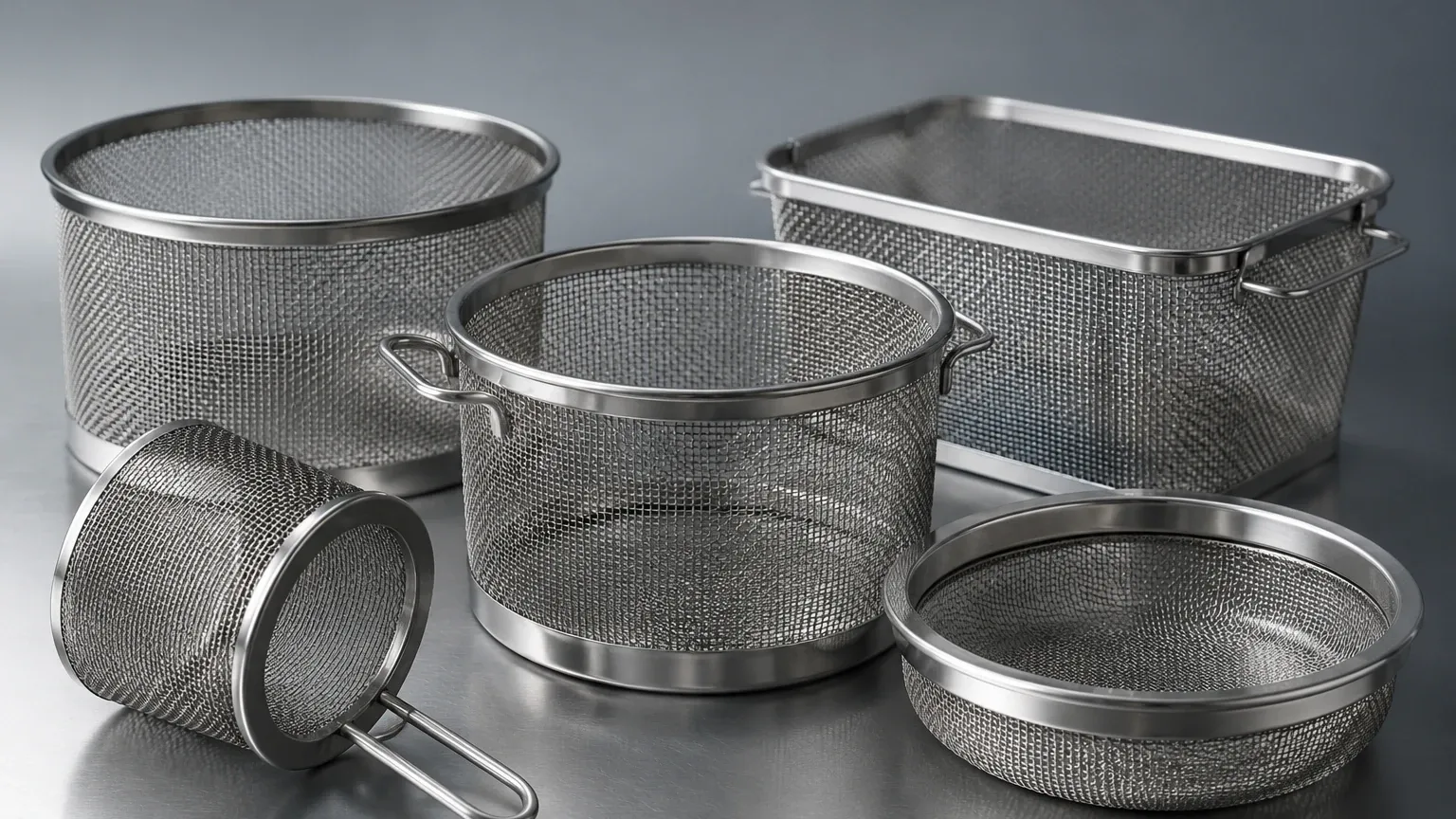
Customization Options for Specific Processing Needs
Every industrial food processing line has unique constraints. Standardized baskets rarely meet the exact needs of high-volume producers. Customization is often necessary to integrate the basket into existing machinery.
Handling and Integration
For manual operations, ergonomic handle designs with heat-resistant grips are essential. For automated systems, baskets must be designed with specific mounting points, hooks, or flanges that interface with overhead hoists or conveyor systems. Precision in these dimensions is critical to prevent mechanical jams or misalignments during the production cycle.
Specialized Shapes and Compartments
Some strainer basket cooking processes require the separation of products within a single batch. Custom baskets can be designed with internal dividers or multiple tiers to allow for the simultaneous cooking of different items with the same cook time, or to prevent delicate items from being crushed by the weight of the batch.
Maintenance and Longevity of Industrial Strainers
To maximize the ROI of industrial Strainers & Baskets, a proactive maintenance schedule is required. Even the highest quality stainless steel can suffer from wear and tear over years of heavy use.
Inspection Protocols
Facility managers should regularly inspect baskets for:
1. Weld Integrity: Checking for hairline cracks or signs of stress corrosion cracking.
2. Mesh Distortion: Ensuring the mesh has not stretched or developed gaps that could allow product to escape.
3. Surface Condition: Monitoring for signs of "tea staining" or localized corrosion that may indicate a breakdown in the passive layer of the stainless steel.
Cleaning Best Practices
Using the correct chemicals is vital. While stainless steel is robust, exposure to concentrated bleach or hydrochloric acid can strip the protective oxide layer. Using specialized stainless steel cleaners and ensuring thorough rinsing after each shift will significantly extend the service life of the equipment.
Selecting the Right Partner for Filtration Solutions
Choosing a manufacturer for industrial cooking baskets requires more than just looking at a catalog. It requires a partner who understands the nuances of filtration accuracy, material durability, and the specific demands of the food processing environment.
Kaifil's expertise in custom stainless steel filtration allows us to provide solutions that are tailored to the exact specifications of your processing line. Whether you are dealing with high-viscosity liquids, abrasive products, or extreme temperature requirements, our engineering team works to ensure that your strainer basket cooking operations are efficient, safe, and cost-effective.
When evaluating your next purchase, consider the total cost of ownership. A cheaper, poorly designed basket may save on initial capital expenditure but will likely lead to higher costs in the form of product waste, frequent replacements, and potential food safety risks. Investing in precision-engineered stainless steel components ensures that your facility maintains peak productivity with minimal downtime.
For more information on selecting the appropriate specifications for your industrial application, or to discuss a custom design, explore our range of Strainers & Baskets and consult with our technical team to find the optimal solution for your filtration and containment needs.
