


Strainer Basket Dollar Tree
In the realm of fluid management and debris removal, the term "strainer basket" spans a vast spectrum of quality and application. While a search for a strainer basket dollar tree variant typically addresses domestic kitchen needs or temporary light-duty tasks, industrial procurement requires a fundamentally different approach. For engineers and facility managers, the distinction between a consumer-grade mesh tool and a precision-engineered industrial component is a matter of operational safety, equipment longevity, and process efficiency.
Industrial Strainers & Baskets are designed to withstand high pressures, corrosive environments, and continuous flow rates that would instantly compromise a retail-grade product. This article explores the technical engineering considerations that separate industrial filtration solutions from consumer alternatives, focusing on material science, structural integrity, and the total cost of ownership in professional environments.
Material Science: Beyond Basic Stainless Steel
When evaluating a strainer basket dollar tree option, the material is often a generic "stainless steel" or chrome-plated carbon steel with minimal corrosion resistance. In contrast, industrial filtration components manufactured by specialists like Kaifil utilize specific alloys tailored to the chemical composition of the fluid being processed.
Grade 304 vs. Grade 316L
Most high-quality industrial baskets are constructed from AISI 304 or 316L stainless steel. Grade 316L, containing molybdenum, offers superior resistance to chlorides and acids, making it essential for pharmaceutical and chemical processing. A consumer-grade strainer often lacks the metallurgical certification required to guarantee performance in these aggressive environments.
Corrosion and Contamination
In food and beverage production, the risk of rouge or pitting corrosion is a critical concern. Industrial-grade baskets undergo passivation or electropolishing to enhance the protective oxide layer. A low-cost consumer basket may leach heavy metals or develop rust spots after limited exposure to cleaning agents, leading to batch contamination and regulatory non-compliance.
Structural Integrity and Pressure Ratings
A primary difference between domestic strainers and industrial Strainers & Baskets is the ability to handle differential pressure (ΔP). In an industrial pipeline, a strainer must maintain its shape and filtration accuracy even as debris accumulates and pressure builds.
1. Reinforced Frames: Industrial baskets feature heavy-duty top rings, longitudinal bars, and bottom plates. These elements prevent the mesh from collapsing or "ballooning" under the force of the flow.
2. Welding Techniques: While a strainer basket dollar tree item may use simple spot welding or mechanical crimping, industrial versions utilize TIG (Tungsten Inert Gas) or plasma welding. these methods ensure a seamless, high-strength bond that eliminates bypass paths for contaminants.
3. Burst Pressure: Engineers must calculate the maximum allowable pressure drop across a clean and dirty strainer. Industrial components are rated for specific PSI levels, whereas consumer items have no rated structural limits.
Filtration Precision: Mesh vs. Perforation
In consumer applications, "fine mesh" is a subjective term. In industrial filtration, precision is measured in microns (μm) or mesh counts per linear inch. The choice between a perforated metal basket and a wire mesh lined basket depends on the particle size distribution of the solids being removed.
Perforated Metal Bases
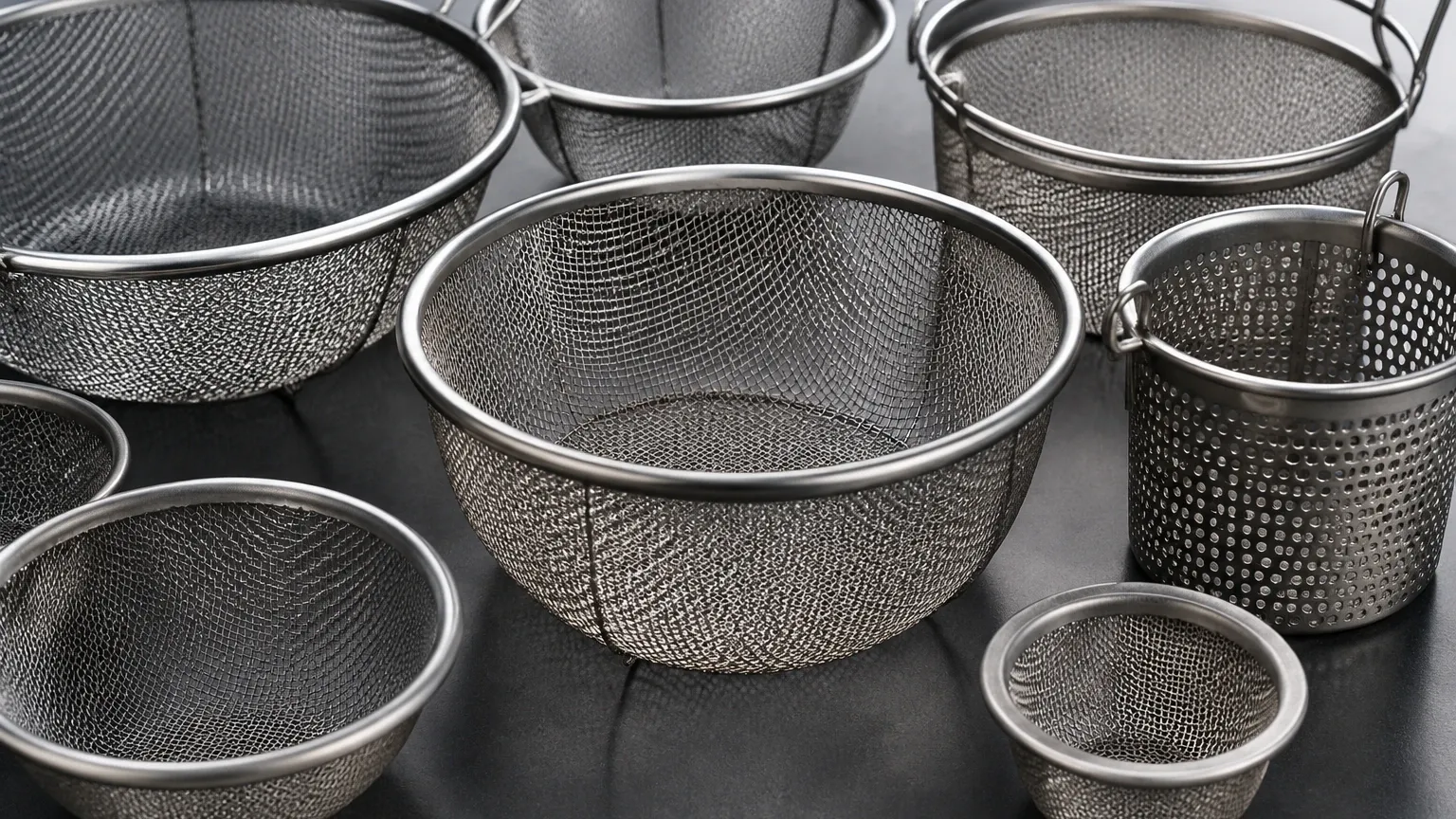
Industrial baskets often use a perforated metal sheet as the primary structural layer. The hole size, shape (round, square, or slotted), and "open area" percentage are engineered to balance filtration efficiency with flow capacity. A standard strainer basket dollar tree usually lacks a structural perforated backing, relying solely on thin wire mesh that is prone to tearing.
Multi-Layer Sintered Mesh
For high-precision applications, multiple layers of stainless steel wire mesh are sintered together to create a robust, porous medium. This technology allows for filtration ratings down to 5 microns while maintaining the mechanical strength of a much thicker plate. This level of engineering is absent in retail-grade products but is standard for protecting sensitive downstream equipment like pumps and spray nozzles.
Application-Specific Engineering
Industrial Strainers & Baskets are rarely "one size fits all." They are customized to fit specific housing dimensions and flow characteristics.
Chemical Processing
In chemical plants, strainers must resist a wide range of pH levels and temperatures. Custom gaskets and seals (such as Viton, PTFE, or EPDM) are integrated into the basket design to ensure a tight seal within the strainer housing, preventing any bypass of harmful particulates.
Food and Beverage Standards
For dairy or beverage production, baskets must meet 3-A Sanitary Standards or FDA requirements. This involves ensuring that all surfaces are smooth (typically Ra < 0.8 μm) and that there are no "dead zones" where bacteria can proliferate. A strainer basket dollar tree product, with its folded edges and rough welds, would be a significant biohazard in a professional food processing line.
Hydraulic and Lubrication Systems
In hydraulic systems, even microscopic metal shavings can cause catastrophic pump failure. Industrial baskets in these systems are designed to capture high-density particles without causing a significant drop in oil pressure, which could lead to cavitation.
Total Cost of Ownership (TCO) Analysis
The low initial price of a strainer basket dollar tree item is often cited as a benefit for non-critical tasks. However, in a B2B context, the Total Cost of Ownership (TCO) tells a different story.
* Replacement Frequency: An industrial stainless steel basket is designed for years of service and can be cleaned and reused hundreds of times. A consumer-grade item is essentially a disposable commodity that requires frequent replacement, leading to higher long-term costs.
* Downtime Costs: If a low-quality strainer fails and allows debris to damage a $50,000 centrifugal pump, the "savings" on the strainer are negated instantly. Industrial filters act as insurance for the entire production line.
* Cleaning Efficiency: Industrial baskets are designed for easy cleaning, often compatible with ultrasonic baths or high-pressure backwashing. The intricate, non-reinforced mesh of a cheap strainer is difficult to clean thoroughly, leading to permanent clogging and reduced flow.
Customization and OEM Capabilities
One of the most significant advantages of working with a professional manufacturer like Kaifil is the ability to customize Strainers & Baskets to exact specifications. While a strainer basket dollar tree offers a fixed, standard size, industrial applications often require unique configurations:
* Slanted or Offset Bottoms: To accommodate specific housing geometries.
* Magnetic Inserts: To capture fine ferrous particles that might pass through the mesh.
* Custom Handles: Designed for ergonomic removal or to lock into specific lid configurations.
* Varying Micron Ratings: The ability to have a coarse outer support with a very fine inner liner.
Selection Criteria for Engineers
When moving away from consumer-grade thinking and toward industrial procurement, engineers should use the following checklist to evaluate their filtration needs:
1. Fluid Compatibility: Does the stainless steel grade match the chemical profile of the process fluid?
2. Flow Rate and Velocity: Is the open area of the basket sufficient to prevent excessive pressure drop at maximum flow?
3. Particle Load: How often will the basket need to be cleaned based on the concentration of solids?
4. Temperature Extremes: Will the basket maintain its structural properties at the operating temperature?
5. Regulatory Requirements: Does the component need to meet ISO, FDA, or ASME standards?
Conclusion
While the search for a strainer basket dollar tree might be suitable for a home kitchen, industrial processes demand a level of precision and durability that only specialized manufacturing can provide. High-performance Strainers & Baskets are critical components that protect expensive machinery, ensure product purity, and maintain the safety of industrial operations. By investing in engineered filtration solutions, companies reduce the risk of catastrophic failure and optimize their long-term operational costs. For those requiring reliable, custom-manufactured filtration components, focusing on material quality, structural design, and application-specific requirements is the only path to consistent performance.
