


Strainer Basket Stainless Steel
In industrial fluid handling systems, the protection of downstream equipment is a critical engineering priority. Whether the application involves high-pressure hydraulic lines, chemical processing reactors, or food-grade production belts, the presence of unwanted particulates can lead to catastrophic pump failure, valve damage, and compromised product purity. A strainer basket stainless steel component serves as the primary mechanical barrier, designed to intercept and retain solids from liquid or gas streams.
Choosing the right strainer basket requires a deep understanding of fluid dynamics, material science, and mechanical design. As a professional manufacturer, Kaifil specializes in engineering Strainers & Baskets that meet the rigorous demands of modern industrial environments, ensuring that filtration efficiency does not come at the cost of system performance.
Understanding the Role of Stainless Steel Strainer Baskets in Industrial Filtration
Strainer baskets are typically housed within a strainer body—such as a Simplex, Duplex, or Y-strainer—and are designed for easy removal and cleaning. Unlike disposable filter cartridges, these baskets are intended for long-term reuse, making the choice of material and construction quality paramount to the total cost of ownership.
Stainless steel is the industry standard for these components due to its exceptional mechanical strength and resistance to environmental stressors. In a B2B context, the transition from standard carbon steel or plastic to stainless steel is often driven by the need for thermal stability and chemical inertness. Stainless steel baskets can withstand extreme temperature fluctuations without losing structural integrity, and they do not leach contaminants into the process fluid, which is essential for pharmaceutical and food-processing applications.
Material Selection: Evaluating 304 vs. 316 Stainless Steel
The performance of a strainer basket stainless steel unit is largely dictated by the specific grade of alloy used. While many grades exist, the industrial sector primarily utilizes Grade 304 and Grade 316.
Grade 304 Stainless Steel
Grade 304 is the most common stainless steel used in filtration. It offers excellent corrosion resistance to most oxidizing acids and is highly durable. It is suitable for water treatment, general industrial cooling systems, and many food-service applications where the environment is not excessively saline or acidic.
Grade 316 and 316L Stainless Steel
For more demanding environments, Grade 316 is the preferred choice. The addition of molybdenum (2-3%) significantly enhances its resistance to chlorides (such as seawater or de-icing salts) and industrial solvents. In the chemical and pharmaceutical industries, 316L (the low-carbon version) is often specified to prevent sensitization during welding, which ensures the basket remains resistant to intergranular corrosion at the weld points. For engineers managing aggressive chemical streams, Grade 316 provides the necessary safety margin to prevent premature failure.
Engineering Specifications for Custom Strainer Baskets
A one-size-fits-all approach rarely works in industrial filtration. The efficiency of a strainer basket depends on the relationship between the particle size to be removed and the allowable pressure drop across the system. Kaifil provides several construction methods to balance these requirements.
Perforated Metal vs. Woven Wire Mesh
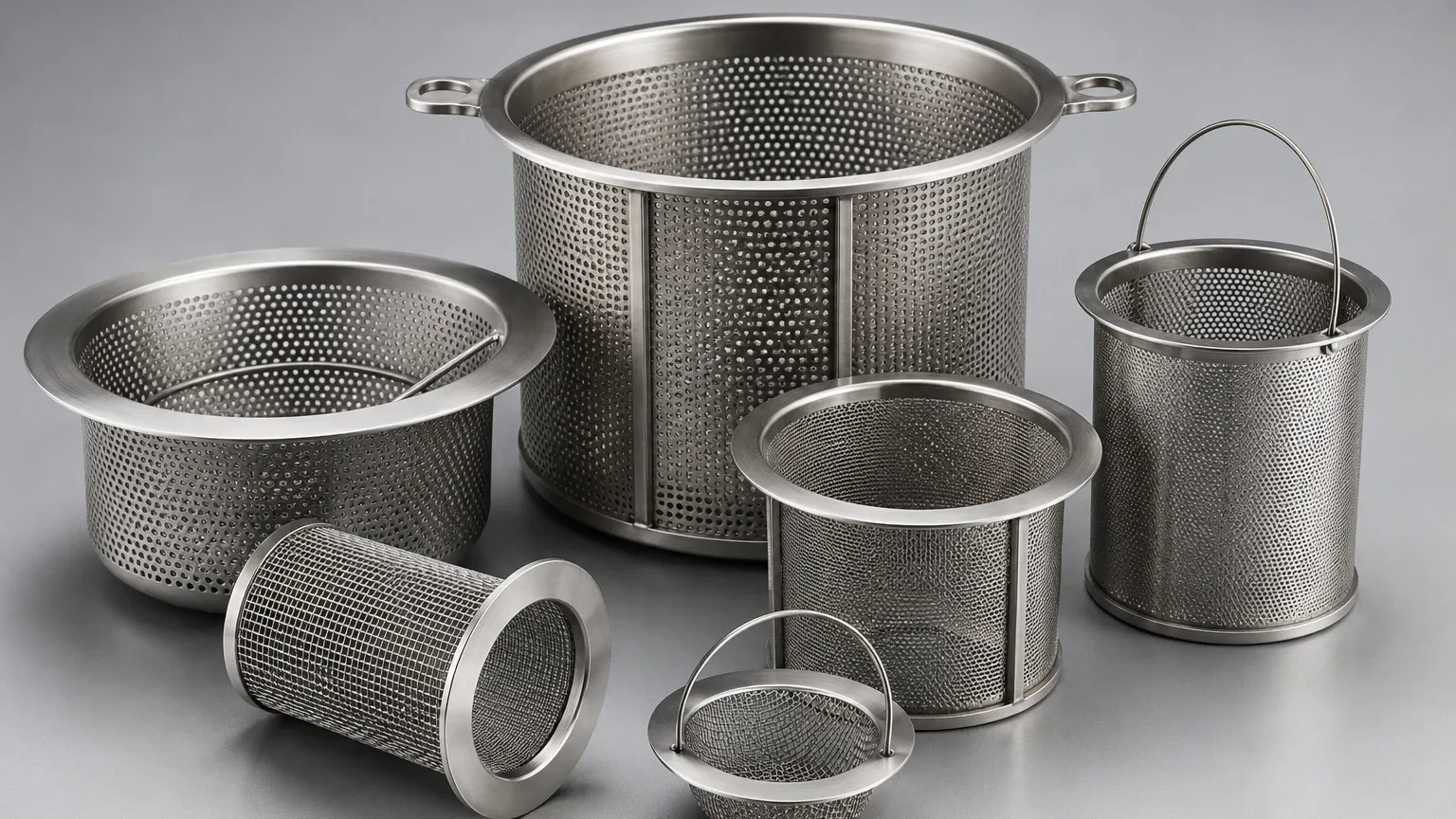
Most industrial baskets utilize a perforated metal plate as the base structure. Perforated plates offer high mechanical strength and can handle significant differential pressures. However, the filtration accuracy is limited by the hole size. To achieve finer filtration (down to the micron level), a woven wire mesh liner is often added to the interior or exterior of the perforated basket. This "multi-layered" approach combines the structural rigidity of the plate with the precision of the mesh.
Micron Ratings and Mesh Counts
Selecting the correct mesh count is a balance of science and application experience. A mesh that is too fine will clog rapidly, leading to frequent maintenance and potential pump cavitation. A mesh that is too coarse will allow damaging particles to pass through. Engineers must confirm the "Open Area Ratio" (OAR)—the ratio of the total area of the holes to the total area of the basket. A higher OAR results in a lower initial pressure drop and longer service intervals.
Design Features for Optimized Flow and Handling
The physical design of the strainer basket stainless steel assembly impacts both the ease of maintenance and the efficiency of the fluid path. When specifying a basket for a new or existing system, several design elements should be considered:
* Handle Designs: For large industrial strainers, the weight of a basket filled with debris can be significant. Custom handle options, such as heavy-duty swing handles, slanted handles, or dual-grip designs, facilitate safer and faster removal during cleaning cycles.
* Sealing Mechanisms: To prevent fluid bypass, the basket must seat perfectly within the strainer housing. This is often achieved through a machined flange or a specialized gasket (Viton, EPDM, or PTFE). A precise fit ensures that 100% of the fluid passes through the filtration media.
* Bottom Configurations: While flat-bottom baskets are standard, pleated or conical bottoms can be engineered to increase the available surface area. This is particularly useful in systems with high solids loading, as it extends the time between cleaning cycles without increasing the footprint of the strainer housing.
Calculating Performance: Pressure Drop and Dirt-Holding Capacity
From an engineering perspective, the most critical performance metric for a strainer basket is the "Clean Pressure Drop." This is the difference in pressure between the inlet and outlet of the strainer when the basket is clean. As debris accumulates, the pressure drop increases.
If the pressure drop exceeds a certain threshold (usually 5-10 psi depending on the system), the basket must be cleaned. High-quality Strainers & Baskets are designed to maximize dirt-holding capacity. This is achieved by optimizing the basket's volume-to-surface-area ratio. By increasing the depth of the basket or utilizing a multi-basket design in larger housings, Kaifil helps operators reduce the frequency of manual interventions, thereby lowering labor costs and reducing system downtime.
Industry-Specific Applications and Compliance
Different industries impose unique constraints on the manufacturing of stainless steel filtration components.
* Chemical and Petrochemical: These sectors require baskets that can withstand high temperatures and corrosive hydrocarbons. Heavy-gauge perforated metal is often used to ensure the basket does not collapse under high differential pressure during a surge.
* Food and Beverage: Cleanability is the priority. Baskets must feature sanitary finishes (often electropolished) to remove surface imperfections where bacteria could grow. Welds must be smooth and free of pits, complying with FDA or 3-A sanitary standards.
* Water Treatment: In municipal or industrial water intake systems, strainer baskets must handle large volumes of organic debris. Durability against erosion and the ability to withstand backwashing are key considerations.
* Hydraulic Systems: Precision is vital here. Even microscopic metal shavings can destroy a hydraulic pump. Stainless steel mesh liners with high filtration accuracy are essential for protecting these high-value assets.
Maintenance Protocols and Replacement Cycles
While a strainer basket stainless steel unit is designed for longevity, it is not indestructible. Regular maintenance is required to ensure peak performance. Cleaning methods vary based on the contaminant:
1. Manual Cleaning: Rinsing with a high-pressure hose or using a soft brush for larger debris.
2. Ultrasonic Cleaning: Ideal for wire mesh liners where fine particles are trapped deep within the weave.
3. Chemical Soaking: Used when sticky resins or oils have coated the stainless steel, requiring a solvent to break down the bond without damaging the metal.
Engineers should monitor for signs of "mesh blinding" (permanent clogging) or mechanical fatigue, such as cracked welds or distorted frames. A well-maintained stainless steel basket can last for years, but having a replacement cycle based on the criticality of the downstream equipment is a recommended B2B best practice. Keeping spare baskets on-site allows for a "swap-and-clean" strategy, minimizing the time the system is offline.
Why Customization Matters in Industrial Filtration
Off-the-shelf filtration solutions often fail to account for the nuances of specific flow rates, viscosities, and particle shapes. A custom-engineered strainer basket stainless steel solution ensures that the filtration media is perfectly matched to the application. At Kaifil, we work closely with engineering teams to provide OEM solutions that integrate seamlessly into existing infrastructure.
When evaluating a supplier, purchasing teams should confirm the manufacturer’s ability to provide material certifications (MTRs), pressure testing data, and precise dimensional drawings. These documents are essential for quality assurance and regulatory compliance in high-stakes industries like oil and gas or pharmaceuticals.
For technical teams looking to optimize their filtration processes, understanding the interplay between material grade, mesh geometry, and structural design is the first step toward a more reliable system. To explore specific configurations and technical data, engineers can Review product options and application support to find the ideal solution for their unique operational requirements.
