


Strainer Basket Walmart
In the realm of fluid handling and industrial processing, the term "strainer basket" often appears in both consumer and commercial contexts. For maintenance managers and procurement officers, a search for a "strainer basket walmart" might initially seem like a shortcut to finding quick replacement parts for general utility or breakroom maintenance. However, when transitioning from domestic or light commercial needs to heavy-duty industrial applications, the technical requirements for Strainers & Baskets become significantly more complex.
Industrial filtration demands more than just a physical barrier; it requires precision engineering, material compatibility, and structural integrity that retail-grade products are not designed to provide. This article explores the critical differences between general-purpose retail strainers and industrial-grade basket filters, providing engineers and technical professionals with the information needed to select the right components for demanding environments.
Understanding the Difference: Retail vs. Industrial Strainer Baskets
When a procurement team searches for a "strainer basket walmart," they are typically looking at products designed for residential kitchens, pool maintenance, or basic plumbing. While these items serve their intended purpose in low-pressure, non-corrosive environments, they differ fundamentally from industrial filtration components in several key areas.
Material Composition
Retail strainer baskets are often manufactured from thin-gauge stainless steel (frequently 200-series or low-grade 304), plastic, or chrome-plated brass. In contrast, industrial strainers utilize heavy-gauge 304, 316, or 316L stainless steel, and sometimes exotic alloys like Monel or Hastelloy. These materials are chosen for their resistance to specific chemical agents, high temperatures, and the mechanical stresses of high-flow systems.
Filtration Precision
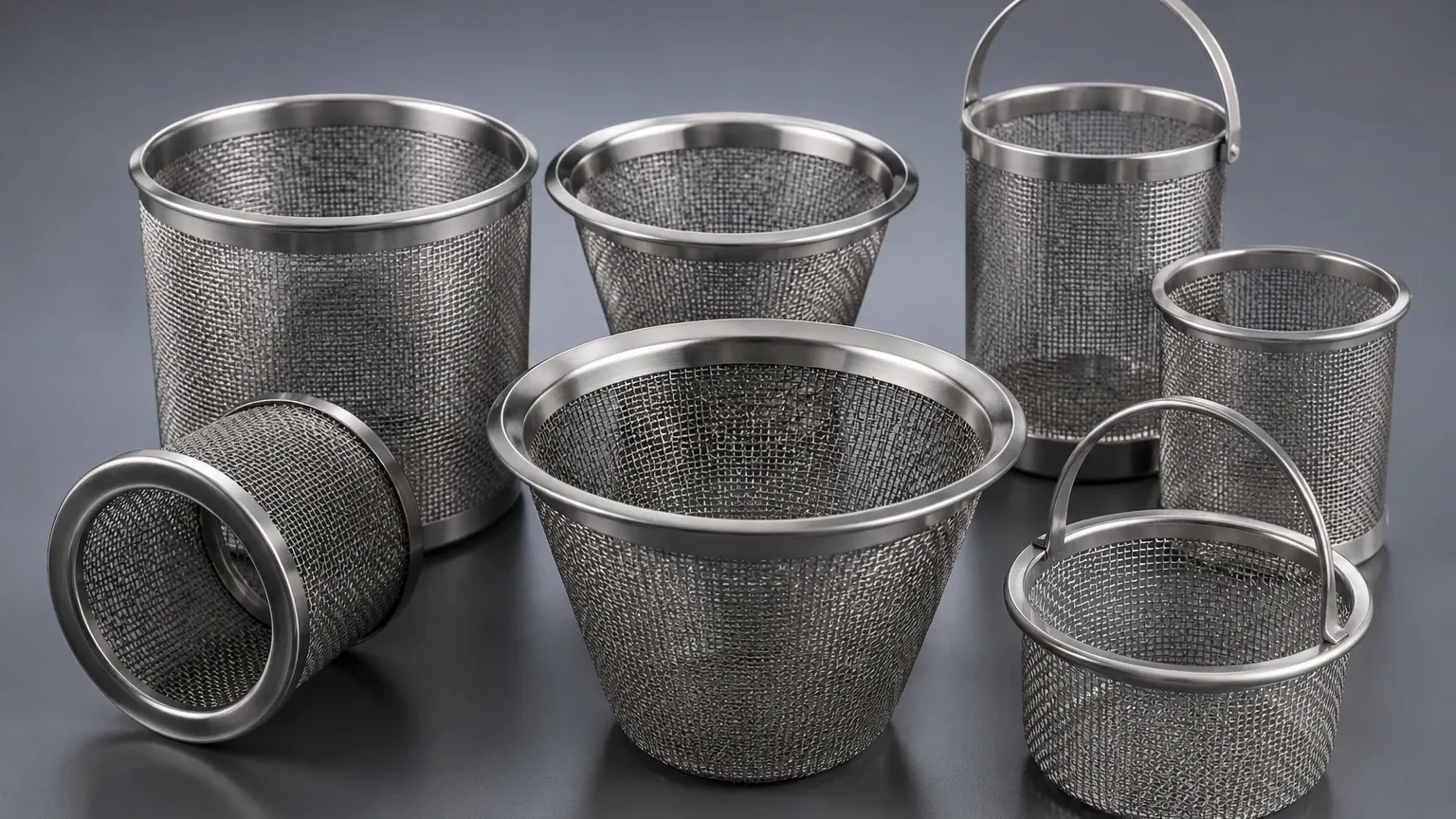
Consumer-grade baskets usually feature large perforations designed to catch visible debris like food scraps or leaves. Industrial baskets, however, are engineered for specific micron ratings. They often utilize a multi-layer construction where a perforated metal cylinder provides structural support for a fine wire mesh lining. This allows for the removal of particles as small as 5 to 10 microns, which is essential for protecting downstream equipment like pumps, nozzles, and heat exchangers.
Pressure and Flow Dynamics
Industrial systems operate under significant pressure. A retail-grade basket would likely collapse or bypass fluid under the differential pressures common in chemical processing or hydraulic systems. Industrial baskets are designed with reinforced rings, heavy-duty handles, and precise tolerances to ensure a tight seal within the strainer housing, preventing "leak-by" and maintaining system efficiency.
Engineering Considerations for Industrial Strainers & Baskets
Selecting the appropriate strainer basket for an industrial application requires a deep dive into the physics of the process. Engineers must look beyond the physical dimensions and consider how the basket will interact with the fluid over time.
Open Area Ratio
The "open area" refers to the total area of the holes in the strainer basket expressed as a percentage of the total surface area. For industrial applications, a high open area ratio is critical to minimize pressure drop (ΔP). Ideally, the open area of the basket should be several times the cross-sectional area of the inlet pipe. This ensures that even as the basket begins to collect debris, the flow rate remains stable and the pump does not experience cavitation.
Mesh Weave and Perforation Patterns
The geometry of the filtration media impacts both performance and cleanability. Common options include:
- Plain Weave: The most common wire mesh, offering a straight-through flow path.
- Dutch Weave: Provides higher strength and finer filtration by using heavier warp wires and smaller shute wires.
- Perforated Metal: Used as a standalone strainer for coarse filtration or as a support cage for fine mesh. The hole pattern (staggered vs. straight) affects the structural strength of the basket.
Structural Reinforcement
In high-viscosity or high-velocity applications, the force exerted on the basket can be immense. Industrial manufacturers like Kaifil incorporate reinforcement bands at the top, middle, and bottom of the basket. Longitudinal stiffeners may also be added to prevent the basket from twisting or bursting under high differential pressure (clogged condition).
Material Selection for Demanding Environments
One of the primary reasons a "strainer basket walmart" search is insufficient for B2B needs is the lack of specialized material options. In industrial settings, the fluid being filtered dictates the material of the strainer.
1. 304 Stainless Steel: Suitable for general-purpose applications, including water treatment and some food and beverage processes where corrosion risk is moderate.
2. 316/316L Stainless Steel: The standard for chemical processing and pharmaceutical industries. The addition of molybdenum provides superior resistance to chlorides and pitting corrosion.
3. High-Temperature Alloys: For applications involving steam or high-heat chemical reactions, specialized alloys ensure the basket maintains its shape and filtration accuracy without becoming brittle.
Furthermore, the finish of the material is vital. In the pharmaceutical and food industries, baskets must often be electropolished to achieve a specific surface roughness (Ra), ensuring that bacteria cannot harbor in microscopic crevices and that the component is easy to sterilize.
Customization Options for Specific Industrial Applications
Unlike off-the-shelf retail products, industrial filtration often requires bespoke solutions. OEM manufacturers provide customization that addresses specific operational challenges.
Custom Dimensions and Flanges
Industrial strainers often need to fit into legacy housings or specialized machinery. Customization allows for the exact diameter, height, and flange thickness required for a perfect seal. This prevents the bypass of contaminants, which is a common failure point when using non-standard or "close-enough" retail parts.
Specialized Handle Designs
In systems where baskets must be changed frequently, the handle design is an ergonomic and safety consideration. Options include heavy-duty lifting bails for crane removal, slanted handles for easy manual grip, or even magnetic inserts to capture fine ferrous particles that might pass through the mesh.
Multi-Stage Filtration
Some industrial baskets are designed as "dual-stage" or "triple-stage" units. These incorporate multiple layers of different mesh sizes within a single basket frame. This design allows for graduated filtration, where larger particles are caught by the outer layer and finer particles by the inner layer, significantly extending the time between cleaning cycles.
Evaluating Performance and Total Cost of Ownership (TCO)
While a retail strainer might have a lower initial purchase price, the Total Cost of Ownership (TCO) in an industrial setting is almost always higher for non-industrial parts. When evaluating Strainers & Baskets, engineers must consider:
- Downtime Costs: A failed strainer basket can lead to hours or days of unscheduled downtime. If a low-quality basket collapses, debris can enter the pump, leading to repairs that cost thousands of dollars.
- Cleaning Efficiency: Industrial baskets are designed for repeated cleaning. High-quality stainless steel can withstand ultrasonic cleaning, high-pressure washing, and chemical baths without degrading. A cheaper basket may deform or rust after only a few cleaning cycles.
- Filtration Accuracy: If a strainer does not meet its micron rating, downstream product quality may suffer, leading to rejected batches in industries like paint, chemicals, or food production.
By investing in a precision-manufactured component, facilities reduce the frequency of replacements and the risk of catastrophic system failure.
Common Applications and Industry Standards
Industrial strainer baskets are utilized across a wide spectrum of sectors, each with its own set of standards and requirements.
- Chemical Processing: Baskets must resist aggressive solvents and acids. Material traceability (MTRs) is often required to ensure the alloy meets the specified grade.
- Food and Beverage: Compliance with FDA or 3A standards is mandatory. This includes using food-grade welding techniques and ensuring there are no sharp edges or "dead zones" where organic matter can accumulate.
- Water Treatment: Large-scale baskets are used for intake water filtration to protect membranes and sensitive equipment from sand, grit, and biological matter.
- Oil and Gas: High-pressure strainers are used to remove scale and particulates from pipelines, requiring exceptionally robust construction.
How to Select the Right Industrial Strainer Basket
To move beyond a general search and toward a technical solution, engineers should prepare the following data points before contacting a manufacturer:
1. Fluid Properties: What is the viscosity, temperature, and chemical composition of the fluid?
2. Flow Rate: What is the maximum and normal operating flow rate (GPM or m³/h)?
3. Contaminant Profile: What is the nature of the solids being removed? Are they hard, soft, fibrous, or abrasive?
4. Micron Requirement: What is the largest particle size allowed to pass through to the downstream equipment?
5. Housing Dimensions: If the basket is a replacement, what are the exact internal dimensions of the strainer housing?
Conclusion
While the convenience of a "strainer basket walmart" search is appealing for household needs, the industrial sector requires a much more rigorous approach to filtration. The integrity of a manufacturing process often rests on the performance of these seemingly simple components. By focusing on material quality, engineering precision, and application-specific customization, companies can ensure their systems operate efficiently, safely, and with minimal maintenance overhead. For those requiring reliable, high-performance filtration, choosing a dedicated manufacturer like Kaifil ensures that every basket is built to withstand the rigors of the industrial environment.
