


Strainer Definition
In the context of industrial fluid handling and process engineering, a clear strainer definition is essential for selecting the correct equipment to protect downstream components. At its most fundamental level, a strainer is a closed vessel with a cleanable screen or mesh element designed to remove foreign particles from a process fluid—whether liquid or gas. While often used interchangeably with the term "filter," a strainer is technically distinguished by its role in removing larger, macroscopic solids to protect pumps, valves, and instrumentation from damage or clogging.
Industrial Strainers & Baskets serve as the first line of defense in piping systems. They are typically installed in-line and are designed to be serviced or cleaned without necessitating the disposal of the entire filtration media. This article explores the technical nuances of strainer design, material selection, and the engineering considerations required for effective implementation in demanding industrial environments.
The Technical Distinction: Strainer vs. Filter
To understand the industrial strainer definition, one must differentiate it from a filter. While both devices remove solids from a fluid stream, the distinction lies primarily in the size of the particles removed and the operational intent.
1. Particle Size: Filters are generally designed to remove microscopic particles, often measured in low micron ratings (sub-1 micron to 40 microns). Strainers are typically utilized for larger particles, ranging from 40 microns up to several millimeters (perforated plate sizes).
2. Pressure Drop: Because strainers deal with larger particles and often feature a larger open area, the initial pressure drop across a clean strainer is usually lower than that of a fine filter.
3. Serviceability: Strainer elements, particularly those made of stainless steel wire mesh or perforated metal, are designed for repeated cleaning and reuse. Many filters use disposable cartridges or membranes that must be replaced once blinded.
4. Placement: Strainers are frequently placed on the suction side of pumps to prevent debris from causing mechanical failure, whereas filters are often placed downstream to ensure final product purity.
Core Components of Strainers & Baskets
The efficiency of a straining system depends on the synergy between its housing and its internal element. The "basket" is the heart of the device, acting as the primary barrier against contaminants.
The Housing
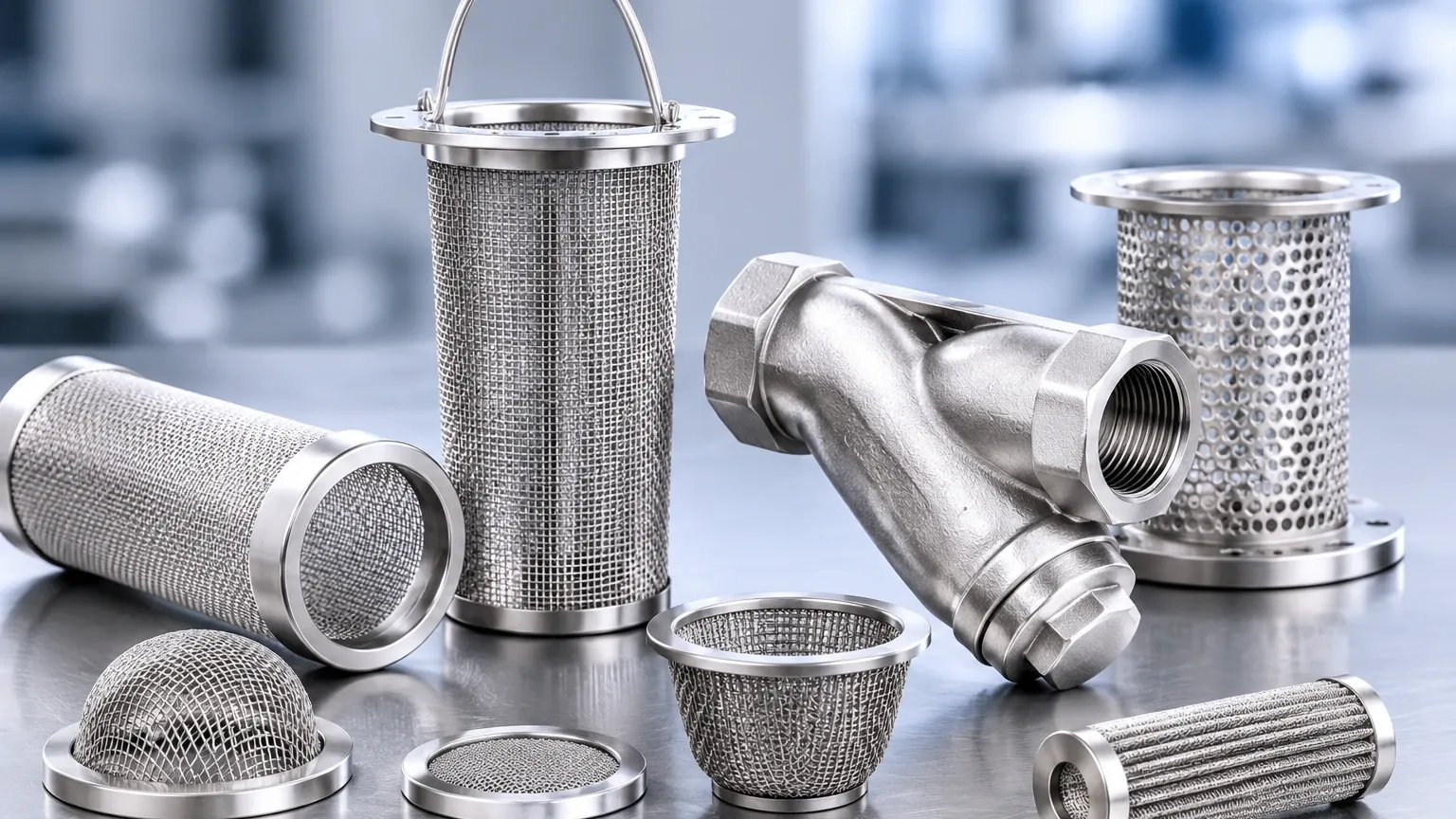
The housing is the pressure vessel that contains the fluid and the straining element. In industrial applications, these are often cast or fabricated from materials like stainless steel to withstand high pressures and corrosive environments. The housing design determines the flow path—whether it is a straight-through flow (as in Y-strainers) or a top-in, side-out flow (as in basket strainers).
The Straining Element (The Basket)
The basket is the removable component that captures debris. It is typically constructed from a combination of perforated metal and wire mesh.
- Perforated Metal: Provides structural rigidity. The hole size and pattern (staggered vs. straight) influence the strength and flow characteristics.
- Wire Mesh: Often layered over or inside the perforated metal to provide finer filtration. This mesh is woven from stainless steel wires, with the "mesh count" indicating the number of openings per linear inch.
Common Types of Industrial Strainers
Selecting the right configuration depends on the flow rate, the allowable pressure drop, and the frequency of cleaning required.
Y-Strainers
Named for their shape, Y-strainers are compact and ideal for applications where the amount of material to be removed is small. They are frequently used in steam lines or high-pressure gas systems. Their primary advantage is the ability to be installed in either horizontal or vertical orientations, provided the "leg" of the Y points downward to collect debris.
Basket Strainers (Simplex)
Simplex basket strainers are used where the process can be shut down for a short period to clean the element. They offer a larger surface area than Y-strainers, which translates to a higher dirt-holding capacity and a lower frequency of maintenance. These are common in liquid applications where flow rates are higher.
Duplex Strainers
For continuous processes that cannot be interrupted, duplex strainers are required. A duplex system consists of two separate strainer chambers connected by a diverting valve. When one basket becomes full, the flow is diverted to the clean chamber, allowing the operator to service the dirty basket without stopping the flow. This is critical in chemical processing and lubrication systems.
Engineering Parameters: Mesh, Micron, and Open Area
When specifying Strainers & Baskets, engineers must look beyond the basic strainer definition and focus on quantitative performance metrics.
Mesh Count vs. Micron Rating
Mesh count refers to the number of wires per inch. A 20-mesh screen has 20 openings per linear inch. However, the micron rating (the actual size of the opening) depends on both the mesh count and the diameter of the wire used. For example, a 100-mesh screen with a standard wire diameter might provide a 140-micron opening. Engineers must specify the required micron rating to ensure the strainer captures the specific debris targeted for removal.
Open Area Ratio (OAR)
The Open Area Ratio is the relationship between the total area of the openings in the strainer element and the cross-sectional area of the inlet pipe. A well-designed strainer typically aims for an OAR of at least 4:1. A higher OAR means the strainer can accumulate more debris before the pressure drop becomes excessive, thereby extending the time between cleaning cycles.
Pressure Drop (Delta P)
Pressure drop is the loss in fluid pressure as it passes through the strainer. It is influenced by fluid viscosity, specific gravity, flow velocity, and the cleanliness of the basket. Excessive pressure drop can lead to cavitation in pumps or reduced flow to critical processes. Calculating the "clean pressure drop" and setting a limit for the "dirty pressure drop" is a standard part of system design.
Material Selection and Durability
In industrial filtration, the choice of material is dictated by the chemical compatibility of the fluid and the temperature of the process. Stainless steel is the industry standard for high-performance strainers due to its corrosion resistance and mechanical strength.
- SS304: Suitable for general-purpose applications, including water treatment and some food processing environments. It offers good resistance to atmospheric corrosion.
- SS316/316L: Contains molybdenum, which provides superior resistance to chlorides and pitting. This is the preferred material for chemical processing, pharmaceutical manufacturing, and marine environments.
- Specialty Alloys: For highly aggressive acids or extreme temperatures, alloys like Monel or Hastelloy may be used for the mesh elements to prevent premature failure.
Applications Across Key Industries
The utility of a robust strainer definition is seen in its diverse application across various sectors:
* Chemical Processing: Protecting expensive flow meters and control valves from scale and particulate matter that can precipitate out of chemical reactions.
* Food and Beverage: Ensuring that ingredients are free from pips, skins, or accidental metal fragments, maintaining product safety and compliance with hygiene standards.
* Pharmaceuticals: Used in the pre-filtration stages to protect fine membrane filters from premature clogging, thereby reducing operational costs.
* Hydraulic Systems: Removing metal shavings or environmental contaminants from hydraulic oils to prevent wear on high-precision pumps and actuators.
* Water Treatment: Acting as a pre-filter for reverse osmosis (RO) membranes or UV sterilization systems to remove sand, grit, and organic debris.
Maintenance and Replacement Cycles
While strainers are designed for durability, their performance is entirely dependent on regular maintenance. A clogged strainer increases the velocity of the fluid through the remaining open areas, which can lead to "particle bypass" or even the structural collapse of the basket if the pressure differential exceeds the element's burst strength.
Cleaning Procedures
Most stainless steel baskets can be cleaned using ultrasonic baths, high-pressure water jets, or chemical cleaning agents, depending on the nature of the contaminant. It is essential to inspect the mesh for signs of fraying or "blinding" (permanent clogging of the mesh pores) during each cleaning cycle.
Total Cost of Ownership (TCO)
When evaluating Strainers & Baskets, purchasing teams should consider the TCO rather than just the initial acquisition cost. A high-quality stainless steel basket with a reinforced structure may have a higher upfront cost but will offer a significantly longer service life and lower pressure drop, leading to energy savings and reduced downtime.
Customization and OEM Solutions
Off-the-shelf strainers do not always meet the specific requirements of complex industrial systems. Customization is often necessary regarding:
* Bespoke Dimensions: Fitting a strainer into an existing piping layout with limited space.
* Reinforced Designs: Baskets designed to withstand high differential pressures without deformation.
* Specific Filtration Accuracy: Custom mesh weaves to target specific particle shapes or sizes.
* Connection Types: Flanged, threaded, or sanitary clamp connections to match industry standards (e.g., ANSI, DIN, or ASME).
As a professional manufacturer, Kaifil specializes in these customized stainless steel filtration solutions. By focusing on precision engineering and high-quality material selection, Kaifil ensures that each strainer element is optimized for its specific application, providing reliable protection for industrial infrastructure.
In conclusion, a comprehensive strainer definition encompasses more than just a simple mesh screen; it represents a critical engineering component designed for system protection and process efficiency. By understanding the relationship between mesh size, material properties, and flow dynamics, engineers can select the ideal straining solution to ensure long-term operational success.
