


Strainer Description
In industrial fluid handling and process engineering, a technical strainer description serves as the foundational document for procurement, system design, and operational safety. Far from being a simple product label, a comprehensive description outlines the mechanical, chemical, and thermal boundaries of a filtration component. For engineers and purchasing teams, understanding how to interpret and define these specifications is critical to protecting downstream equipment such as pumps, valves, and flow meters from particulate damage.
At its core, a strainer is a device used to mechanically remove solids from a flowing liquid or gas through a perforated or wire mesh straining element. While often used interchangeably with the term "filter," a strainer is typically associated with the removal of larger particles to prevent mechanical obstruction, whereas filters are generally reserved for finer particle separation. Accurate specification ensures that the Strainers & Baskets integrated into a system provide the necessary protection without inducing excessive pressure drop or requiring frequent, unplanned maintenance.
Defining the Industrial Strainer: Beyond Basic Terminology
A professional strainer description must begin with the fundamental classification of the device. Industrial strainers are categorized by their housing geometry and the orientation of the flow. The most common configurations include Y-strainers, T-strainers, and basket strainers. Each design offers distinct advantages depending on the installation environment and the expected solids loading.
Y-strainers, named for their shape, are typically used in pressurized lines, either liquid or gas, where the amount of material to be removed is relatively small. Their compact design allows for installation in both horizontal and vertical piping. Conversely, basket strainers are designed for systems where a higher volume of debris is expected. The "basket" configuration allows for a larger holding capacity and a greater open area ratio, which translates to a longer service interval between cleanings.
When drafting a description for procurement, it is essential to specify the connection type—whether flanged, threaded, or socket-weld—and the pressure rating (e.g., ASME Class 150, 300, or 600). These mechanical parameters ensure the strainer housing can withstand the operating environment's stresses without failure.
Key Elements of a Technical Strainer Description
To ensure a strainer meets the specific needs of an industrial application, the technical description must detail the internal components, specifically the straining element. This involves several critical metrics:
1. Micron Rating and Mesh Count
The most vital part of the description is the filtration accuracy. This is defined by either the mesh count (the number of openings per linear inch) or the micron rating (the size of the smallest particle the mesh will reliably trap). For example, a 100-mesh screen has approximately 140-micron openings. Engineers must balance the need for fine filtration with the risk of rapid clogging; specifying a mesh that is too fine for the application will lead to frequent downtime and high pressure differentials.
2. Perforation vs. Wire Mesh
Straining elements can be constructed from perforated metal sheets or woven wire mesh. Perforated metal provides high structural rigidity and is often used as a support backup for finer wire mesh layers. In a detailed strainer description, the hole diameter and the pitch (the distance between holes) should be specified for perforated elements, as these factors determine the "open area" of the strainer.
3. Open Area Ratio (OAR)
The Open Area Ratio is the relationship between the internal cross-sectional area of the inlet pipe and the total open area of the holes in the strainer element. A standard industrial guideline is an OAR of at least 4:1. A higher ratio ensures that even as the strainer begins to collect debris, the flow is not significantly restricted, thereby protecting the pump from cavitation.
Structural Variations in Strainers & Baskets
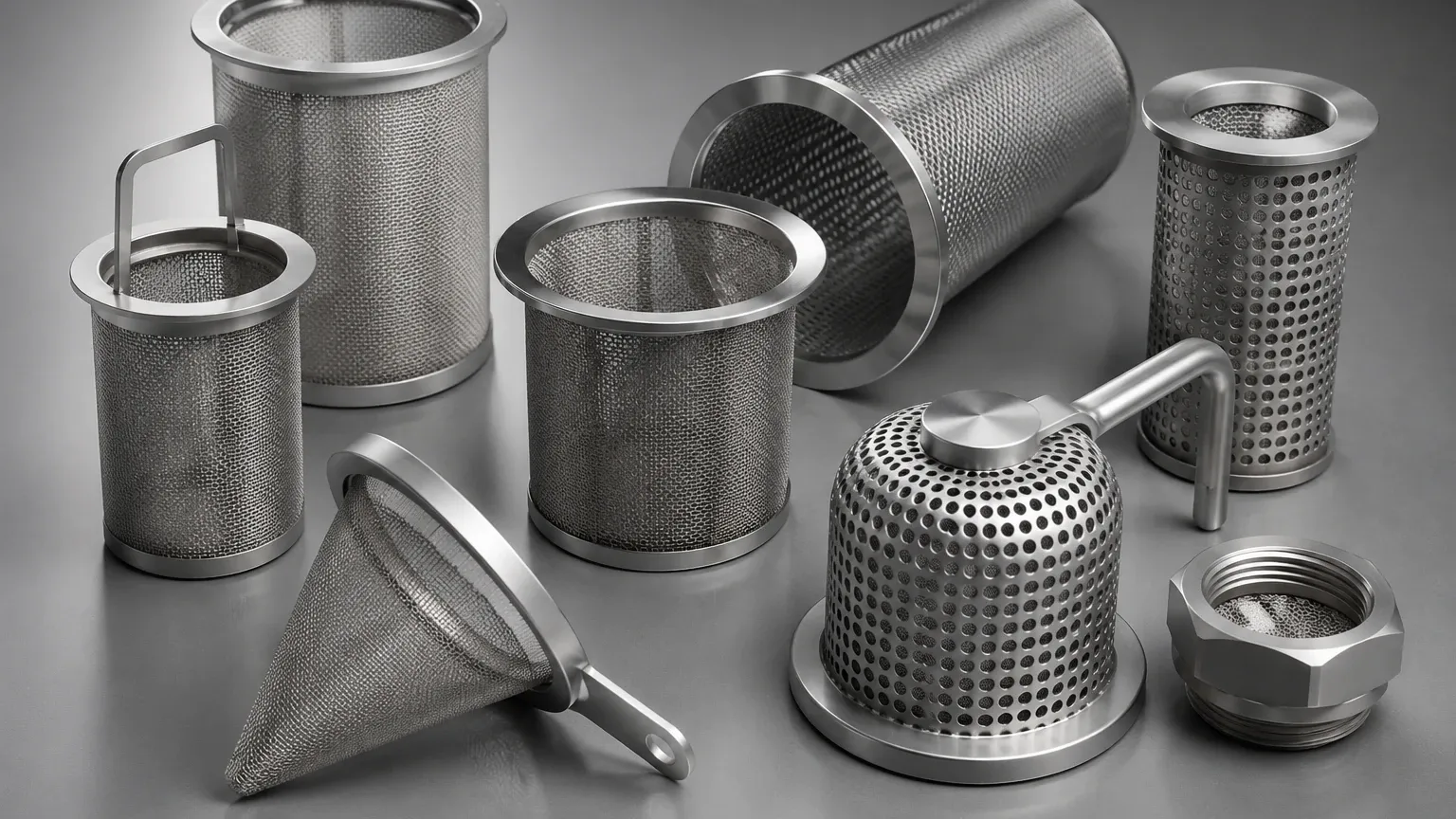
The choice between different Strainers & Baskets often depends on the required flow capacity and the ease of maintenance. A comprehensive description should specify the internal basket design, which can range from simple single-cylinder baskets to multi-layered pleated designs for increased surface area.
* Simplex Strainers: These are used in processes where the flow can be temporarily shut down for basket cleaning. The description should include the type of cover (e.g., bolted, quick-opening, or clamp-style) to indicate how easily the basket can be accessed.
* Duplex Strainers: For continuous-flow applications where the process cannot be stopped, duplex strainers feature two separate chambers with a diverting valve. The description must specify the valve type (plug, ball, or sliding gate) and the mechanism for switching flow between the two chambers.
* Temporary Strainers: Often used during system startup to catch construction debris (welding slag, tools, etc.), these are usually cone-shaped or "witch's hat" designs. Their description focuses on the length of the cone and the flange dimensions.
Material Selection and Environmental Compatibility
Material science is a cornerstone of any industrial strainer description. The housing and the internal element must be compatible with the process fluid to prevent corrosion and contamination. Stainless steel is the industry standard for demanding applications due to its durability and resistance to oxidation.
* Type 304 Stainless Steel: Suitable for general-purpose applications, water treatment, and less aggressive chemicals.
* Type 316/316L Stainless Steel: Contains molybdenum, providing superior resistance to chlorides and pitting. This is essential for pharmaceutical, food and beverage, and marine environments.
* Specialty Alloys: For highly corrosive acids or extreme temperatures, materials like Monel, Hastelloy, or Titanium may be required.
The description must also include the material for seals and gaskets. EPDM, Viton, and PTFE are common choices, each selected based on the chemical composition of the fluid and the operating temperature range. A failure to specify the correct gasket material can lead to leaks, which poses safety risks and environmental hazards.
Engineering Performance Metrics: Pressure Drop and Flow Rate
An effective strainer description is incomplete without addressing the hydraulic performance of the unit. Engineers must calculate the "Clean Pressure Drop" (Delta P). This is the loss in pressure that occurs when the fluid passes through a clean strainer at a specific flow rate and viscosity.
Fluid viscosity plays a significant role in strainer selection. High-viscosity fluids (such as heavy oils or resins) require larger straining elements and coarser mesh to maintain acceptable flow rates. If the strainer description does not account for viscosity, the resulting system may suffer from insufficient flow or mechanical failure of the straining element due to high differential pressure.
Furthermore, the description should note the maximum allowable pressure drop before cleaning is required. In many automated systems, this is monitored by differential pressure sensors that trigger an alarm or switch a duplex valve when the limit is reached.
Customization and Specification for OEM Manufacturing
In many specialized industrial sectors, off-the-shelf solutions may not meet the exact requirements of a complex system. This is where a detailed strainer description becomes a blueprint for customization. Manufacturers like Kaifil specialize in tailoring filtration components to meet specific engineering challenges.
Customization options that should be detailed in a technical specification include:
* Reinforced Baskets: For high-pressure applications where the basket might collapse under the weight of collected debris.
* Magnetic Inserts: Used to capture fine ferrous particles that might pass through a standard mesh.
* Specific Surface Finishes: In the pharmaceutical and food industries, internal surfaces must often be polished to a specific Ra (Roughness Average) to prevent bacterial growth and ensure ease of sterilization.
* Custom Dimensions: Tailoring the height, diameter, or nozzle orientation to fit within the spatial constraints of an existing skid or piping layout.
By providing a granular description, engineers ensure that the OEM manufacturer can produce a component that integrates seamlessly into the larger process architecture.
Maintenance and Total Cost of Ownership (TCO)
Finally, a professional perspective on strainers must consider the long-term operational costs. The initial purchase price is often a small fraction of the total cost of ownership, which includes maintenance labor, replacement parts, and the cost of process downtime.
A well-drafted strainer description aids in reducing TCO by specifying features that simplify maintenance. For example, specifying a "quick-opening cover" can reduce the time required for basket cleaning from thirty minutes to five minutes. Similarly, choosing a high-grade stainless steel for the basket may increase the initial cost but significantly extend the replacement cycle, especially in abrasive or corrosive environments.
When evaluating Strainers & Baskets, technical professionals should also confirm the availability of replacement elements. A strainer is only as effective as its internal mesh; having a clear description of the mesh construction ensures that replacement parts can be sourced accurately, maintaining the original performance standards of the system.
In conclusion, the strainer description is the primary communication tool between the engineer, the purchasing department, and the manufacturer. By focusing on material integrity, hydraulic performance, and structural configuration, organizations can ensure they implement filtration solutions that are both reliable and cost-effective.
