


Strainer Hsn Code
In the landscape of industrial procurement and engineering, the technical specification of a component is only one half of the equation. For global manufacturers and distributors, the regulatory and fiscal classification of products is equally critical. When sourcing Strainers & Baskets, understanding the correct strainer hsn code (Harmonized System of Nomenclature) is essential for ensuring compliance, calculating accurate landed costs, and streamlining customs clearance.
Industrial strainers are specialized filtration components designed to remove unwanted solids from liquid or gas streams. They serve as the primary line of defense for expensive downstream equipment such as pumps, valves, and heat exchangers. However, because these components can range from simple wire mesh inserts to complex high-pressure housings, their classification for international trade requires a nuanced understanding of both the product’s function and its material composition.
The Critical Role of Strainers & Baskets in Fluid Systems
Before diving into the complexities of the strainer hsn code, it is important to define the engineering utility of these components. Unlike fine filters that target microscopic particles, strainers are typically used for coarser filtration, often protecting systems from debris that could cause mechanical failure or process contamination.
In chemical processing, pharmaceutical manufacturing, and food production, the integrity of the filtration system is paramount. Stainless steel is the material of choice for these applications due to its corrosion resistance and ability to withstand high temperatures and pressures. Kaifil specializes in manufacturing these high-performance components, ensuring that every basket and strainer meets the rigorous demands of industrial environments.
Protecting Downstream Assets
Without effective strainers & baskets, particulate matter can lead to:
* Pump Impeller Damage: Abrasive solids can erode impellers, leading to loss of head and eventual pump failure.
* Valve Seating Issues: Debris trapped in valve seats prevents proper closure, causing leaks and safety hazards.
* Heat Exchanger Fouling: Solids can accumulate in the narrow passages of plate or shell-and-tube heat exchangers, drastically reducing thermal efficiency.
Understanding the Strainer HSN Code for Global Trade
The HSN code is a six-digit (or more, depending on the country) uniform code used to classify traded products. For engineers and purchasing managers, the correct application of the strainer hsn code determines the applicable customs duties, taxes (such as GST in India or VAT in other regions), and any import/export restrictions.
Common HSN Classifications for Filtration Products
Industrial strainers generally fall under Chapter 84 or Chapter 73 of the Harmonized System, depending on their complexity and intended use.
1. HS Code 8421: This is the most common category for industrial filtration. It covers "Centrifuges, including centrifugal dryers; filtering or purifying machinery and apparatus, for liquids or gases."
* 8421.21: Specifically for the filtering or purifying of water.
* 8421.29: Others (Filtering or purifying machinery and apparatus for liquids other than water).
Most industrial basket strainers used in oil, chemical, or process lines are classified under 8421.29 because they are considered specialized machinery components for liquid purification.
2. HS Code 7326: If the product is viewed strictly as a fabricated article of iron or steel without mechanical or specialized filtering apparatus status, it might be classified under "Other articles of iron or steel."
* 7326.90: Often used for simple wire mesh baskets or perforated metal strainers that do not include a housing or complex assembly.
3. HS Code 7314: This code applies to cloth, grill, netting, and fencing of iron or steel wire. If a company is importing raw wire mesh to fabricate their own strainers, this is the relevant code.
Selecting the wrong strainer hsn code can lead to significant delays at customs, potential fines, or overpayment of duties. It is always recommended to consult with a logistics expert or the manufacturer to confirm the specific classification based on the technical drawing and material data sheet.
Technical Parameters for Selecting Industrial Strainers
Beyond the regulatory classification, engineers must focus on the performance characteristics that ensure the strainer is fit for purpose. Choosing the right Strainers & Baskets involves balancing filtration accuracy with system pressure requirements.
Filtration Accuracy and Mesh Selection
Filtration accuracy is typically measured in microns or mesh size. The mesh count refers to the number of openings per linear inch. As the mesh count increases, the size of the openings decreases, providing finer filtration. However, finer filtration also increases the resistance to flow.
* Perforated Metal: Used for coarse straining (e.g., 1/8" or 1/16" holes). It provides high structural strength.
* Wire Mesh: Used for finer straining. Stainless steel wire mesh can be layered or pleated to increase surface area and durability.
Pressure Drop (ΔP)
The pressure drop across a strainer is a critical design factor. A high initial pressure drop indicates that the strainer is too small for the flow rate or that the mesh is too fine. Engineers must calculate the "clean pressure drop" and establish a "dirty pressure drop" limit, at which point the basket must be cleaned or replaced.
Open Area Ratio (OAR)
The OAR is the ratio of the total area of the holes in the strainer to the cross-sectional area of the inlet pipe. A common industry standard is an OAR of 4:1 or 6:1. A higher OAR allows for longer run times between cleanings and a lower pressure drop.
Material Science: Why Stainless Steel is the Standard
In industrial filtration, the material of construction is non-negotiable. Kaifil utilizes high-grade stainless steel to ensure that strainers & baskets can survive aggressive chemical environments and high-temperature sterilization processes.
Grade 304 Stainless Steel
304 is the most common grade, offering excellent corrosion resistance in most atmospheric and freshwater environments. It is widely used in the food and beverage industry for general-purpose straining.
Grade 316 and 316L Stainless Steel
316 stainless steel contains molybdenum, which provides superior resistance to chlorides and acids. 316L (low carbon) is preferred for applications involving welding, as it prevents carbide precipitation and maintains corrosion resistance at the weld joints. These grades are essential for chemical processing and pharmaceutical applications.
Specialty Alloys
For extreme environments involving high concentrations of sulfuric acid or seawater, specialty alloys like Duplex stainless steel or Monel may be required. These materials ensure that the strainer does not become the weak point in the piping system.
Customization and Engineering Support for OEM Applications
Standard off-the-shelf strainers rarely meet the specific needs of complex industrial machinery. Customization is often required to fit existing piping footprints, meet specific micron ratings, or handle unusual flow velocities.
Custom Basket Designs
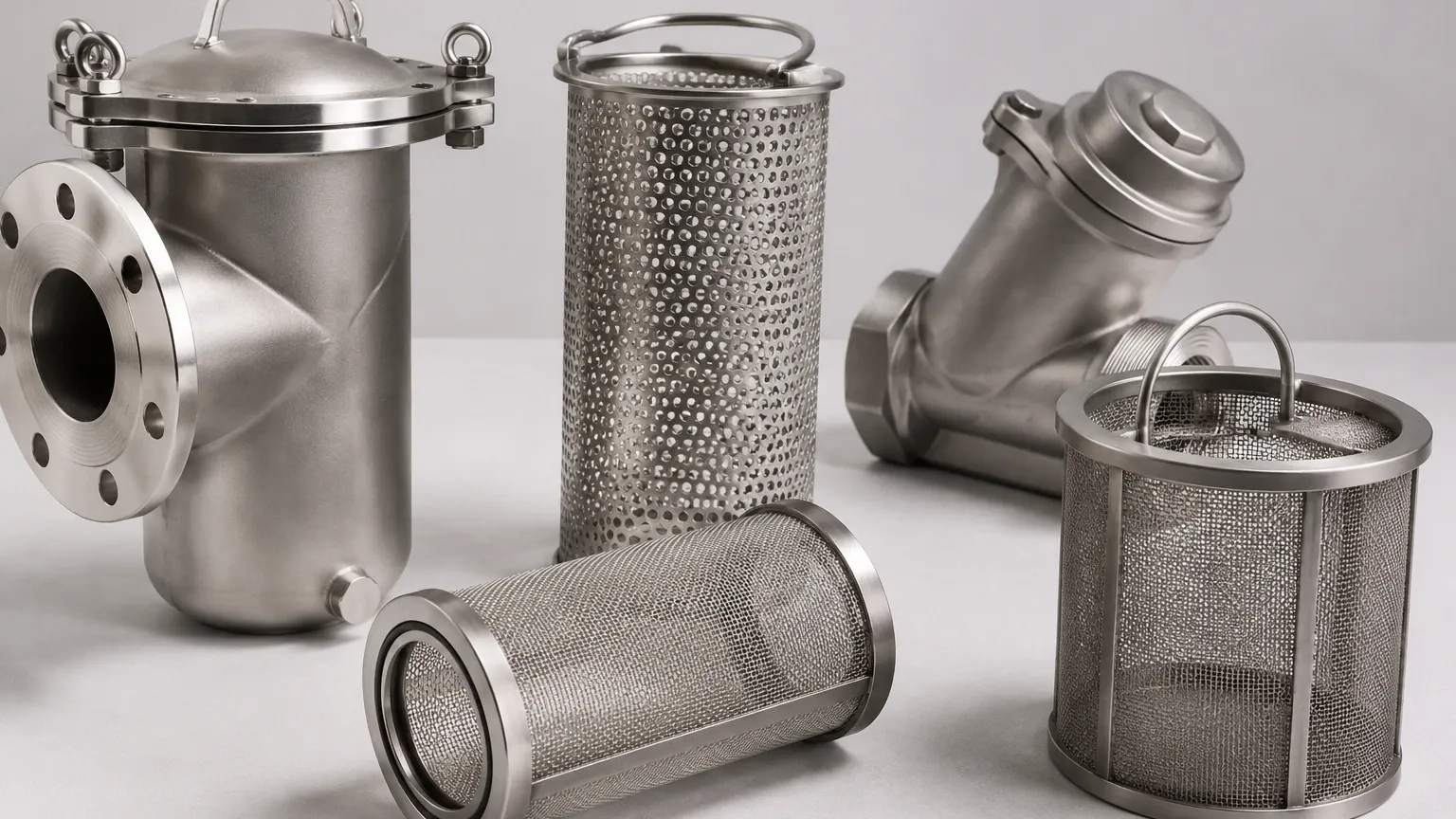
Kaifil provides OEM services for custom basket designs, including:
* Slant-top Baskets: For easy removal in tight spaces.
* Pleated Elements: To maximize surface area within a small housing footprint.
* Reinforced Structures: Adding external support cages to prevent basket collapse under high differential pressure.
* Handle Variations: Incorporating specialized lifting handles for ergonomic maintenance.
Engineering Collaboration
When selecting a strainer, providing the manufacturer with a detailed process fluid profile is vital. This includes viscosity, density, operating temperature, and the nature of the solids (e.g., hard, soft, fibrous). This data allows engineers to recommend the optimal mesh type and structural reinforcement, ensuring the final product performs reliably under real-world conditions.
Optimizing Maintenance and Replacement Cycles
The total cost of ownership (TCO) of a filtration system is heavily influenced by maintenance requirements. A strainer that is difficult to clean or frequently clogs will lead to increased labor costs and process downtime.
Cleaning Procedures
Most industrial baskets are designed to be reusable. Cleaning methods include:
* Backwashing: Reversing the flow to dislodge particles.
* Ultrasonic Cleaning: Using high-frequency sound waves in a solvent bath to remove fine particles trapped deep within the mesh.
* Manual Scrubbing: Using soft brushes to clean perforated metal or coarse mesh.
Determining Replacement Cycles
While stainless steel baskets are durable, they are not permanent. Over time, repeated pressure cycles and cleaning can lead to metal fatigue or mesh blinding (permanent entrapment of particles). Engineers should monitor the pressure drop after each cleaning; if the "clean ΔP" begins to rise, it indicates that the basket is reaching the end of its service life and should be replaced to prevent system inefficiency.
Conclusion: Integrating Technical and Regulatory Excellence
Successfully implementing Strainers & Baskets in an industrial setting requires a dual focus. On one hand, the engineering team must ensure the technical specifications—material, mesh size, and OAR—align with the process requirements. On the other hand, the procurement and logistics teams must navigate the complexities of the strainer hsn code to ensure a smooth and compliant supply chain.
By partnering with a manufacturer like Kaifil, which combines technical manufacturing expertise with an understanding of global industrial standards, companies can optimize their filtration processes. Whether you are designing a new chemical plant or upgrading a food processing line, selecting the right strainer is a fundamental step toward operational reliability and long-term cost efficiency. Always verify your HSN classification and technical requirements early in the procurement phase to avoid costly errors and ensure your fluid systems remain protected.
