


Strainer Used in Piping
In industrial fluid handling, the integrity of downstream equipment is paramount to operational efficiency and safety. A strainer used in piping acts as a critical mechanical component designed to remove unwanted solids from liquid, gas, or steam lines by means of a perforated or wire mesh straining element. While often grouped with filters, strainers are specifically engineered to protect expensive system components—such as pumps, control valves, flow meters, and heat exchangers—from damage caused by scale, rust, weld beads, and other foreign debris.
For engineers and procurement professionals, selecting the appropriate Strainers & Baskets requires a deep understanding of fluid dynamics, material compatibility, and the specific mechanical requirements of the piping system. This guide examines the technical nuances of strainer selection, installation, and maintenance within industrial environments.
The Fundamental Role of Strainers in Industrial Fluid Systems
The primary function of a strainer used in piping is the protection of the process system. In many industrial applications, even small amounts of particulate matter can lead to catastrophic failure or significant downtime. For instance, in a hydraulic system, a single metal shard can score a cylinder wall or clog a precision orifice. In chemical processing, debris can contaminate a batch or damage high-cost centrifugal pumps.
Unlike a filter, which is typically designed to remove particles measured in microns (often for the purpose of clarifying the fluid), a strainer is generally used to remove larger particles that could cause mechanical obstruction. However, the boundary between the two is fluid, as modern stainless steel mesh technology allows strainers to achieve high levels of precision. The choice to implement a strainer is essentially an insurance policy for the piping infrastructure, ensuring that the "process fluid" remains free of solids that could compromise mechanical seals or internal valve components.
Classification of Strainers and Baskets by Design
Industrial strainers are categorized based on their housing configuration and the orientation of the straining element. Each design offers specific advantages depending on the pressure, flow rate, and maintenance requirements of the system.
Y-Strainers
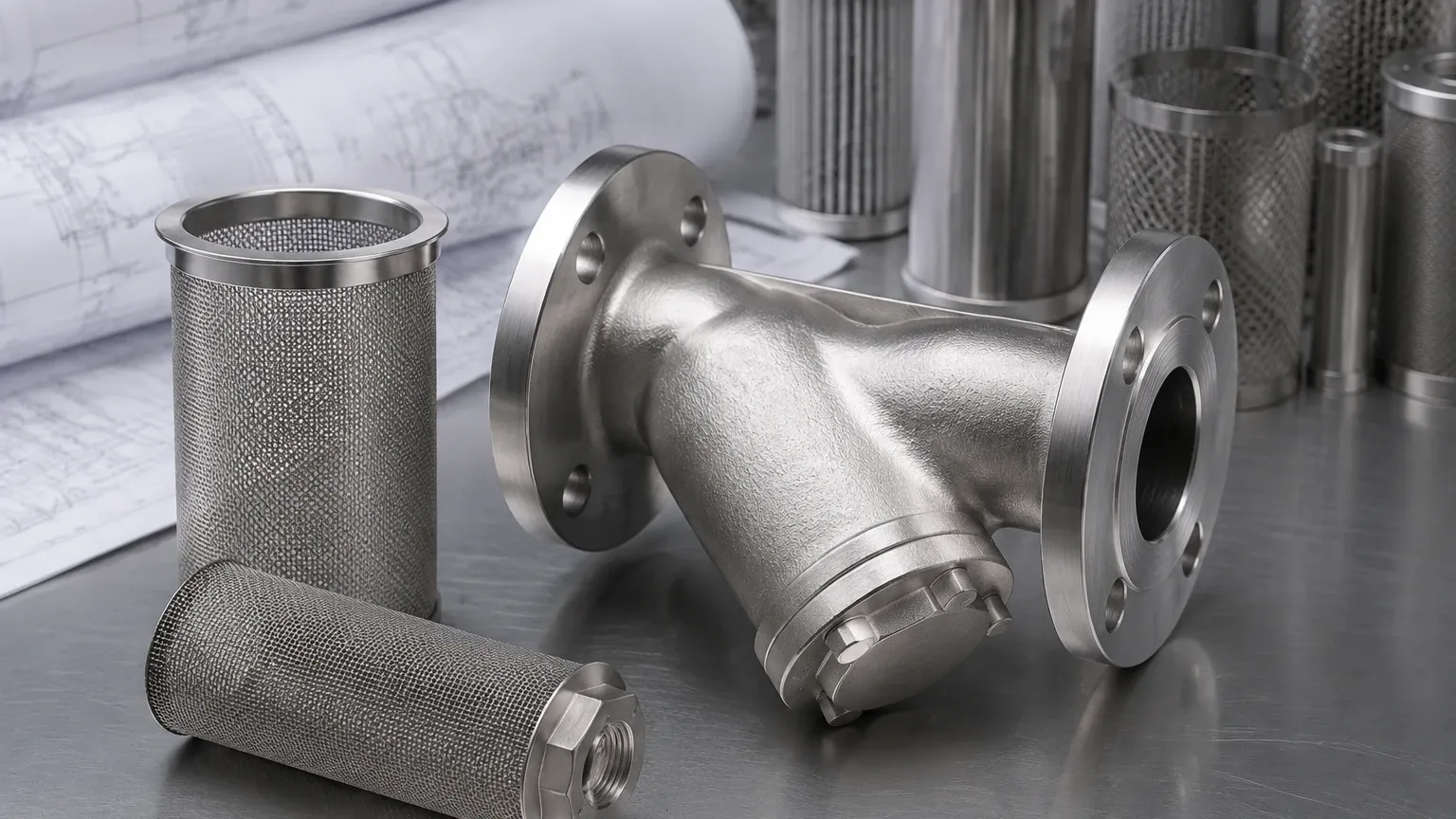
The Y-strainer is perhaps the most common type used in industrial piping. Its name is derived from its shape, which features a leg extending at an angle from the main flow path. This design is particularly well-suited for high-pressure applications (such as steam lines) where the amount of material to be removed is relatively small. Y-strainers can be installed in either horizontal or vertical positions, provided the "leg" points downward to collect debris.
Basket Strainers (Simplex)
Basket strainers, or bucket strainers, feature a vertical chamber that houses a large, removable basket. Because the basket has a significantly higher surface area than a Y-strainer element, it can hold more debris before requiring cleaning. This makes them ideal for liquid applications where high flow rates and higher solids loading are expected. Basket strainers are typically installed in horizontal lines and offer a lower pressure drop compared to Y-strainers of the same size.
Duplex Strainers
In processes where the flow cannot be shut down for maintenance, duplex strainers are employed. These units consist of two separate strainer baskets connected by a diverting valve. When one basket becomes full, the flow is diverted to the clean basket, allowing the operator to remove and clean the first basket without interrupting the process. This is a critical requirement in pharmaceutical, chemical, and cooling water systems where continuous operation is mandatory.
Material Selection and Chemical Compatibility
The longevity of a strainer used in piping is heavily dependent on its material construction. Because strainers are often exposed to corrosive fluids, high temperatures, and abrasive particles, selecting the correct alloy is an engineering priority.
Stainless Steel (304 and 316L)
Stainless steel is the industry standard for high-performance filtration components. Type 304 provides excellent resistance to many chemicals and atmospheric conditions. However, for applications involving chlorides, acids, or high-purity pharmaceutical requirements, Type 316L is preferred due to its superior corrosion resistance and lower carbon content, which prevents sensitization during welding. Kaifil specializes in these alloys to ensure that the internal mesh and the housing can withstand demanding chemical environments.
Specialty Alloys
In extreme environments—such as seawater intake or highly acidic chemical processing—specialty alloys like Monel, Hastelloy, or Duplex Stainless Steel may be required. These materials prevent pitting and stress-corrosion cracking, ensuring the strainer does not become a point of failure in the piping system.
Engineering Specifications: Sizing and Filtration Accuracy
Selecting a strainer is not merely a matter of matching the pipe size. An undersized strainer will cause excessive pressure drop, while an oversized one may be unnecessarily expensive and heavy. Engineers must evaluate several technical parameters:
Mesh vs. Perforation
The straining element usually consists of a perforated metal sheet that acts as a support for a finer wire mesh. Perforated metals are used for coarse straining (e.g., 1/8" or 1/16" holes), while wire mesh is used for finer applications. Mesh size is defined by the number of openings per linear inch. For example, a 100-mesh screen has 100 openings per inch, capable of stopping particles larger than approximately 140 microns.
Open Area Ratio (OAR)
The Open Area Ratio is the relationship between the internal cross-sectional area of the pipe and the total open area of the holes in the strainer element. A common engineering standard is an OAR of 4:1. This means the strainer has four times the flow area of the pipe, which ensures that even as the strainer begins to clog, the pressure drop remains within acceptable limits for a longer period.
Viscosity Considerations
Fluid viscosity significantly impacts the pressure drop across a strainer. Higher viscosity fluids (such as heavy oils or resins) require larger straining areas and coarser mesh to maintain flow. Engineers must calculate the "Clean Pressure Drop" using the specific gravity and viscosity of the fluid at operating temperature to ensure the pump head is sufficient.
Flow Dynamics and Pressure Drop Considerations
Pressure drop (Delta P) is the loss in fluid pressure as it passes through the strainer. In any piping system, maintaining the required discharge pressure is vital. The total pressure drop is the sum of the drop through the housing and the drop through the clean straining element.
As debris accumulates on the mesh, the effective open area decreases, and the pressure drop increases exponentially. If the pressure drop exceeds the structural integrity of the basket, the element may collapse, sending both the debris and pieces of the mesh downstream—the very outcome the strainer was installed to prevent. Therefore, industrial strainers should always be equipped with differential pressure gauges or sensors to alert operators when the cleaning threshold has been reached.
Installation and Maintenance Protocols
Proper installation is critical to the performance of a strainer used in piping. For Y-strainers in steam service, the strainer should be installed horizontally with the leg in the horizontal plane to prevent water (condensate) from collecting in the pocket, which could cause water hammer. In liquid service, the leg should point downward.
Maintenance cycles depend on the "cleanliness" of the process. In new piping systems, strainers often clog rapidly during the first few hours of operation as construction debris (weld slag, tape, dirt) is flushed through. After the initial commissioning phase, maintenance becomes a function of the process fluid quality.
When cleaning a basket strainer, the system must be depressurized. The use of "quick-opening" covers can significantly reduce downtime. For stainless steel mesh elements, cleaning should be performed carefully using ultrasonic baths or high-pressure air/water from the outside-in to avoid embedding particles deeper into the weave.
Evaluating Total Cost of Ownership and OEM Customization
While the initial purchase price of a strainer is a factor, the total cost of ownership (TCO) includes maintenance labor, replacement element costs, and the potential cost of downstream equipment repair if a low-quality strainer fails.
Customization is often required for specific industrial footprints. OEM manufacturers like Kaifil provide tailored solutions where standard off-the-shelf strainers may not fit. This includes custom flange ratings (ANSI, DIN, JIS), specialized mesh linings for specific particle sizes, and reinforced baskets for high-differential pressure scenarios. By working with a manufacturer that understands the engineering nuances of stainless steel filtration, purchasing teams can ensure that the Strainers & Baskets they procure are optimized for the specific flow characteristics and chemical realities of their facility.
In conclusion, the strainer used in piping is a fundamental component that requires careful engineering selection. By prioritizing material quality, accurate sizing based on open area ratios, and robust maintenance access, industrial operators can protect their infrastructure and maintain consistent process performance.
