


Strainers for Fire Pumps
In industrial and commercial fire protection, the fire pump is the critical component that ensures adequate water pressure and flow reach suppression systems during an emergency. However, the reliability of these pumps is often threatened by the very medium they transport: water. Debris, scale, and foreign objects present in water sources—whether from municipal mains, suction tanks, or open bodies of water like reservoirs—can cause catastrophic failure if they reach the pump’s internal components. This is why the selection and engineering of strainers for fire pumps are fundamental to system integrity.
Industrial filtration specialists like Kaifil emphasize that a fire pump strainer is not merely a peripheral accessory; it is a precision-engineered safety component. Choosing the right Strainers & Baskets requires a deep understanding of hydraulic dynamics, material science, and regulatory compliance to ensure that the system remains operational when every second counts.
The Critical Role of Strainers in Fire Protection
The primary function of a strainer in a fire pump system is to protect the pump impeller and the downstream distribution network. Fire pumps, particularly centrifugal designs, operate at high speeds. Even small particulates can cause erosion of the impeller blades over time, while larger debris can lead to immediate mechanical blockage or imbalance, resulting in pump cavitation or total motor failure.
Beyond pump protection, strainers prevent the clogging of fire sprinklers and spray nozzles. Most fire suppression nozzles have relatively small orifices. If debris passes through the pump and into the piping network, it can lodge in these orifices, rendering the suppression system ineffective. Therefore, strainers for fire pumps serve as the first and most vital line of defense for the entire fire protection infrastructure.
Engineering Standards and NFPA 20 Compliance
For engineers and facility managers, the design of fire pump suction strainers is strictly governed by standards such as NFPA 20 (Standard for the Installation of Stationary Pumps for Fire Protection). These regulations are designed to ensure that the strainer does not become a point of failure itself by restricting flow excessively.
The Net Open Area Requirement
One of the most critical specifications in NFPA 20 is the requirement for the net open area of the strainer. Generally, the standard dictates that the total area of the openings in the strainer must be at least four times the cross-sectional area of the suction pipe. This "4:1 ratio" is essential because it accounts for the inevitable partial clogging that occurs during operation. By providing a large surface area, the strainer ensures that even if a portion of the mesh is obstructed, the pump can still draw the required volume of water without experiencing a significant pressure drop or suction-side cavitation.
Mesh and Perforation Sizing
Selecting the correct perforation or mesh size is a balancing act between protection and flow. If the mesh is too coarse, harmful debris passes through. If it is too fine, the strainer will clog rapidly, causing a hydraulic bottleneck. In fire pump applications, the goal is typically to remove solids large enough to damage the pump or clog the smallest downstream nozzle. Engineers must verify the orifice size of the sprinklers in the system to determine the maximum allowable particle size for the strainer.
Types of Strainers for Fire Pump Applications
Depending on the water source and the physical layout of the pump room, different configurations of strainers & baskets are utilized. Each has specific advantages and maintenance requirements.
1. Suction Bell Strainers
Used primarily in vertical turbine pump installations where water is drawn from a wet pit or reservoir, suction bell strainers are attached directly to the bottom of the pump column. These are often designed as robust, basket-style components made from heavy-duty stainless steel to withstand the mechanical stresses of submerged operation.
2. Y-Strainers and T-Strainers
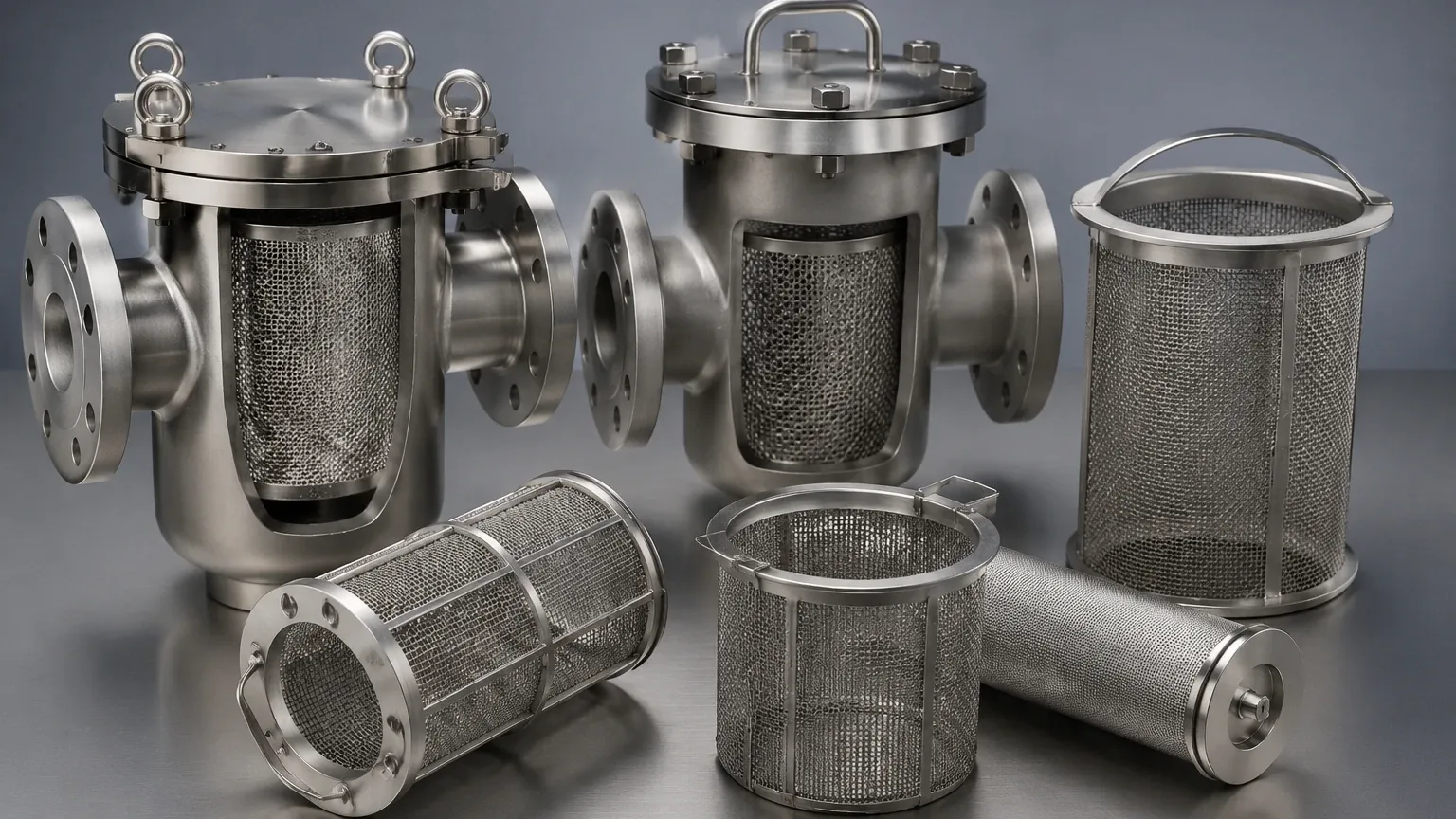
In horizontal split-case pump installations drawing from pressurized mains or tanks, Y-strainers or T-strainers are common. Y-strainers are often preferred for their compact footprint, while T-strainers offer a straight-through flow path that can result in lower pressure drops. Both types allow for the removal of the internal basket for cleaning without disconnecting the main piping.
3. Basket Strainers (Simplex and Duplex)
For systems where high debris loads are expected, basket strainers provide a larger holding capacity for captured solids. While simplex baskets are standard, some critical industrial applications may utilize duplex strainers, which allow flow to be diverted to a clean basket while the other is serviced, ensuring the fire system never has to be taken offline for maintenance.
Material Selection: Why Stainless Steel is Standard
Fire protection systems often sit idle for long periods, with water remaining stagnant inside the pipes. This environment is highly conducive to corrosion. Using inferior materials for strainers for fire pumps can lead to two major issues: the strainer itself can corrode and fail, or the corrosion products (rust scales) can break off and clog the system.
Kaifil recommends stainless steel—specifically Grade 304 or Grade 316—for fire pump filtration components.
* Corrosion Resistance: Stainless steel resists the pitting and oxidation that plague carbon steel or galvanized components in water-contact applications.
* Structural Integrity: During a fire event, the pump operates at maximum capacity. The strainer must be strong enough to resist the high differential pressures created by suction without collapsing or deforming.
* Longevity: A stainless steel basket strainer can last the entire lifespan of the fire pump system, providing a lower total cost of ownership compared to materials that require frequent replacement due to degradation.
Hydraulic Considerations and Pressure Drop
Every component added to the suction side of a fire pump introduces friction loss, which reduces the Net Positive Suction Head Available (NPSHa). If the pressure drop across the strainer is too high, the pump may cavitate, leading to noise, vibration, and damage to the impeller and seals.
When specifying strainers for fire pumps, engineers must consult the manufacturer’s flow coefficient (Cv) data. This data allows the designer to calculate the expected pressure drop at the pump’s rated flow and at 150% of the rated flow (as required by NFPA 20). A well-designed basket strainer will minimize turbulence and provide a smooth flow path to the pump inlet, ensuring the hydraulic performance of the system remains within the required safety margins.
Maintenance and Operational Readiness
A strainer is only effective if it is clean. In fire protection, the "set it and forget it" mentality can be dangerous. Standard maintenance protocols should include:
* Regular Inspection: During periodic fire pump flow tests, the pressure differential across the strainer should be monitored. A significant increase in pressure drop indicates that the basket is accumulating debris.
* Ease of Access: When designing the pump room, sufficient clearance must be provided to remove the strainer basket. If the strainer is difficult to access, it is less likely to be serviced properly.
* Blow-off Valves: Many Y and basket strainers can be equipped with blow-off valves. This allows for the flushing of loose sediment from the bottom of the strainer housing without having to open the unit, which is useful for routine maintenance between full inspections.
Customization in Industrial Fire Systems
Not every fire pump installation is standard. Industrial sites, such as chemical processing plants or offshore platforms, often face unique challenges. These may include corrosive saltwater environments, high-temperature water, or the presence of specific chemical contaminants.
In these scenarios, off-the-shelf solutions may not suffice. Custom-manufactured Strainers & Baskets allow for the adjustment of dimensions, flange ratings, and material grades to meet specific site requirements. For example, an offshore fire pump might require Super Duplex stainless steel to survive constant exposure to seawater, while a refinery might need specialized mesh linings to capture fine particulates unique to their process water.
Conclusion: Ensuring Reliability Through Proper Selection
The effectiveness of a fire suppression system is entirely dependent on the reliability of the fire pump, and the pump’s reliability is inextricably linked to the quality of its suction strainer. By adhering to NFPA standards, selecting high-grade materials like stainless steel, and carefully calculating hydraulic impacts, engineers can ensure that strainers for fire pumps perform their duty without compromise.
When evaluating filtration components, it is essential to partner with manufacturers who understand the technical rigors of industrial applications. High-quality construction, precise filtration accuracy, and a focus on durability are the hallmarks of a filtration solution that protects not just the equipment, but the lives and property the fire system is designed to save.
