


Strainers in Piping
In industrial fluid handling, the integrity of downstream equipment often depends on the efficiency of primary filtration. Strainers in piping serve as the essential mechanical components designed to remove unwanted solids from liquid, gas, or steam lines by means of a perforated or wire mesh straining element. Unlike fine filters, which are typically designed to remove sub-micron particles, strainers are generally used to protect pumps, valves, meters, and heat exchangers from larger debris that could cause mechanical failure or process downtime.
Selecting the correct configuration for strainers in piping requires a deep understanding of fluid dynamics, material compatibility, and the specific operational constraints of the industrial environment. This guide examines the technical considerations, design variations, and engineering criteria necessary for optimizing filtration performance.
The Function and Importance of Strainers in Piping Systems
The primary role of a strainer is protection. In any complex piping network, debris such as pipe scale, weld beads, rust, and external contaminants can enter the flow stream. If left unmanaged, these particles can lead to catastrophic equipment failure. For example, in centrifugal pumps, even small solids can erode impellers or clog mechanical seals, leading to expensive repairs and unscheduled maintenance.
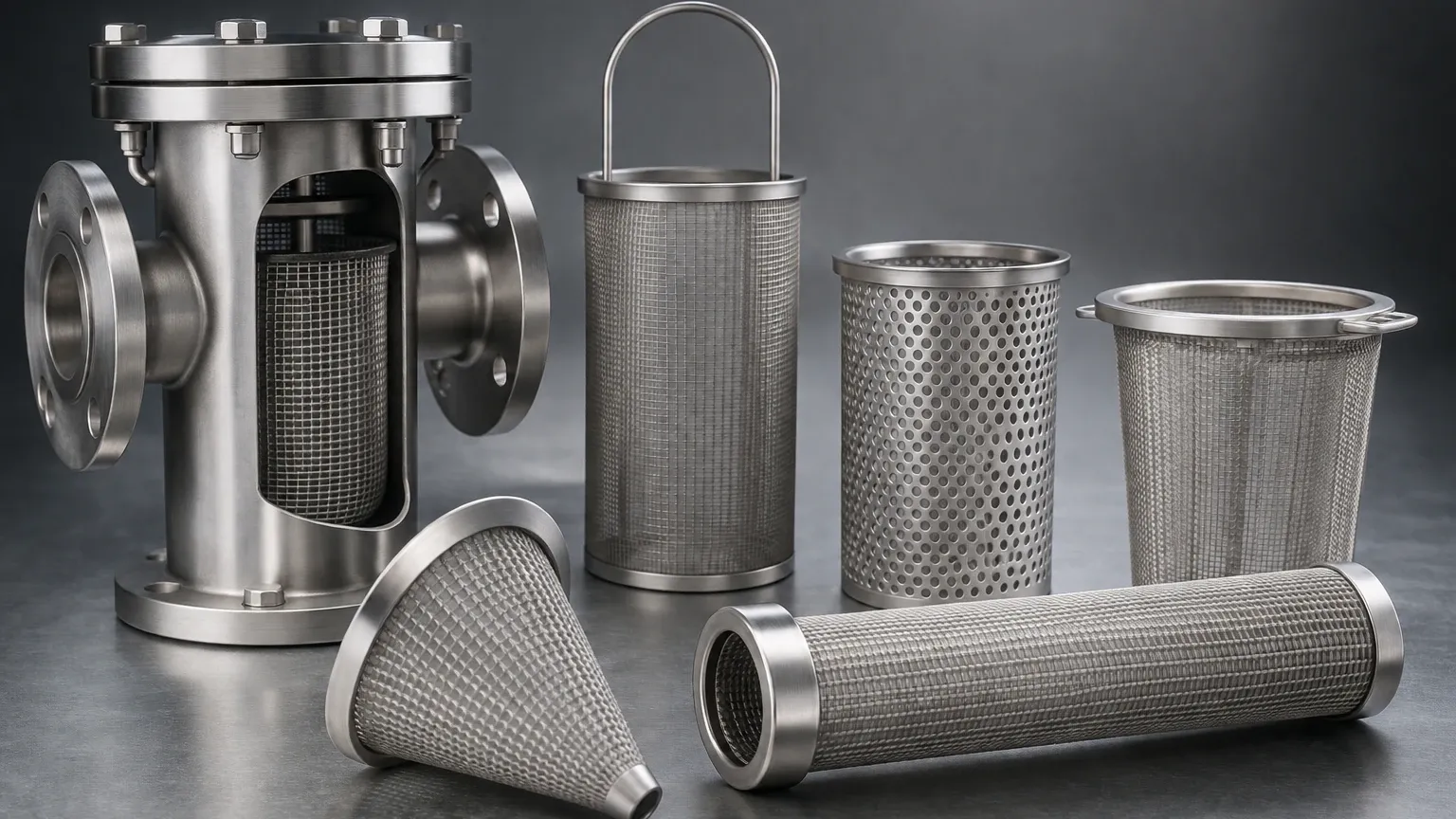
Beyond simple protection, strainers in piping are critical for maintaining process consistency. In industries such as chemical processing and water treatment, the presence of oversized particulates can interfere with chemical reactions or contaminate the final product. By implementing robust Strainers & Baskets, engineers ensure that the fluid reaching sensitive components meets the required cleanliness standards.
Types of Piping Strainers and Their Applications
Industrial strainers are categorized by their body shape and the orientation of their flow path. Each design offers specific advantages depending on the pressure, flow rate, and maintenance requirements of the system.
Y-Strainers
The Y-strainer is perhaps the most common type used in industrial piping. Its name is derived from its shape, where the straining element is housed in a leg that branches off the main flow path at an angle. Y-strainers are particularly effective in high-pressure steam lines and gas applications. Their compact design allows them to be installed in both horizontal and vertical positions, provided the "leg" points downward to collect debris.
Basket Strainers (Simplex and Duplex)
Basket strainers feature a vertical cylinder that houses a removable basket-shaped element. These are generally used in horizontal lines where high flow rates and a large debris-holding capacity are required.
* Simplex Strainers: Used in batch processes where the flow can be interrupted to clean the basket.
* Duplex Strainers: These consist of two separate strainer chambers connected by a diverting valve. They are essential for continuous-flow applications—such as oil lubrication systems or cooling water lines—where the process cannot be shut down for maintenance. One chamber remains in operation while the other is cleaned.
T-Strainers
T-strainers, or tee-type strainers, are characterized by a compact, right-angle design. They offer a lower pressure drop compared to Y-strainers and are often used in larger pipe diameters where space is at a premium. They are commonly found in suction lines for pumps.
Key Engineering Evaluation Criteria
When specifying strainers in piping, engineers must move beyond basic sizing and evaluate the component based on its performance under real-world conditions. The following factors are critical to the selection process:
1. Pressure Drop ($ΔP$)
The pressure drop is the difference in pressure between the inlet and the outlet of the strainer. A high initial pressure drop indicates that the strainer is undersized or that the mesh is too fine for the application. As the strainer collects debris, the $ΔP$ will increase. It is standard engineering practice to size a strainer so that the initial pressure drop does not exceed 2 PSI at the maximum flow rate.
2. Open Area Ratio (OAR)
The Open Area Ratio is the relationship between the total area of the holes in the straining element and the cross-sectional area of the inlet pipe. A high OAR (typically 4:1 or higher) ensures that the strainer can accumulate a significant amount of debris before the pressure drop becomes critical. This directly impacts the frequency of maintenance cycles.
3. Material Selection and Corrosion Resistance
Since strainers are often exposed to aggressive chemicals or high temperatures, material selection is paramount. Stainless steel (304, 316, or 316L) is the industry standard due to its excellent corrosion resistance and mechanical strength. For pharmaceutical or food and beverage applications, 316L stainless steel is preferred to prevent metallic contamination and ensure compliance with hygiene standards.
Critical Design Factors for Custom Strainers & Baskets
Standard off-the-shelf components often fail to meet the rigorous demands of specialized industrial processes. Customization allows for the optimization of the filtration element to match the specific particle size distribution and fluid viscosity of the application.
When designing custom Strainers & Baskets, engineers consider several structural enhancements:
* Reinforced Mesh: For high-pressure applications, the wire mesh may be backed by a perforated metal plate to prevent the element from collapsing under high differential pressure.
* Custom Perforation Patterns: The size and spacing of the perforations can be adjusted to balance flow efficiency with filtration accuracy.
* Closure Types: Depending on the frequency of cleaning, strainers can be equipped with bolted covers for high-pressure safety or quick-opening "swing-bolt" covers for rapid maintenance.
Common Risks and Operational Challenges
Failure to properly specify or maintain strainers in piping can lead to several operational risks:
* Bypass: If the straining element is not seated correctly within the housing, fluid will bypass the mesh, allowing contaminants to move downstream. This is often caused by poor manufacturing tolerances or damaged gaskets.
* Structural Collapse: If the differential pressure across a clogged strainer exceeds the burst pressure of the element, the mesh can collapse. This not only allows all accumulated debris to flush into the system but also introduces fragments of the broken strainer into the flow.
* Erosion-Corrosion: High-velocity fluid entering the strainer can cause localized erosion at the inlet, especially if the fluid contains abrasive particles. This can thin the housing walls over time, leading to leaks.
Maintenance and Replacement Cycles
Effective maintenance of strainers in piping is governed by the monitoring of differential pressure. Installing pressure gauges on both the upstream and downstream sides of the strainer allows operators to identify exactly when the element needs cleaning.
Cleaning protocols should be standardized. For basket strainers, the element should be removed and cleaned using an ultrasonic bath or high-pressure water jet, depending on the nature of the contaminants. It is also vital to inspect the seals and gaskets during every maintenance cycle; a compromised seal is a primary cause of system bypass.
In many high-demand environments, keeping spare Strainers & Baskets on-site is a cost-effective strategy to minimize downtime during cleaning cycles. Replacing a dirty basket with a clean one takes minutes, whereas waiting to clean a single basket can halt production for hours.
Procurement Guide: What to Confirm Before Ordering
To ensure the selected strainer meets the technical requirements of the project, purchasing teams and engineers should confirm the following data points with their manufacturer:
1. Fluid Characteristics: Confirm the viscosity, specific gravity, and chemical composition of the fluid. Highly viscous fluids require larger strainers to maintain acceptable pressure drops.
2. Operating Parameters: Define the maximum operating pressure and temperature. This dictates the pressure rating (e.g., ASME Class 150, 300, or 600) of the strainer body.
3. Filtration Requirement: Specify the "retention micron rating." This is determined by the smallest orifice or clearance in the downstream equipment that needs protection.
4. Connection Type: Ensure the strainer connections (flanged, threaded, or socket weld) match the existing piping standards to avoid the need for adapters that could introduce leak points.
5. Total Cost of Ownership: Look beyond the initial purchase price. Consider the durability of the materials, the ease of maintenance, and the availability of replacement elements, as these factors significantly impact the long-term operational budget.
By focusing on these technical fundamentals, industrial facilities can implement strainers in piping that provide reliable, long-term protection for their most critical assets.
