


Strainers in Water
In industrial fluid handling, the management of suspended solids is a critical factor in maintaining system integrity and operational efficiency. The use of strainers in water systems serves as the primary defense mechanism for downstream equipment, such as pumps, control valves, heat exchangers, and spray nozzles. Unlike fine filtration systems designed to remove microscopic contaminants, industrial strainers are engineered to capture larger debris—ranging from scale and rust to pebbles and organic matter—that could otherwise cause mechanical failure or significant process downtime.
For engineers and procurement professionals, selecting the correct straining solution requires a deep understanding of fluid dynamics, material compatibility, and the specific requirements of the application. Whether the water source is a municipal supply, a cooling tower loop, or a raw intake from a river, the configuration of the strainer must align with the expected contaminant load and the required flow rates.
The Technical Distinction Between Straining and Filtering
While the terms are often used interchangeably in casual conversation, in a B2B industrial context, a clear distinction exists between straining and filtering. Straining is generally defined as the removal of larger particles from a liquid using a perforated metal or wire mesh medium. This process is typically mechanical and focuses on protecting the "macro" components of a system.
Strainers in water applications are usually rated by mesh size or hole diameter rather than the sub-micron ratings common in membrane filtration. The goal is to provide a low-pressure-drop solution that can handle high flow volumes while sequestering debris in a way that allows for easy removal. Selecting an overly fine mesh for a high-debris water line can lead to rapid clogging and excessive maintenance, while an overly coarse mesh may allow damaging particles to pass through to sensitive components.
Material Selection for Industrial Water Environments
Industrial water is rarely "pure." Depending on the source and the process, it may contain dissolved minerals, chemicals, or varying pH levels that can be highly corrosive to standard carbon steel. Consequently, stainless steel is the industry standard for high-performance strainers.
1. Type 304 Stainless Steel: This is the most common material for general water service. It provides excellent strength and good corrosion resistance for treated water, cooling water, and many industrial process streams.
2. Type 316/316L Stainless Steel: For more aggressive environments, such as brackish water, seawater, or water containing high chloride levels, 316 stainless steel is preferred. The addition of molybdenum enhances resistance to pitting and crevice corrosion.
3. Specialty Alloys: In chemical processing or high-temperature steam applications, specialized alloys may be required to ensure the longevity of the strainer housing and the internal mesh element.
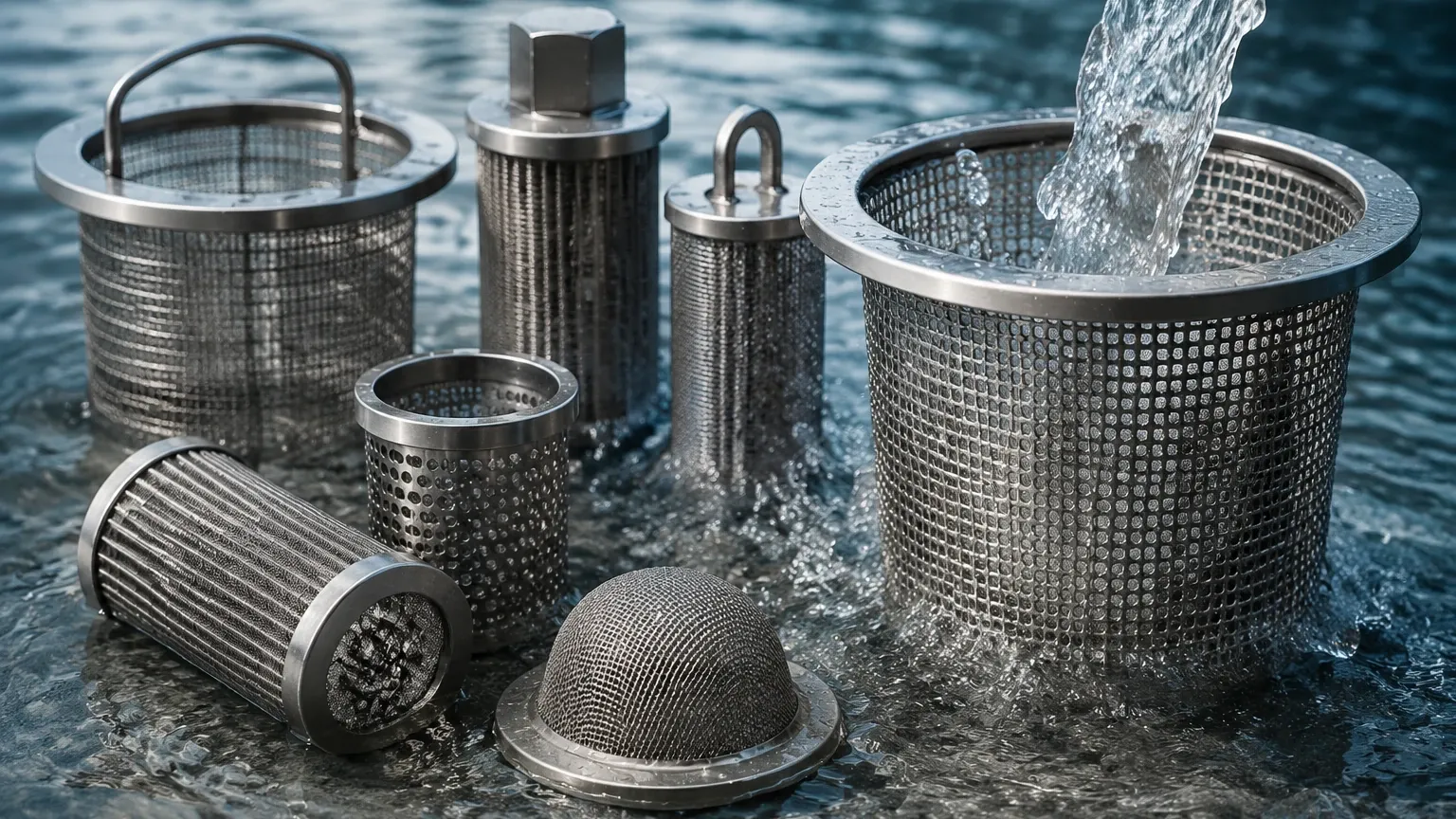
Kaifil specializes in manufacturing these components with precision, ensuring that the structural integrity of the Strainers & Baskets remains uncompromised even under high-pressure differentials.
Engineering Considerations: Pressure Drop and Flow Velocity
One of the most critical parameters in the design of water systems is the allowable pressure drop (ΔP) across the strainer. Every strainer introduces some resistance to flow. As the strainer collects debris, this resistance increases.
The Open Area Ratio
Engineers must consider the "Open Area Ratio" (OAR) of the strainer. This is the ratio of the total area of the holes in the mesh to the cross-sectional area of the inlet pipe. A common industry standard for water strainers is an OAR of 4:1 or higher. A higher OAR means the strainer can accumulate more debris before the pressure drop becomes significant, thereby extending the intervals between cleaning cycles.
Flow Velocity Limits
In water applications, flow velocity is typically kept within specific ranges (usually 5 to 10 feet per second for liquids) to prevent erosion of the strainer element and to minimize turbulence. If the velocity is too high, the force of the water can actually push flexible debris through the mesh or cause fatigue in the metal structure over time.
Common Configurations for Water Straining
The physical layout of the piping system and the nature of the process dictate which type of strainer is most appropriate.
Y-Strainers
Y-strainers are characterized by their compact, "Y" shaped design. They are most effective in applications where the amount of debris is relatively low. They are often installed in pressurized lines, either horizontally or vertically, and are favored for their low initial cost and space-saving profile. However, because their dirt-holding capacity is limited, they are not ideal for high-sediment water sources.
Basket Strainers
For systems where high flow rates and significant debris loads are expected, basket strainers are the preferred choice. These units feature a large, vertical cylinder (the basket) that provides a much greater surface area than a Y-strainer. This design allows for a higher OAR and longer run times. Basket strainers are typically used in horizontal pipelines and are designed for easy top-access, allowing maintenance teams to remove and clean the basket without dismantling the entire piping assembly.
Duplex Strainers
In critical processes where the water flow cannot be interrupted—such as cooling systems for power plants or continuous chemical production—duplex strainers are utilized. These consist of two separate strainer housings connected by a diverting valve. When one side becomes clogged, the flow is diverted to the clean side, allowing the first basket to be serviced without shutting down the system.
Application-Specific Requirements for Strainers in Water
The requirements for strainers in water vary significantly across different industrial sectors:
* Food and Beverage: Water used in these facilities must meet strict hygiene standards. Strainers must be made of food-grade stainless steel with smooth surface finishes (often electropolished) to prevent bacterial growth and allow for thorough Clean-in-Place (CIP) procedures.
* Chemical Processing: Compatibility with various process chemicals is paramount. The strainer must withstand not just the water, but any additives or contaminants present in the stream without leaching or corroding.
* HVAC and Cooling Towers: These systems often deal with scale and biological growth. Strainers are essential to prevent this material from fouling the small passages in heat exchangers, which would drastically reduce thermal efficiency.
* Pharmaceutical: High-purity water systems require precision-engineered strainers that ensure no particulate matter enters the sensitive downstream filtration stages.
Maintenance and Lifecycle Management
The total cost of ownership for strainers in water is determined less by the initial purchase price and more by the maintenance requirements and the impact on system energy consumption.
Monitoring Differential Pressure
Installing differential pressure gauges across the strainer is the most effective way to manage maintenance. By monitoring the pressure drop, operators can clean the strainer exactly when needed—neither too early (wasting labor) nor too late (risking pump cavitation or mesh failure).
Cleaning Procedures
Stainless steel mesh and perforated baskets are designed for durability. In most water applications, cleaning involves removing the basket and using a high-pressure water spray or a soft brush to dislodge debris. It is vital to inspect the mesh for any signs of "blinding" (where particles become permanently lodged in the openings) or mechanical damage during every cleaning cycle.
Customization and OEM Integration
Standard off-the-shelf strainers do not always meet the rigorous demands of specialized industrial equipment. This is where custom manufacturing becomes essential. Factors that can be customized include:
* Micron/Mesh Ratings: Fine-tuning the aperture size to match specific particle distribution data.
* Housing Dimensions: Fitting a high-capacity strainer into a restricted physical footprint.
* Connection Types: Providing flanged, threaded, or sanitary connections to match existing infrastructure.
* Reinforced Baskets: Adding structural support to the mesh to handle high-pressure surges or heavy debris loads.
As a professional manufacturer, Kaifil works closely with engineering teams to develop these customized solutions, ensuring that the filtration components are optimized for the specific fluid dynamics of the project. By focusing on precision manufacturing and high-quality materials, we help industrial operators achieve reliable, long-term performance in their water management systems.
Conclusion: Confirming Requirements for Procurement
Before finalizing a selection for strainers in water, technical buyers should confirm several key data points with their supplier:
1. Maximum Flow Rate: To ensure the strainer is sized for an acceptable initial pressure drop.
2. Nature of Contaminants: Is the debris hard (sand/scale) or soft (algae/fibers)? This affects mesh selection.
3. Operating Pressure and Temperature: To ensure the housing and seals meet safety standards.
4. Cleaning Frequency: Does the process allow for downtime, or is a duplex system required?
By addressing these technical considerations upfront, engineers can ensure that their choice of strainers and baskets provides the necessary protection for their industrial water systems, minimizing maintenance costs and maximizing equipment lifespan.
