


Strainers Mesh
In industrial fluid handling, the integrity of downstream equipment—such as pumps, valves, and heat exchangers—depends heavily on the effectiveness of primary filtration. The critical component within these systems is the strainers mesh. This precision-engineered material serves as the physical barrier that intercepts particulate matter while allowing the fluid medium to pass through with minimal resistance. For engineers and procurement specialists, selecting the correct mesh for Strainers & Baskets is a balancing act between filtration fineness, mechanical strength, and flow efficiency.
Understanding the nuances of strainers mesh requires a deep dive into material science, weave patterns, and fluid dynamics. This guide explores the technical specifications and engineering considerations necessary to optimize filtration performance in demanding industrial environments.
Understanding Strainers Mesh: Materials and Construction
The performance of a strainer is fundamentally limited by the material and construction of its mesh. In most industrial applications, stainless steel is the preferred material due to its durability and resistance to various chemical environments.
Material Selection: SS304 vs. SS316L
Stainless steel 304 is the standard for general-purpose industrial use, offering excellent strength and basic corrosion resistance. However, for more aggressive environments—such as chemical processing or marine applications—SS316L is often specified. The addition of molybdenum in 316L provides superior resistance to pitting and crevice corrosion, particularly in chloride-rich environments. For high-temperature applications, specialized alloys may be required, but for the majority of food, beverage, and pharmaceutical processes, 316L remains the industry benchmark for hygiene and longevity.
Weave Types and Their Impact
The way the wires are interlaced determines the mesh’s filtration characteristics and structural integrity:
* Plain Weave: The most common type, where each warp wire crosses over and under each shute wire. It provides a consistent opening size and is ideal for standard straining tasks.
* Twill Weave: Each warp wire passes over and under two shute wires. This allows for thicker wires to be used for a given mesh count, increasing the mechanical strength and durability of the strainers mesh.
* Dutch Weave: This weave uses different diameters for warp and shute wires, resulting in a much tighter, denser mesh. Dutch weaves are typically used for fine filtration (micron-rated) where high pressure and high flow rates are expected.
Filtration Efficiency and Performance Metrics
When specifying strainers mesh, engineers must distinguish between "mesh count" and "micron rating." These terms are often used interchangeably in casual conversation, but they represent different technical realities.
Mesh Count vs. Micron Rating
* Mesh Count: Refers to the number of openings per linear inch. A 40-mesh screen has 40 openings per inch. As the mesh count increases, the opening size decreases.
* Micron Rating: Defines the actual size of the particles that the mesh can intercept. For instance, a 100-mesh screen typically has an opening of approximately 140 microns.
The Importance of Open Area
The "percentage of open area" is a critical metric for calculating flow capacity and pressure drop. A mesh with a high open area allows for higher flow rates and lower initial pressure drops but may be more fragile. Conversely, a mesh with a lower open area is stronger but may require larger strainer housings to maintain the desired flow rate without excessive energy loss. Calculating the ratio of the strainer's open area to the pipe's cross-sectional area (often aiming for a 4:1 or 6:1 ratio) is essential to prevent premature clogging and system stress.
Engineering Considerations for Mesh Selection
Selecting a strainers mesh involves more than just picking a hole size. Engineers must account for the physical properties of the fluid and the operational dynamics of the system.
Viscosity and Flow Velocity
High-viscosity fluids, such as heavy oils or resins, create higher resistance when passing through a fine mesh. If the mesh is too fine for a viscous fluid, the pressure drop (differential pressure) will rise rapidly, potentially collapsing the strainer basket or forcing particles through the mesh (bypass). In these cases, a coarser mesh or a larger surface area is required to maintain system efficiency.
Mechanical Strength and Support
Mesh by itself is often flexible and can be deformed under high pressure. To ensure durability, strainers mesh is frequently bonded to or supported by a perforated metal backup. This "basket" structure provides the necessary rigidity to withstand the differential pressure that builds up as the strainer captures debris. For high-pressure hydraulic or steam applications, the reinforcement design is just as important as the mesh selection itself.
Particle Loading and Type
Is the contaminant hard and granular, or soft and fibrous? Fibrous materials tend to "staple" themselves into the mesh, making cleaning difficult. Granular particles can cause abrasion over time. Understanding the nature of the solids being removed helps in choosing a weave type (like a smooth Dutch weave) that facilitates easier cleaning and resists blinding.
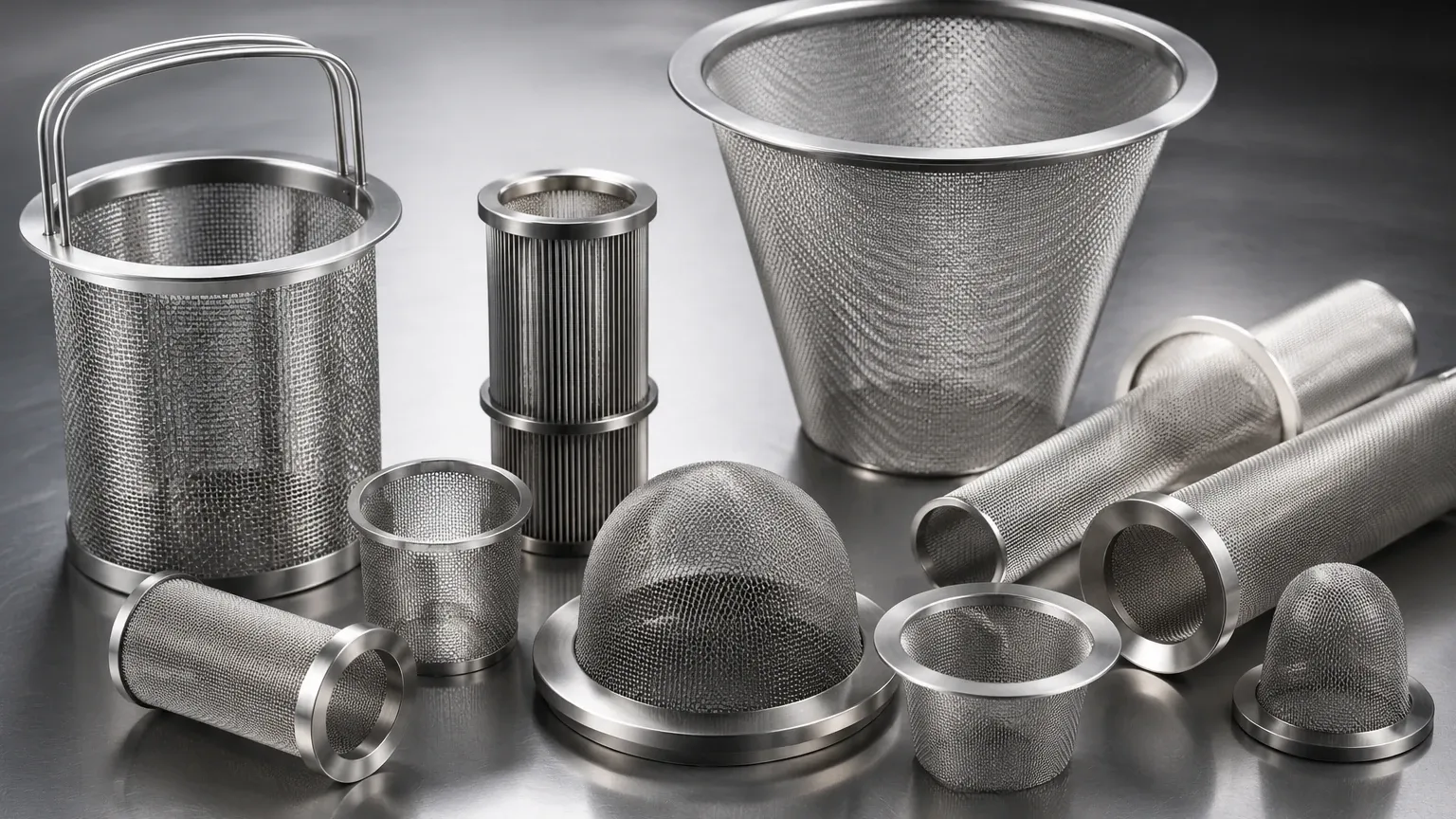
Customization and Design for Specific Industrial Applications
Off-the-shelf solutions rarely meet the specific needs of complex industrial processes. Customization of Strainers & Baskets allows for optimized performance tailored to unique environmental constraints.
Chemical Processing
In chemical plants, the primary concern is material compatibility. Custom strainers mesh may involve exotic alloys or specific surface treatments to prevent chemical degradation. Furthermore, the design must often accommodate hazardous materials, requiring leak-proof housings and mesh that can be cleaned in place (CIP) to minimize operator exposure.
Food and Beverage
Hygiene is the priority here. The mesh must be manufactured to high standards of smoothness to prevent bacterial growth in crevices. Custom designs often include magnetic inserts to capture fine metallic fragments that the mesh might miss, providing an extra layer of product safety.
Water Treatment and Desalination
These applications deal with high volumes of water and varying debris loads. Customization might involve multi-stage straining, where a coarse outer mesh protects a finer inner mesh, extending the service life of the fine filtration component and reducing maintenance frequency.
Maintenance, Cleaning, and Replacement Cycles
The total cost of ownership (TCO) for industrial filtration is heavily influenced by how long the strainers mesh lasts and how easily it can be maintained.
Cleaning Protocols
Most stainless steel strainers mesh can be cleaned and reused. The method of cleaning—whether manual scrubbing, ultrasonic cleaning, or backwashing—depends on the mesh fineness and the nature of the debris. It is vital to avoid abrasive tools that could damage the wire weave, as even a small tear can compromise the entire filtration system.
Signs of Fatigue and Blinding
Over time, even the most durable mesh will experience wear. "Blinding" occurs when particles become permanently lodged in the mesh openings, reducing the open area and increasing the constant pressure drop. Additionally, repeated pressure cycles can lead to metal fatigue, manifesting as small cracks near the weld points or support structures. Regular inspection protocols should be established to identify these issues before a catastrophic failure occurs.
Replacement Strategy
While stainless steel mesh is long-lasting, it is not permanent. Maintaining a stock of replacement baskets or mesh inserts is a best practice for minimizing downtime. Engineers should track the pressure drop across the strainer; a baseline "clean" pressure drop that gradually increases even after cleaning is a clear indicator that the mesh has reached the end of its effective service life.
Key Questions for Procurement and Engineering Teams
Before finalizing an order for strainers mesh, technical teams should confirm the following details to ensure the product meets application requirements:
1. What is the exact chemical composition of the fluid? This determines if SS304 is sufficient or if SS316L/specialty alloys are required.
2. What is the maximum allowable pressure drop? This influences the required open area and the overall size of the strainer basket.
3. What is the smallest particle size that must be removed? This dictates the micron rating and the appropriate weave type.
4. Will the system experience pressure surges or water hammer? If so, heavy-duty reinforcement for the mesh is mandatory.
5. Is the application subject to specific regulatory standards? (e.g., FDA for food, 3-A for dairy, or ASME for pressure vessels).
By addressing these factors, organizations can ensure they invest in filtration solutions that provide the highest level of protection for their industrial infrastructure. Kaifil’s expertise in manufacturing custom stainless steel filtration components ensures that every strainers mesh is engineered for precision, durability, and optimal flow performance in the most demanding environments.
