


Strainers Plumbing
In industrial fluid management and piping design, the term "strainers plumbing" refers to the strategic integration of mechanical filtration components into a piping system. Unlike standard residential plumbing, industrial strainers are engineered to protect high-value downstream equipment—such as pumps, control valves, flow meters, and heat exchangers—from damage caused by scale, weld beads, metal chips, and other foreign debris.
For engineers and procurement professionals, selecting the correct Strainers & Baskets is a critical decision that impacts the longevity, safety, and efficiency of the entire process line. This guide examines the technical nuances of industrial strainer integration, material selection, and the engineering criteria required to optimize performance in demanding environments.
The Role of Strainers in Industrial Piping Systems
Industrial plumbing systems are the lifelines of chemical plants, food processing facilities, and pharmaceutical laboratories. Within these systems, strainers act as the first line of defense. While a filter is typically designed to remove microscopic particles, a strainer is generally used to remove larger, visible solids from a liquid or gas stream.
In the context of strainers plumbing, the primary objective is to ensure that the fluid remains clean enough to prevent mechanical interference or abrasion in sensitive components. For example, a pump impeller can be easily eroded or jammed by small metal fragments left over from pipe installation or maintenance. By installing a high-quality stainless steel strainer, operators can significantly reduce the risk of catastrophic equipment failure and unplanned downtime.
Engineering Considerations for Strainer Selection
When specifying components for strainers plumbing, several technical parameters must be evaluated to ensure the component can withstand the operational rigors of the application. Engineers should focus on the following criteria:
1. Material Compatibility and Durability
In industrial applications, material selection is paramount. Stainless steel (typically Grade 304 or 316L) is the industry standard due to its excellent corrosion resistance and structural integrity at varying temperatures.
- SS304: Suitable for general industrial use, water treatment, and mildly corrosive environments.
- SS316L: Preferred for chemical processing, marine environments, and pharmaceutical applications where high resistance to pitting and chloride-induced stress corrosion cracking is required.
2. Filtration Accuracy (Mesh vs. Micron)
The "tightness" of the strainer is determined by the mesh size or micron rating. In strainers plumbing, the goal is to select a mesh that is fine enough to protect the equipment but coarse enough to avoid excessive pressure drop.
- Mesh Size: Refers to the number of openings per linear inch. A higher mesh number indicates a finer opening.
- Micron Rating: Refers to the actual size of the particles the strainer will capture.
3. Flow Rate and Pressure Drop ($ΔP$)
Every strainer introduces a degree of resistance to the flow. This resistance is measured as pressure drop. If a strainer is undersized or uses a mesh that is too fine for the flow rate, the pressure drop can become excessive, leading to cavitation in pumps or reduced system efficiency. Engineers must calculate the Open Area Ratio (OAR)—the ratio of the total area of the holes in the strainer element to the internal cross-sectional area of the pipe. A standard OAR for industrial strainers is typically between 3:1 and 6:1.
Comparing Basket Strainers and Y-Strainers
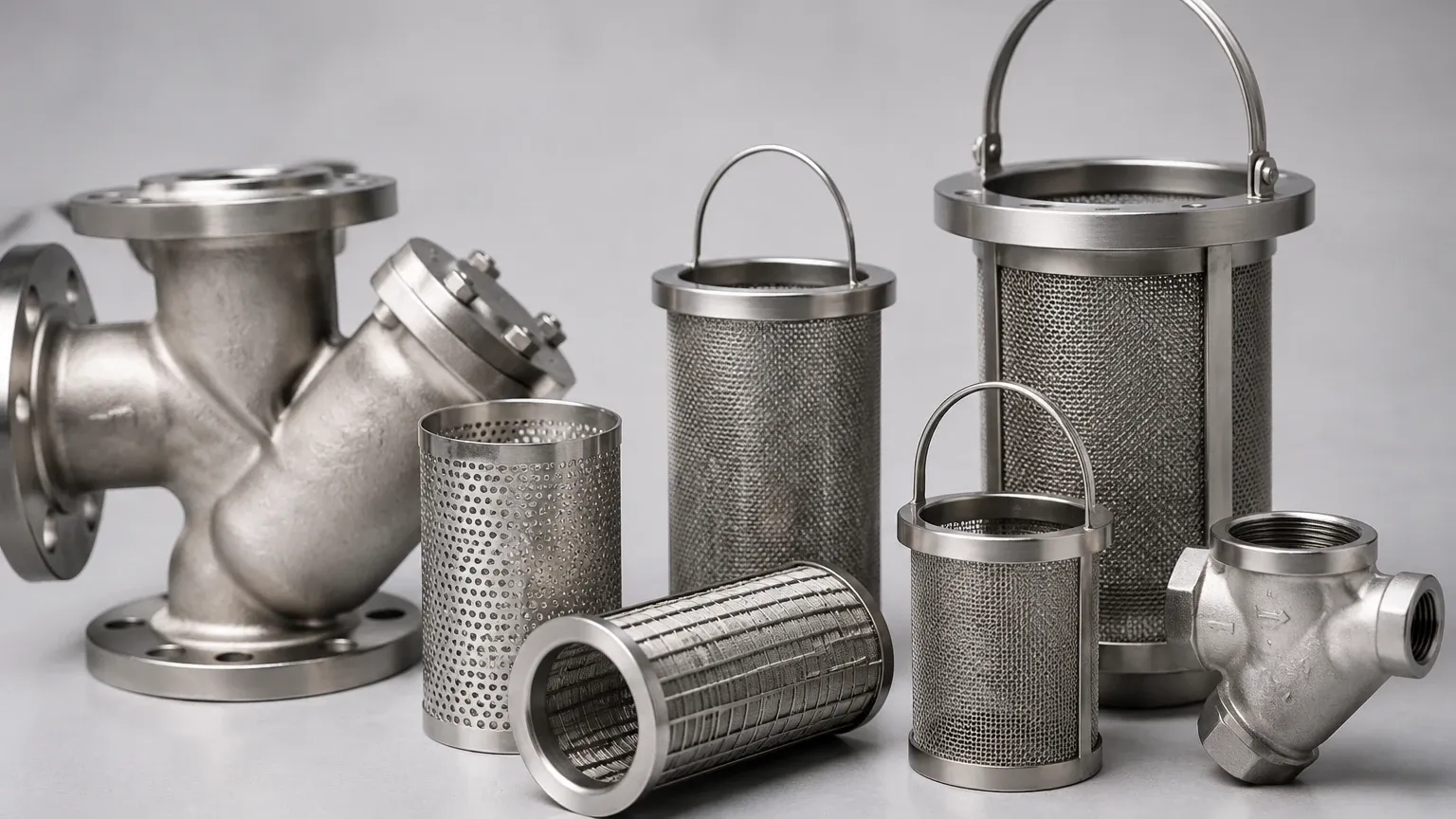
Within the scope of strainers plumbing, two primary designs dominate the market: the Y-strainer and the basket (Simplex/Duplex) strainer. Each serves a specific purpose based on the piping layout and maintenance requirements.
Y-Strainers
Y-strainers are named for their shape and are typically used in pressurized lines (liquid or gas). They are compact and can be installed in either horizontal or vertical positions, provided the "leg" of the Y points downward to collect debris. They are ideal for applications with low levels of contamination where frequent cleaning is not required.
Basket Strainers
Basket strainers are designed for horizontal piping systems and feature a larger debris-holding capacity than Y-strainers. This makes them the preferred choice for liquids containing a higher volume of solids.
- Simplex Strainers: Used in systems where the flow can be temporarily shut down for cleaning.
- Duplex Strainers: Feature two separate strainer chambers with a diversion valve. This allows one side to be cleaned while the other remains in operation, ensuring continuous flow—a critical requirement in many chemical and power generation processes.
For more information on these configurations, you can Review product options and application support.
Customization and OEM Solutions in Strainers Plumbing
Off-the-shelf solutions do not always meet the unique demands of specialized industrial processes. Customization is often necessary to account for non-standard pipe diameters, extreme temperature fluctuations, or specific chemical exposures.
As a professional manufacturer, Kaifil specializes in custom stainless steel filtration solutions. This includes tailoring the physical dimensions of the strainer to fit existing plumbing footprints, as well as engineering specialized internal baskets with reinforced mesh to handle high-velocity flows. Customization also extends to the type of connections—whether flanged, threaded, or socket-weld—ensuring seamless integration into the project's specific strainers plumbing requirements.
Installation and Maintenance Best Practices
Proper installation is just as important as the selection of the strainer itself. Incorrectly installed strainers can lead to bypass (where fluid flows around the element) or structural failure.
Orientation and Access
Strainers must be installed with the flow in the direction indicated by the arrow on the housing. Furthermore, sufficient clearance must be provided to allow for the removal of the basket or screen for cleaning. In vertical strainers plumbing, the flow should always be downward to ensure that gravity assists in settling the debris into the collection area.
Monitoring Performance
The most effective way to manage strainer maintenance is through the use of differential pressure gauges. By measuring the pressure before and after the strainer, operators can determine exactly when the element is clogged. A common rule of thumb is to clean or replace the strainer element when the pressure drop reaches 5-10 psi over the clean-start pressure.
Cleaning Cycles and Total Cost of Ownership (TCO)
While the initial purchase price of a strainer is important, the total cost of ownership is driven by maintenance frequency and the durability of the internal components. High-quality stainless steel baskets can be cleaned and reused multiple times, whereas lower-quality materials may deform under pressure or corrode, leading to frequent replacements and potential downstream damage.
Common Risks and Failure Modes in Strainers Plumbing
Understanding the risks associated with industrial strainers helps in developing a more robust maintenance strategy. Common issues include:
1. Clogging and Collapse: If a strainer is not cleaned regularly, the buildup of debris can create a pressure differential so high that the internal basket collapses, allowing all the captured debris to rush downstream into sensitive equipment.
2. Erosion: In high-velocity systems, abrasive particles can erode the mesh of the strainer over time, effectively increasing the micron rating and allowing larger particles to pass through.
3. Seal Failure: Gaskets and O-rings within the strainer housing must be compatible with the process fluid. Chemical degradation of these seals can lead to external leaks or internal bypass.
4. Improper Sizing: Using a strainer that is too small for the pipe size or flow rate will result in permanent energy loss due to high pressure drop, increasing the operational costs of the pumping system.
Conclusion: Optimizing Your Filtration Strategy
Successful strainers plumbing requires a balance of engineering precision and practical maintenance planning. By selecting the right material, understanding the flow characteristics of the system, and choosing between Y-strainers and basket strainers based on debris load, industrial operators can ensure long-term system reliability.
Whether you are designing a new facility or upgrading an existing piping network, the quality of your Strainers & Baskets will directly influence your operational efficiency. Partnering with a manufacturer like Kaifil provides access to technical expertise in material selection and custom engineering, ensuring that your filtration components are perfectly suited to the specific demands of your industrial environment.
By focusing on high-performance stainless steel components and adhering to rigorous installation standards, engineering teams can minimize risks, reduce maintenance costs, and protect the integrity of their industrial plumbing systems for years to come.
