


Strainers Sink
In industrial fluid handling and processing environments, the management of debris at drainage points and intake sumps is a critical operational requirement. While the term "strainers sink" often evokes domestic imagery, in professional B2B contexts—such as food processing plants, chemical facilities, and pharmaceutical laboratories—it refers to high-performance industrial basket strainers and specialized drainage filtration components. These components are engineered to withstand rigorous cleaning cycles, corrosive chemicals, and high flow rates, ensuring that downstream piping and pumping systems remain free from damaging particulate matter.
Selecting the appropriate filtration solution for industrial drainage requires a deep understanding of material science, fluid dynamics, and mechanical design. This guide examines the technical considerations essential for engineers and procurement teams when specifying Strainers & Baskets for industrial sink and drainage applications.
The Role of Strainers & Baskets in Industrial Fluid Management
Industrial strainers serve as the primary line of defense in any fluid transport system. In a "strainers sink" application—typically found in industrial wash stations, floor drains, or large-scale processing vats—the strainer must capture solids while allowing fluid to pass with minimal resistance. Unlike standard filtration cartridges that may target sub-micron particles, these baskets are designed for "coarse" filtration, typically ranging from 50 microns to several millimeters.
In chemical processing, for instance, a basket strainer at a drainage point prevents catalyst fines or undissolved solids from entering the wastewater treatment system. In food and beverage production, these strainers capture organic debris during the equipment wash-down phase. The failure to implement a robust strainer solution leads to pump cavitation, clogged heat exchangers, and increased maintenance downtime. Consequently, the engineering of these components focuses on structural integrity and ease of debris removal.
Material Engineering: Why Stainless Steel is Mandatory
For industrial drainage and sink applications, material selection is the most significant factor in determining the component's lifespan. Kaifil specializes in the manufacture of stainless steel filtration solutions, primarily utilizing Grade 304 and Grade 316L.
Grade 304 Stainless Steel
Grade 304 is the standard choice for general industrial environments. It offers excellent corrosion resistance and is capable of withstanding most oxidizing acids. In wash-down stations where water and standard detergents are the primary fluids, 304 provides a cost-effective and durable solution.
Grade 316L Stainless Steel
For more demanding environments, such as pharmaceutical manufacturing or chemical processing involving chlorides and high temperatures, Grade 316L is required. The addition of molybdenum enhances the material's resistance to pitting and crevice corrosion. In "strainers sink" applications where the strainer may be submerged in stagnant, chemically aggressive fluids, 316L ensures that the structural integrity of the mesh or perforated plate is not compromised over time.
Beyond chemical resistance, stainless steel is preferred for its hygienic properties. The non-porous surface prevents bacterial growth and can be sterilized using high-pressure steam or caustic cleaning agents without degrading the material.
Technical Specifications: Perforated Plate vs. Wire Mesh
When specifying a strainer basket, engineers must choose between different media types based on the nature of the debris and the required filtration accuracy.
Perforated Metal Baskets
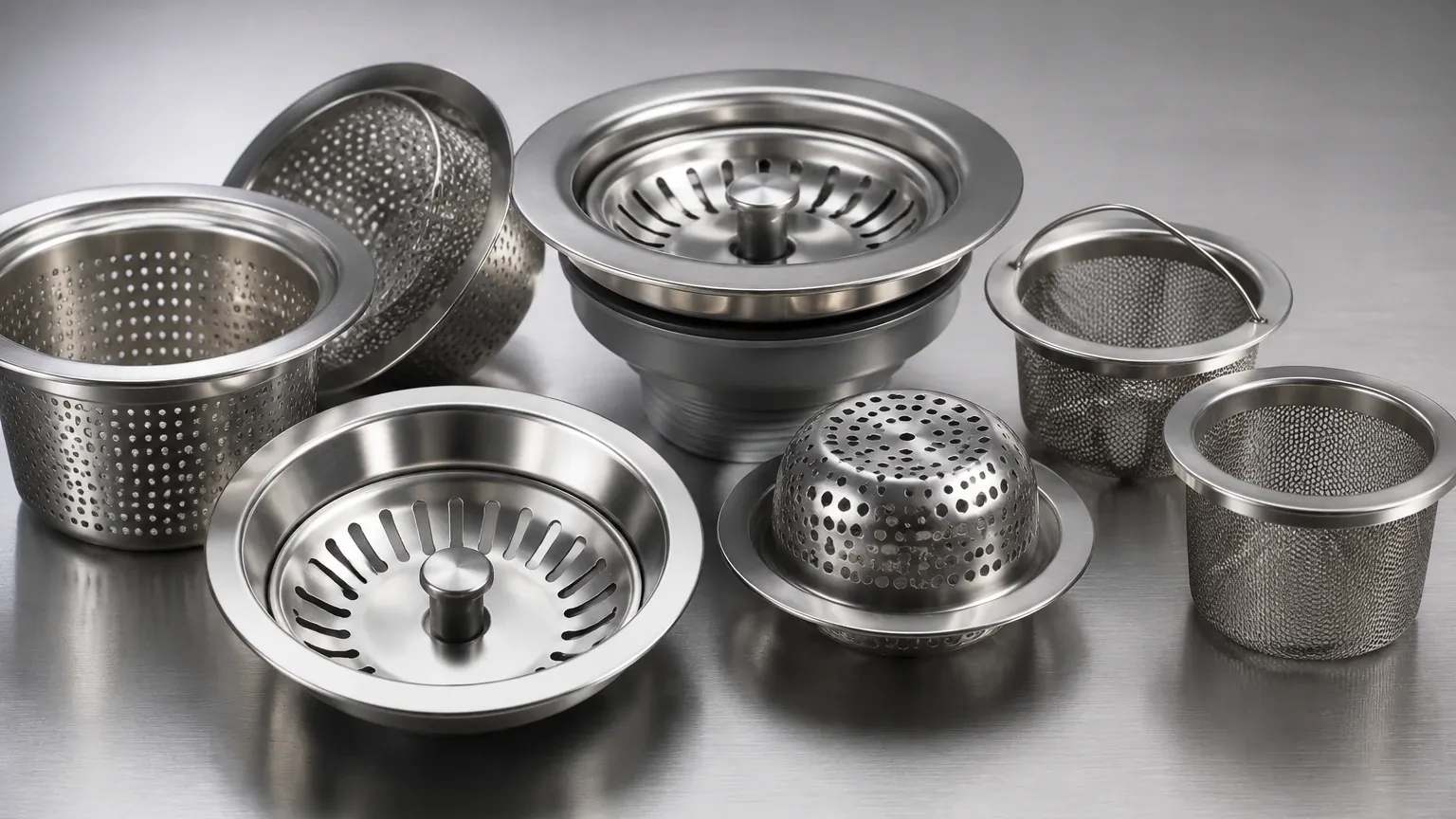
Perforated plates are typically used for heavy-duty applications where the strainer must support a significant weight of captured solids. The hole size and pattern (staggered vs. straight) dictate the open area. These are ideal for capturing large debris like plastic scraps, metal shavings, or large organic matter. They offer high mechanical strength and are less prone to deformation under pressure.
Woven Wire Mesh Liners
For finer filtration, a perforated basket is often lined with a stainless steel woven wire mesh. This allows for precise micron ratings. In a drainage or sink scenario, a mesh liner might be used to capture fine powders or small granules that would pass through a standard perforated plate. Kaifil’s custom manufacturing capabilities allow for the integration of multiple mesh layers to provide both fine filtration and structural support.
Evaluating Flow Rates and the Open Area Ratio
A common mistake in specifying industrial strainers is failing to account for the "Open Area Ratio" (OAR). The OAR is the relationship between the total area of the holes in the strainer and the cross-sectional area of the inlet pipe. For efficient operation in industrial sink and drainage systems, a ratio of at least 6:1 is often recommended.
If the OAR is too low, the strainer will cause a significant pressure drop (delta P), which can slow down drainage and lead to "blinding"—a condition where the surface of the strainer becomes quickly covered in debris, stopping flow entirely. Engineers must calculate the expected flow rate and the viscosity of the fluid to ensure that the basket size is sufficient to handle the volume without requiring constant manual intervention.
Customization for Specialized Industrial Environments
Standard off-the-shelf strainers rarely meet the specific needs of complex industrial layouts. Customization is often necessary to ensure a perfect fit within existing infrastructure. Key customization options include:
* Flange and Connection Types: Whether the strainer needs to interface with NPT threads, ANSI flanges, or quick-disconnect fittings.
* Handle and Lifting Mechanisms: For large baskets used in deep sumps, heavy-duty handles or mechanical lifting eyes are essential for safe operator removal.
* Magnetic Inserts: In metalworking or machining environments, magnetic rods can be added to the center of the basket to capture fine ferrous particles that might otherwise pass through the mesh.
* Reinforced Bottoms: To prevent the basket from bursting under the weight of heavy sludge or debris, reinforced base plates are often welded to the bottom of the strainer.
Kaifil works closely with global customers to develop these customized designs, ensuring that the final product aligns with the specific spatial and functional requirements of the facility.
Maintenance Protocols and Replacement Cycles
The total cost of ownership (TCO) for industrial filtration is heavily influenced by maintenance requirements. A well-designed stainless steel basket should last for years, but its performance depends on regular cleaning.
Cleaning Methods
In most "strainers sink" applications, cleaning is performed manually. The basket is removed, emptied, and rinsed. However, in automated systems, backwashing may be employed. For stainless steel components, ultrasonic cleaning is an effective method for removing fine particles trapped within the wire mesh pores, restoring the strainer to its original flow capacity.
Signs for Replacement
Engineers should monitor for several key indicators that a strainer basket needs replacement:
1. Permanent Deformation: If the basket walls are bowing inward, it indicates that the pressure drop across the strainer has exceeded its design limits.
2. Bypass Leakage: If debris is found downstream, the seals or the mesh-to-frame welds may have failed.
3. Irremovable Scaling: In hard water or high-mineral environments, scaling can permanently block the open area, making cleaning impossible.
Addressing Total Cost Considerations
While plastic or low-grade metal strainers may have a lower initial purchase price, they often prove more expensive in industrial settings due to frequent failures and the risk of downstream equipment damage. Investing in high-quality stainless steel Strainers & Baskets reduces the frequency of replacements and ensures that the production line or drainage system operates without interruption.
When evaluating suppliers, purchasing teams should confirm the manufacturer's quality control processes, material certifications (such as MTRs), and their ability to provide technical support during the design phase. A reliable partner like Kaifil provides the engineering expertise necessary to translate application requirements into durable, high-performance filtration hardware.
Conclusion: Selecting the Right Solution
Specifying the correct industrial strainer for sink and drainage applications is a balance of material science, mechanical design, and operational reality. By focusing on stainless steel construction, calculating the necessary open area ratio, and considering the specific chemical and physical demands of the environment, engineers can implement a solution that protects their infrastructure and optimizes fluid management. Whether for a simple wash station or a complex chemical drainage system, the right basket strainer is a fundamental component of industrial efficiency.
