


Strainers Stainless Steel
In industrial fluid handling and processing, the protection of downstream equipment—such as pumps, valves, meters, and spray nozzles—is a critical engineering priority. Industrial strainers serve as the primary line of defense, removing coarse particles from liquid or gas streams. While various materials are available, strainers stainless steel remain the industry standard for demanding applications due to their exceptional mechanical strength, thermal stability, and resistance to corrosive media.
Selecting the appropriate strainer involves more than simply matching pipe sizes. It requires a deep understanding of material science, fluid dynamics, and the specific requirements of the application environment. For engineers and procurement teams, evaluating the structural integrity and filtration efficiency of Strainers & Baskets is essential to ensuring long-term operational reliability and minimizing total cost of ownership.
The Role of Stainless Steel in Industrial Strainer Design
Stainless steel is preferred in industrial filtration because it addresses the three primary failure modes of filtration components: corrosion, mechanical deformation, and thermal degradation. Unlike carbon steel or plastic alternatives, stainless steel maintains its structural profile under high-pressure differentials and across a wide temperature spectrum.
In chemical processing and water treatment, the choice of stainless steel prevents the introduction of oxidation products (rust) into the process stream, which is vital for maintaining product purity. Furthermore, the smooth surface finish of stainless steel components facilitates effective cleaning and sterilization, making it the material of choice for the food, beverage, and pharmaceutical industries.
Material Grades: Selecting Between 304 and 316L
The performance of strainers stainless steel is largely dictated by the specific grade of the alloy used. While many grades exist, 304 and 316L are the most prevalent in industrial filtration.
Type 304 Stainless Steel
Type 304 is a versatile, general-purpose stainless steel containing approximately 18% chromium and 8% nickel. It offers excellent resistance to many atmospheric environments and moderately corrosive media. It is typically used in applications involving potable water, light chemicals, and general industrial lubricants where the risk of chloride-induced pitting is low.
Type 316L Stainless Steel
Type 316L includes the addition of molybdenum (typically 2-3%), which significantly enhances its resistance to pitting and crevice corrosion in chloride-rich environments. The "L" stands for low carbon content, which improves weldability and reduces the risk of intergranular corrosion in the heat-affected zones of welded components. This grade is essential for marine applications, pharmaceutical processing, and aggressive chemical filtration where 304 might fail prematurely.
Engineering Specifications: Mesh, Perforation, and Open Area Ratios
The effectiveness of a strainer is measured by its ability to capture specific particle sizes while maintaining an acceptable pressure drop. This is achieved through two primary media types: perforated metal and wire mesh.
Perforated Metal Cores
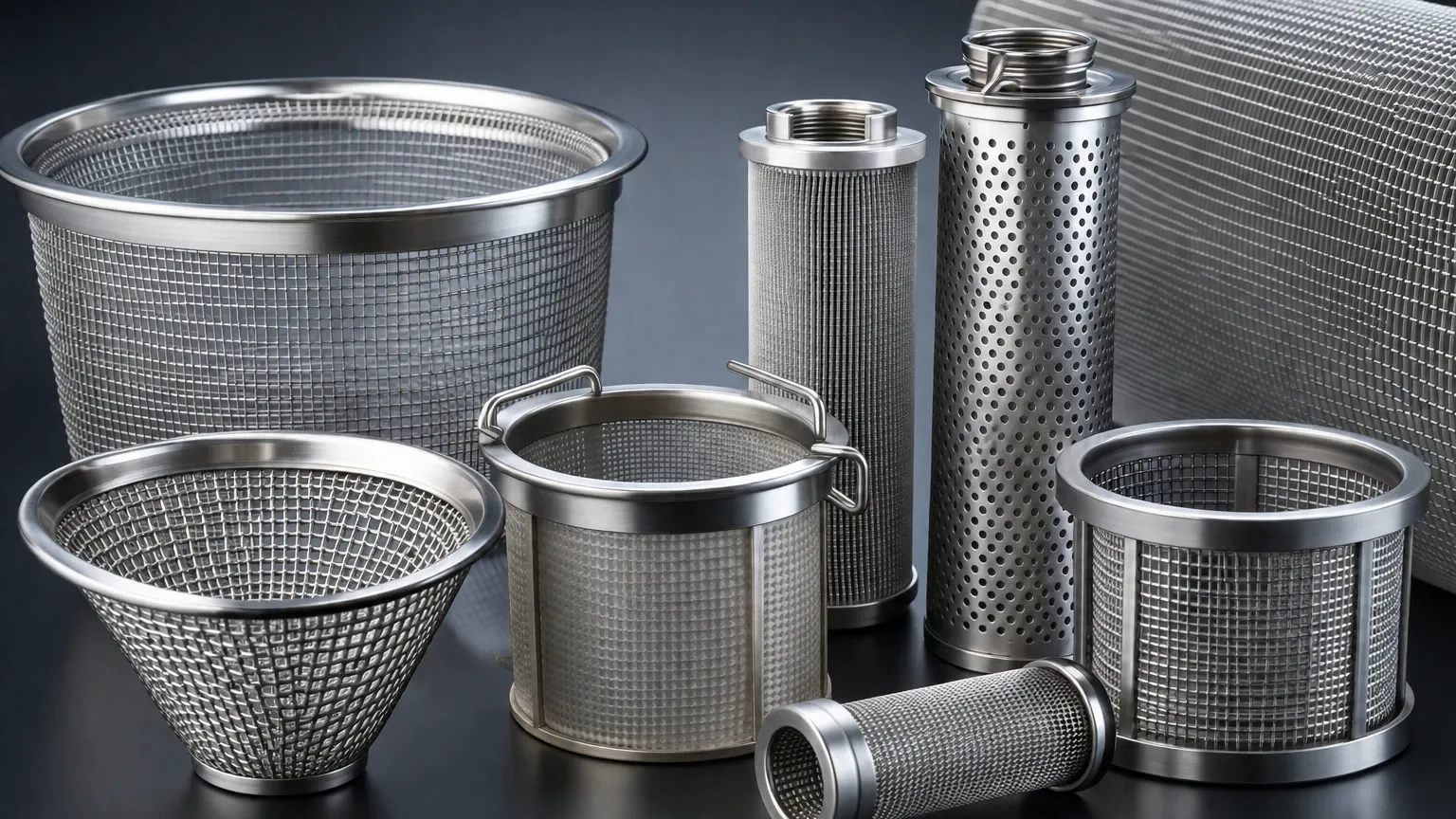
Perforated metal serves as the structural foundation for most industrial baskets. It is manufactured by punching holes into stainless steel sheets. Engineers must specify the hole diameter and the pitch (the distance between holes). Perforated media is ideal for removing larger debris and provides the mechanical strength necessary to withstand high flow velocities.
Wire Mesh Linings
For finer filtration requirements, a stainless steel wire mesh is often lined inside or outside the perforated basket. Mesh is defined by the number of openings per linear inch. For example, a 100-mesh screen has 100 openings per inch. When selecting mesh, it is vital to consider the wire diameter, as thicker wires increase durability but decrease the open area.
Open Area Ratio (OAR)
One of the most critical technical metrics in strainer selection is the Open Area Ratio. This is the ratio between the total area of the openings in the strainer media and the cross-sectional area of the inlet pipe. A common engineering standard is an OAR of at least 4:1. A higher OAR allows for a lower initial pressure drop and longer intervals between cleaning cycles, as the strainer can accommodate more debris before flow is significantly restricted.
Structural Configurations of Strainers & Baskets
The physical design of the strainer must align with the piping layout and the nature of the contaminants. There are several standard configurations, each with specific advantages:
* Simplex Strainers: Used in batch processes where the flow can be temporarily halted to clean or replace the basket. They are simple, cost-effective, and robust.
* Duplex (Twin) Strainers: These consist of two separate strainer chambers connected by a diverting valve. This allows for continuous operation; when one basket becomes clogged, the flow is diverted to the clean chamber, allowing the first basket to be serviced without shutting down the system.
* Y-Strainers: Characterized by their "Y" shape, these are typically used for gas or steam lines where the amount of debris is relatively low. They are compact and can be installed in both horizontal and vertical orientations.
* Basket Strainers: These feature a larger dirt-holding capacity than Y-strainers and are designed for liquid applications with higher solids loading. The basket design allows for easy removal from the top of the housing.
Customization for Demanding Industrial Environments
Standard off-the-shelf strainers often fall short in specialized industrial environments. Customization is frequently required to meet specific mechanical or chemical demands. Manufacturers like Kaifil specialize in developing tailored Strainers & Baskets that address unique engineering challenges.
Reinforced Structures
In high-pressure hydraulic systems or applications with high-viscosity fluids, standard baskets may collapse under the differential pressure. Custom strainers can be engineered with internal support cages, reinforced longitudinal seams, and heavy-duty flanges to ensure structural integrity under extreme stress.
Specialized Connection Types
While NPT threads and standard ANSI flanges are common, many systems require specialized connections such as Tri-Clamp fittings for sanitary applications, DIN flanges for international equipment, or custom weld-neck configurations. Custom manufacturing ensures that the strainer integrates seamlessly into existing piping without the need for inefficient adapters.
Surface Treatments
Beyond the base material, surface treatments can enhance performance. Electropolishing is often used in the pharmaceutical and food industries to create an ultra-smooth surface that resists bacterial growth and facilitates easier cleaning. Passivation is also standard to maximize the corrosion resistance of the stainless steel after the fabrication and welding processes.
Performance Evaluation and Pressure Drop Calculations
An essential part of the procurement process is calculating the "Clean Pressure Drop" (Delta P). Every strainer introduces some resistance to flow. If the initial pressure drop is too high, it reduces the efficiency of the pump and limits the "dirt-holding capacity" before the system reaches its maximum allowable pressure differential.
Engineers should request flow coefficient (Cv) data from the manufacturer. The Cv value represents the flow rate in gallons per minute (GPM) of water at 60°F that will pass through the strainer with a pressure drop of 1 psi. By using the Cv value and the specific gravity and viscosity of the process fluid, engineers can accurately predict how the strainer will perform in situ.
Maintenance and Longevity: Best Practices for Stainless Steel Components
The total cost of ownership for strainers stainless steel is heavily influenced by maintenance practices. Unlike disposable filters, stainless steel baskets are designed for reuse, but their lifespan depends on proper handling.
1. Differential Pressure Monitoring: Installing pressure gauges upstream and downstream of the strainer is the most effective way to determine when cleaning is required. A common rule of thumb is to clean the basket when the pressure drop reaches 10-15 psi over the clean reading.
2. Cleaning Protocols: Depending on the contaminant, baskets can be cleaned via backflushing, ultrasonic cleaning, or chemical soaking. It is vital to avoid using carbon steel brushes or wool, as this can embed carbon steel particles into the stainless steel, leading to localized "tea staining" or galvanic corrosion.
3. Gasket and Seal Inspection: While the stainless steel basket may last for years, the seals and gaskets (often made of EPDM, Viton, or PTFE) are wear items. These should be inspected every time the strainer is opened to prevent bypass and external leaks.
4. Structural Audits: During cleaning, baskets should be inspected for signs of wire fatigue, broken welds, or de-lamination of the mesh from the perforated backing. Small breaches in the mesh can lead to significant downstream damage if not addressed immediately.
Conclusion
Selecting the right strainers stainless steel is a balance of material science, structural engineering, and fluid dynamics. By focusing on high-quality alloys like 304 or 316L, optimizing the open area ratio, and considering the specific mechanical stresses of the application, industrial operators can significantly improve the reliability of their systems.
Whether for a standard water treatment plant or a complex chemical refinery, the investment in precision-engineered Strainers & Baskets pays dividends in reduced downtime and the protection of expensive downstream assets. As a manufacturer committed to technical excellence, Kaifil provides the expertise and customization capabilities necessary to meet the most rigorous industrial filtration standards.
