


2 Wire Screen
In the landscape of industrial filtration and separation, the term 2 wire screen refers to the fundamental structural composition of high-precision filtration media, most notably represented by the dual-component assembly of profile wires and support rods. This configuration is the cornerstone of Wedge Wire Screens, providing a robust, non-clogging surface that is essential for demanding industrial processes. For engineers and procurement specialists, understanding the technical nuances of this two-component system is critical for optimizing flow rates, ensuring structural integrity, and minimizing long-term maintenance costs.
Unlike traditional woven wire mesh, which relies on a complex interlacing of multiple wires, the 2 wire screen design focuses on the synergy between two distinct functional elements. The first is the surface wire (profile wire), which defines the filtration accuracy, and the second is the support wire (or rod), which provides the necessary mechanical strength to withstand high differential pressures. This article examines the engineering principles, material considerations, and application-specific advantages of this filtration technology.
Technical Fundamentals of 2 Wire Screen Construction
The performance of a 2 wire screen is dictated by the precise geometry and the welding integrity of its two primary components. The manufacturing process typically involves resistance welding, where the surface profile wire is fused to the underlying support rods at every intersection point. This creates a rigid, single-piece structure that maintains its slot dimensions even under significant mechanical stress.
The Profile Wire (Surface Component)
The surface wire is usually V-shaped or wedge-shaped. This geometry is intentional and serves a specific hydraulic purpose. By having the narrowest part of the opening at the surface, any particle that passes through the initial slot will continue to move freely through the widening gap. This "point contact" filtration mechanism effectively eliminates blinding and clogging, which are common failure modes in multi-layered or woven filtration media. In a 2 wire screen configuration, the profile wire's width, height, and angle are customized based on the viscosity of the fluid and the size of the solids being targeted.
The Support Rod (Structural Component)
The support rods are positioned perpendicularly to the profile wires. While they do not participate directly in the filtration of particles, their spacing and cross-sectional area determine the screen's resistance to collapse and bursting. In heavy-duty applications, such as mining or deep-well water extraction, the support rods are often reinforced or spaced more closely to handle the massive hydraulic loads. The interaction between these two wires defines the overall durability of the Wedge Wire Screens.
Engineering Advantages of the Two-Component Design
The transition from standard mesh to a 2 wire screen system offers several technical advantages that directly impact the efficiency of industrial operations. These advantages are rooted in the mechanical stability and hydraulic efficiency of the design.
Precision Slot Control
One of the primary reasons engineers specify a 2 wire screen is the ability to achieve exact slot tolerances. Because the profile wire is welded to a rigid support structure, the distance between the wires (the slot size) remains consistent across the entire surface area. This is vital in applications like pharmaceutical processing or fine chemical filtration, where even a minor deviation in slot width can lead to product contamination or loss of valuable catalysts.
High Open Area and Flow Efficiency
Despite its heavy-duty construction, the 2 wire screen can be engineered to provide a high percentage of open area. By optimizing the ratio between the profile wire width and the slot opening, manufacturers can maximize throughput while maintaining structural safety factors. The smooth, V-shaped slots also reduce friction loss, allowing for higher flow velocities compared to the tortuous paths found in depth filters or multi-layered mesh.
Mechanical Rigidity and Longevity
The welded nature of the 2 wire screen ensures that it does not vibrate or shift during high-pressure pulses or backwashing cycles. In hydraulic systems or high-velocity liquid-solid separation, the stability of the filter media prevents wire fatigue and premature failure. This rigidity also allows the screens to be used as self-supporting structures in large-scale vessels, reducing the need for complex internal bracing.
Material Selection and Environmental Compatibility
Selecting the correct alloy for a 2 wire screen is as important as the mechanical design. Since these screens are often deployed in corrosive or high-temperature environments, material science plays a pivotal role in the selection process.
1. Stainless Steel 304/304L: The standard choice for general industrial applications. It provides excellent strength and basic corrosion resistance for water treatment and food processing.
2. Stainless Steel 316L: Preferred for pharmaceutical, chemical, and marine environments. The addition of molybdenum enhances resistance to pitting and crevice corrosion, especially in chloride-rich environments.
3. Duplex Stainless Steels: Used in highly aggressive chemical processing or high-stress environments where both superior corrosion resistance and high yield strength are required.
4. Specialty Alloys (Monel, Hastelloy): Reserved for extreme conditions involving high concentrations of acids or specialized petrochemical processes.
Engineers must also consider the thermal expansion coefficients of the materials, especially if the 2 wire screen will operate in fluctuating temperatures. Since the profile wire and support rods are welded, mismatched expansion can lead to internal stresses if the material is not uniform or properly heat-treated.
Customization Parameters for Industrial Applications
A 2 wire screen is rarely an "off-the-shelf" product. To achieve optimal performance, several parameters must be tailored to the specific application. When consulting with a manufacturer like Kaifil, engineers should be prepared to define the following:
* Slot Size (Aperture): Typically ranging from 20 microns to several millimeters. This is the most critical factor for filtration accuracy.
* Profile Wire Shape: Options include standard V-wire, heavy-duty wedge wire, or specialized teardrop profiles for specific hydrodynamic effects.
* Support Rod Shape and Spacing: Round rods are common for general use, while rectangular or threaded rods may be used for specific mounting requirements or increased structural stiffness.
* Surface Treatment: Options such as electropolishing can be applied to enhance the smoothness of the profile wires, further reducing the risk of bacterial growth in food and beverage or pharmaceutical applications.
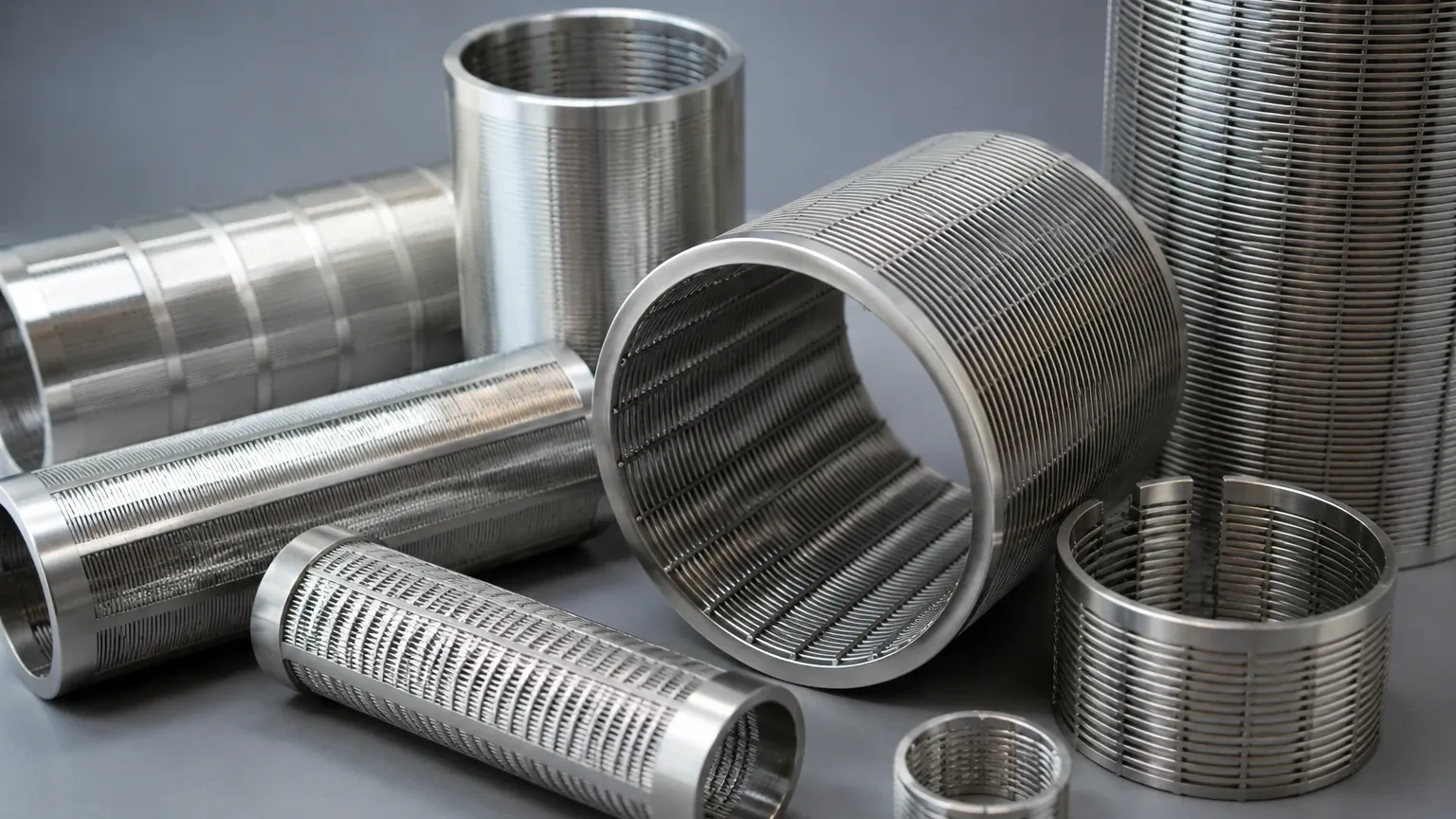
Application Scenarios for 2 Wire Screens
The versatility of the 2 wire screen construction allows it to be adapted into various forms, including flat panels, cylindrical cartridges, and curved sieves. This adaptability makes it a staple in several key industries.
Water and Wastewater Treatment
In municipal and industrial water treatment, Wedge Wire Screens are used for intake screening, dewatering, and as media retainers in carbon filters. The 2 wire design is particularly effective at preventing the loss of expensive filter media while allowing treated water to pass with minimal resistance.
Food and Beverage Processing
From malting floors in breweries to sugar juice filtration, the hygienic properties of stainless steel 2 wire screens are indispensable. The lack of crevices (thanks to the smooth V-profile) ensures that the screens can be effectively cleaned using Clean-in-Place (CIP) systems, meeting stringent food safety standards.
Petrochemical and Refining
In refinery reactors, these screens serve as internal components that support catalyst beds. The high strength-to-weight ratio of the 2 wire screen allows it to support tons of catalyst material while maintaining uniform flow distribution across the reactor bed.
Selection Criteria and Procurement Considerations
When purchasing industrial filters, the initial cost is only one part of the equation. Purchasing teams and engineers should evaluate the total cost of ownership (TCO) by considering the following factors:
* Filtration Efficiency vs. Pressure Drop: A screen with a higher open area might have a lower initial cost but could lead to higher energy consumption if the pressure drop is not optimized for the pump system.
* Replacement Cycles: Because of their robust construction, 2 wire screens often outlast woven mesh by a factor of five or more. This reduces downtime and labor costs associated with frequent filter changes.
* Backwashing Compatibility: If the system requires automated cleaning, the screen must be able to withstand the reverse pressure of backwashing without deforming. The welded 2 wire screen is specifically designed for this type of service.
* OEM Customization: For equipment manufacturers, sourcing a 2 wire screen that fits perfectly into a proprietary housing is essential. Working with a manufacturer that offers custom fabrication ensures that the filtration component does not become a bottleneck in the overall machine design.
Maintenance and Performance Optimization
While 2 wire screens are inherently low-maintenance due to their non-clogging design, a proactive maintenance schedule can further extend their service life. Monitoring the differential pressure (the pressure difference before and after the screen) is the most effective way to determine when cleaning is necessary.
Cleaning methods for 2 wire screens include:
* Backwashing: Reversing the flow of fluid to dislodge particles from the surface.
* Ultrasonic Cleaning: Using high-frequency sound waves in a solvent bath to remove fine particles or scales from the slots.
* Chemical Cleaning: Using mild acids or bases to dissolve organic or mineral buildup, provided the screen material is compatible with the cleaning agents.
Regular inspection for mechanical wear or localized corrosion is also recommended, especially in high-abrasion environments like sand filtration or mineral processing. If the profile wires show signs of thinning, the slot accuracy may be compromised, signaling that a replacement is needed.
Conclusion
The 2 wire screen represents a sophisticated engineering solution for industrial filtration challenges. By combining the precision of the profile wire with the structural strength of the support rod, this technology provides a reliable, efficient, and durable medium for liquid-solid separation. Whether used in the form of Wedge Wire Screens for water treatment or as precision components in chemical reactors, the 2 wire design offers a level of performance that traditional mesh cannot match. For technical teams, the key to success lies in detailed material selection, precise slot specification, and a thorough understanding of the hydraulic demands of the application.
