


Wedge Wire Dimensions
In industrial filtration and separation, the performance of a system is dictated by the precision of its components. Among these, wedge wire screens stand out as a premier solution for demanding environments. However, the effectiveness of these screens is not a matter of chance; it is a direct result of specific engineering choices regarding wedge wire dimensions. For engineers and procurement professionals, understanding these dimensions is critical for optimizing flow rates, ensuring structural integrity, and achieving the desired filtration accuracy.
Selecting the right dimensions involves more than just picking a slot size. It requires a comprehensive look at the profile wire geometry, support rod spacing, and the overall mechanical requirements of the application. This guide examines the technical nuances of wedge wire dimensions to help technical teams make informed decisions when specifying components for chemical processing, water treatment, or food and beverage production.
The Fundamental Geometry of Wedge Wire Screens
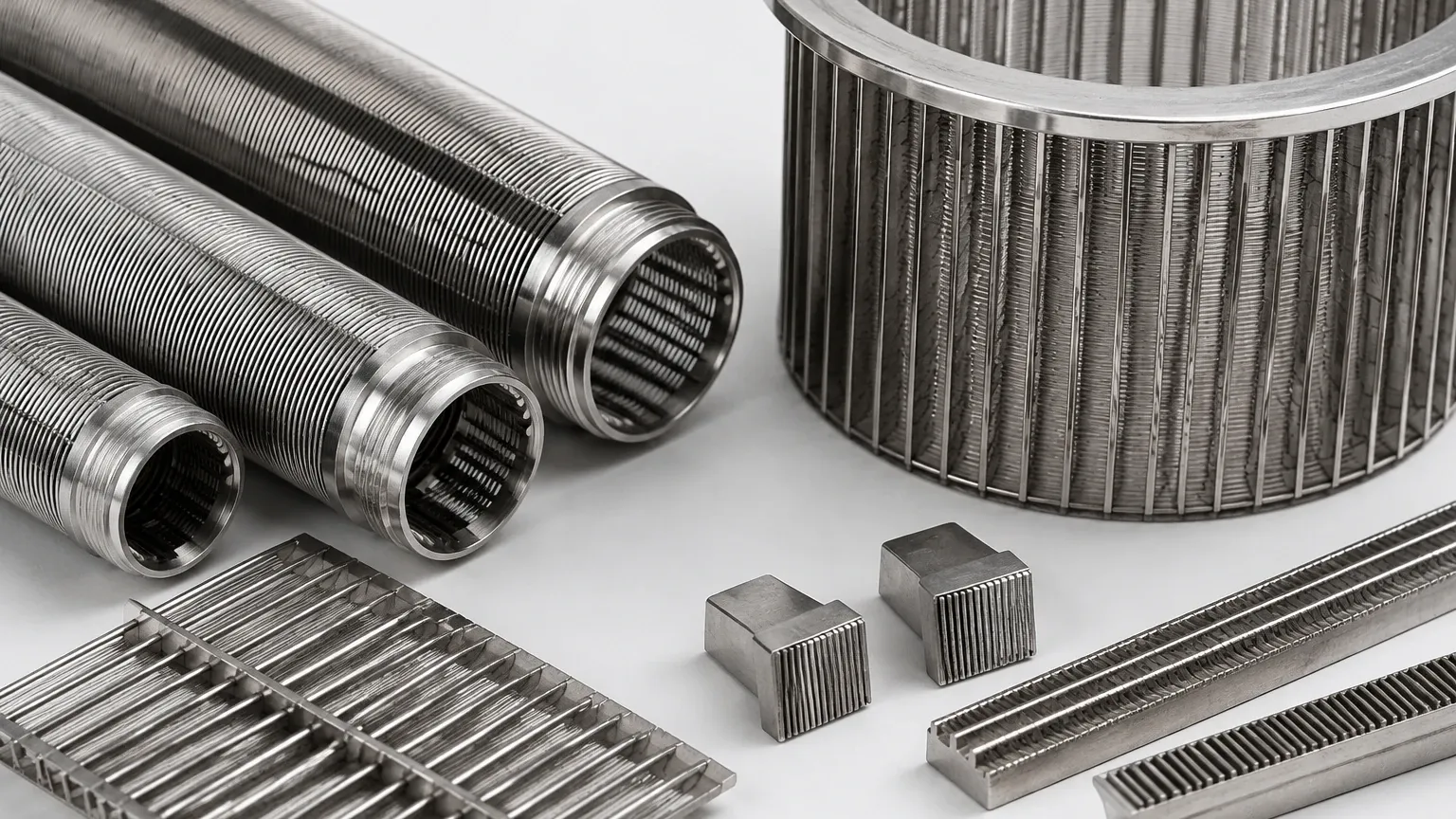
Wedge Wire Screens are characterized by their unique V-shaped profile wires. These wires are resistance-welded onto support rods at each intersection, creating a non-clogging surface. The "wedge" shape is the defining feature, as it creates a narrow opening at the surface that widens toward the discharge side. This geometry ensures that any particle capable of passing through the initial slot will continue through the screen without becoming wedged or blinded.
When discussing dimensions, we must consider three primary components:
1. Profile Wires: The surface wires that come into contact with the media.
2. Slot Openings: The precise gap between the profile wires.
3. Support Rods: The underlying structure that provides mechanical strength.
Each of these components has its own set of dimensions that must be balanced to meet the specific needs of an industrial process.
Key Profile Wire Dimensions and Their Impact
The profile wire is the most visible part of the screen, and its dimensions—specifically width and height—determine both the filtration capability and the durability of the screen.
Width and Height
Profile wires are typically identified by a code or their actual measurements in millimeters. Common widths range from 0.75mm to 3.0mm, while heights can vary from 1.5mm to over 6.0mm.
* Narrower Wires: Using a narrower profile wire increases the number of slots per unit of area. This results in a higher percentage of open area, which is beneficial for high-flow applications where pressure drop must be minimized.
* Wider/Taller Wires: In abrasive environments or high-pressure systems, wider and taller profile wires are preferred. The additional mass provides a larger "wear life" and greater resistance to mechanical deformation under heavy loads.
The V-Shape Angle
The angle of the wedge is another critical dimension. A sharper angle (more acute) facilitates easier release of particles, which is essential in sticky or high-viscosity applications. Conversely, a shallower angle may be used when the screen needs to provide more surface area for a specific type of cake formation in filtration processes.
Slot Openings: Precision and Tolerance
The slot opening is perhaps the most scrutinized of all wedge wire dimensions. It defines the filtration rating of the screen. In industrial applications, slot widths can range from as small as 20 microns (0.020mm) to several millimeters.
Calculating Open Area
The relationship between the slot width and the profile wire width determines the "Percentage of Open Area." This is a vital metric for hydraulic calculations. The formula is:
Open Area (%) = [Slot Width / (Slot Width + Profile Wire Width)] × 100
For example, if an engineer specifies a 0.5mm slot with a 1.5mm profile wire, the open area is 25%. If the application requires a higher flow rate but the slot size must remain 0.5mm, the only way to increase the open area is to reduce the profile wire width, which may compromise the structural strength. This trade-off is a central challenge in filter design.
Tolerance Standards
In precision manufacturing, maintaining consistent slot dimensions across the entire surface of the screen is paramount. High-quality manufacturers like Kaifil utilize advanced resistance welding technology to ensure that slot tolerances are kept within strict limits (often +/- 0.05mm or better). Inconsistent slot widths lead to "bypass," where larger-than-intended particles pass through the screen, potentially damaging downstream equipment like pumps or high-pressure nozzles.
Support Rod Dimensions and Spacing
While the profile wire handles the filtration, the support rods handle the load. The dimensions and spacing of these rods determine the collapse strength and the span capability of the screen.
Support Rod Shapes
Support rods are not always round. Depending on the application, they may be:
* Round Rods: Standard for most general-purpose applications.
* Flat Bars: Used when the screen is subjected to extreme pressure or when it must be integrated into a frame.
* Wedge Wires (as supports): Sometimes used in heavy-duty mining or vibratory screens for added rigidity.
Support Rod Pitch
The "pitch" is the distance between the center points of two adjacent support rods. A tighter pitch (closer spacing) increases the number of weld points, which significantly boosts the mechanical strength of the screen. For high-pressure hydraulic filters, a support rod pitch of 10mm to 25mm is common. In low-pressure water intake screens, the pitch may be expanded to 50mm or more to reduce weight and cost.
Structural Integrity and Mechanical Stress
In many B2B industrial environments, wedge wire screens are subjected to significant mechanical stress, including differential pressure, thermal expansion, and vibration. The dimensions must be engineered to withstand these forces without failure.
Differential Pressure (ΔP)
As a filter accumulates debris, the pressure difference between the upstream and downstream sides increases. If the wedge wire dimensions (specifically the profile wire height and support rod pitch) are insufficient, the screen may buckle or the welds may shear. Engineers must calculate the maximum expected ΔP and select dimensions that provide a safety factor, typically 2:1 or 3:1.
Thermal Considerations
In chemical processing or steam applications, temperatures can fluctuate wildly. Stainless steel expands and contracts with temperature changes. If the screen is constrained within a housing, the dimensions must account for this thermal movement. Furthermore, the material choice (e.g., 304 vs. 316L vs. Duplex stainless steel) will interact with the dimensions to determine how the screen behaves under thermal load.
Customization and OEM Considerations
One of the primary advantages of working with a professional manufacturer is the ability to customize wedge wire dimensions to fit existing infrastructure. Standard off-the-shelf sizes rarely meet the specific needs of a complex industrial system.
Tailoring Dimensions for Specific Media
* Abrasive Slurries: Require thicker profile wires to extend service intervals.
* High-Purity Pharmaceuticals: Require precise slot tolerances and specific surface finishes (Ra values) to prevent bacterial growth.
* Fibrous Materials: Benefit from specific wedge angles that prevent fibers from wrapping around the wires.
When engaging with an OEM partner, providing the exact dimensions of the housing, the flow direction (Inside-to-Out or Outside-to-In), and the expected particle size distribution is essential for a successful design.
Common Risks of Improper Dimensioning
Selecting incorrect wedge wire dimensions can lead to several operational failures:
1. Premature Blinding: If the slot is too narrow for the flow velocity, particles may be forced into the slots rather than being screened off.
2. Structural Collapse: If the support rods are too far apart or the profile wire is too thin for the operating pressure.
3. Inadequate Flow: If the profile wire is too wide, reducing the open area to a point where the system cannot meet production targets.
4. Erosion: In high-velocity systems, choosing a wire that is too small can lead to rapid erosion of the V-shape, eventually changing the slot size and allowing contaminants through.
Conclusion: Confirming Specifications Before Purchase
Before finalizing a purchase order for industrial screens, engineering teams should confirm several key data points with their supplier. A comprehensive specification sheet should include the profile wire code (width and height), the support rod dimensions and pitch, the exact slot opening with tolerances, and the overall dimensions of the finished component.
At Kaifil, we understand that every industrial application has unique requirements. By focusing on precision manufacturing and engineering expertise, we provide customized filtration solutions that balance flow efficiency with mechanical durability. Whether you are designing a new system or replacing components in an existing installation, careful attention to wedge wire dimensions is the first step toward long-term operational success.
For those evaluating their current filtration performance or looking to optimize a new design, reviewing the relationship between wire geometry and hydraulic capacity is essential. Precise dimensioning ensures that your filtration system remains a reliable asset rather than a maintenance bottleneck.
