


Wedge Wire Screen Cost
In industrial filtration and separation, the selection of equipment is rarely based on the initial purchase price alone. For engineers and procurement specialists, understanding the factors that influence wedge wire screen cost is essential for optimizing both process efficiency and long-term operational budgets. Wedge wire screens, characterized by their V-shaped profile wires and continuous slots, offer distinct advantages in durability and non-clogging performance compared to traditional woven wire mesh or perforated plates. However, these technical benefits come with a unique cost structure influenced by material science, precision engineering, and application-specific customization.
This guide explores the primary drivers of the Wedge Wire Screens price, providing the technical context necessary to evaluate quotes and select the most cost-effective solution for demanding industrial environments.
Material Selection: The Foundation of Cost and Performance
The most significant variable in the wedge wire screen cost is the choice of material. Because these components are often deployed in corrosive, high-temperature, or high-pressure environments, the grade of stainless steel or alloy used directly dictates the lifespan of the filter.
Stainless Steel Grades
Most industrial wedge wire screens are manufactured from 300-series stainless steel.
* Grade 304: This is the standard choice for general industrial applications where moderate corrosion resistance is required. It is the most economical option for water treatment or non-acidic food processing.
* Grade 316L: Containing molybdenum, 316L offers superior resistance to chlorides and pitting. In chemical processing, pharmaceutical manufacturing, and marine environments, the higher initial cost of 316L is justified by its ability to withstand aggressive media that would cause 304 to fail prematurely.
* Duplex and Special Alloys: For extreme conditions involving high concentrations of acids or high-salinity brine, materials like Duplex 2205 or Super Duplex may be specified. These materials can significantly increase the wedge wire screen cost due to both higher raw material prices and the increased difficulty in welding and machining these harder alloys.
Material Volatility
It is important to note that the global market for nickel and chromium—key components of stainless steel—fluctuates. Procurement teams should be aware that quotes for wedge wire products often have a limited validity period to account for these raw material price shifts.
Engineering Specifications: Slot Size and Precision
The "slot" is the opening between the V-shaped profile wires. The precision of this opening determines the filtration accuracy and the flow rate of the system. Engineering these slots requires high-level manufacturing control, which influences the final price.
Slot Opening Width
As a general rule, the smaller the slot opening, the higher the manufacturing cost. Fine slots (e.g., 20 to 50 microns) require more profile wires per inch of screen surface. This increases the total length of wire used and the number of individual weld points required during the fabrication process. Conversely, larger slots (e.g., 2mm to 5mm) used for heavy-duty mining or intake screens require less material and less welding time, resulting in a lower cost per square foot.
Tolerance Requirements
In high-precision industries like pharmaceuticals or fine chemical production, the tolerance of the slot width is critical. Tight tolerances ensure that no oversized particles pass through the filter. Achieving these tolerances requires specialized resistance welding equipment and rigorous quality control measures, which add to the labor and overhead components of the wedge wire screen cost.
Structural Design and Load-Bearing Capacity
Wedge wire screens are not just filtration media; they are often structural components that must support the weight of filter cakes, withstand high differential pressures, or resist the abrasive force of moving slurries. The structural design significantly impacts the price.
Profile Wire and Support Rod Configuration
The combination of the profile wire (the V-shaped surface wire) and the support rod (the perpendicular structural member) determines the screen's strength.
* Heavy-Duty Profiles: Using thicker profile wires increases the wear life of the screen but also increases the weight and material cost.
* Support Rod Spacing: Reducing the distance between support rods increases the burst strength and collapse pressure of a filter cartridge or screen panel. However, more support rods mean more material and more welding, which elevates the price.
Reinforcement and Framing
Flat panels or cylindrical cartridges often require additional framing, such as flanges, reinforcement rings, or custom end fittings. The complexity of these attachments—ranging from simple MIG-welded bars to precision-machined CNC fittings—is a major factor in the total wedge wire screen cost. Custom-engineered frames designed to fit into existing housings without modification can save on installation costs but may carry a higher manufacturing premium.
Manufacturing Complexity and Customization
Unlike standard off-the-shelf mesh, most wedge wire components are custom-engineered for specific OEM applications. This bespoke nature means that manufacturing complexity plays a vital role in pricing.
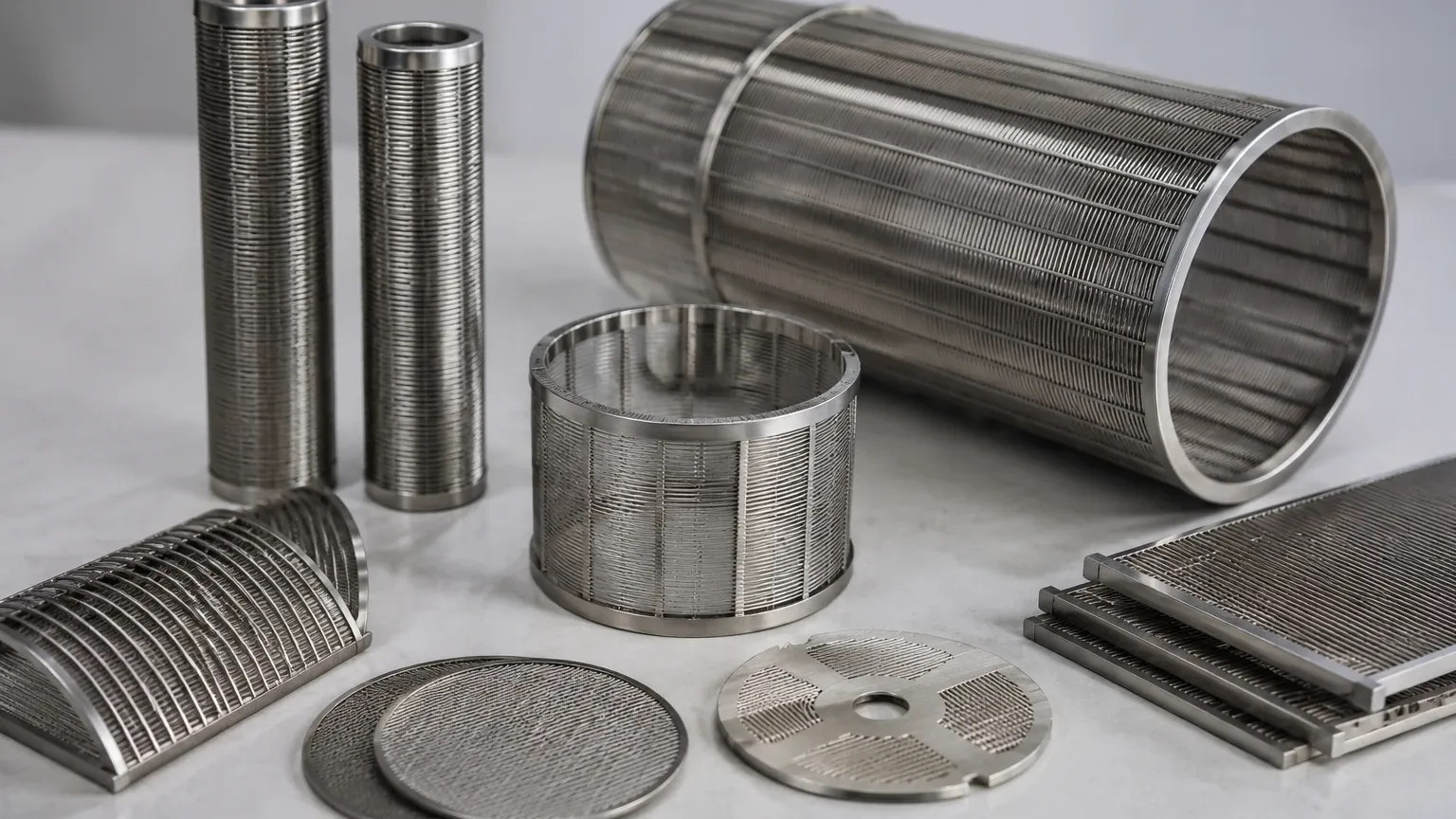
Geometry and Shape
* Flat Panels: Generally the most straightforward to produce, used in vibrating screens and flooring.
* Cylinders and Cartridges: These require the screen to be wrapped or rolled. The direction of the slot (radial vs. axial) and the flow direction (Outside-In vs. Inside-Out) dictate the manufacturing method. Internal or external support structures for high-pressure hydraulic applications add layers of complexity.
* Sieve Bends and Cones: Curved geometries require specialized forming equipment and additional labor to ensure the slot openings remain uniform across the curve.
Surface Treatments
Depending on the application, additional surface treatments may be required:
* Pickling and Passivation: Standard for most stainless steel filters to restore corrosion resistance after welding.
* Electropolishing: Often required in the food, beverage, and pharmaceutical industries to create a microscopically smooth surface that prevents bacterial growth and makes cleaning easier. This process adds a measurable percentage to the wedge wire screen cost.
* Hardening: In abrasive mining applications, surface hardening treatments can extend the life of the profile wires.
Evaluating Total Cost of Ownership (TCO)
When comparing wedge wire to other filtration media, focusing solely on the purchase price can be misleading. A comprehensive financial analysis must consider the Total Cost of Ownership (TCO).
Durability and Replacement Cycles
Wedge wire screens are significantly more robust than woven wire mesh. While a mesh screen might tear or blind (clog) within months, a well-engineered wedge wire screen can last for years. The reduced frequency of replacement and the associated labor costs often make wedge wire the more economical choice over a three-to-five-year horizon.
Cleaning and Operational Efficiency
The V-shaped profile creates a "point contact" between the particle and the screen. This design minimizes blinding and allows for more effective backwashing or mechanical cleaning (such as with a scraper). Higher operational uptime and lower water/chemical consumption for cleaning cycles contribute to a lower TCO, even if the initial wedge wire screen cost is higher.
Energy Consumption
Because wedge wire screens maintain a more consistent open area and resist clogging, the pressure drop across the filter remains lower for longer periods. This reduces the load on pumps and motors, leading to measurable energy savings in high-volume flow applications like municipal water treatment or cooling water loops.
Procurement Strategy: Confirming Key Information
To obtain an accurate and competitive quote, purchasing teams should provide suppliers with detailed technical data. Ambiguity in the specification phase often leads to over-engineering (which wastes budget) or under-engineering (which leads to premature failure).
Before requesting a quote, confirm the following:
1. Media Characteristics: What is the chemical composition, temperature, and pH of the fluid? This dictates the material grade.
2. Filtration Target: What is the minimum particle size that must be retained? This determines the slot width.
3. Pressure Requirements: What are the maximum operating and differential pressures? This determines the profile wire and support rod selection.
4. Flow Direction: Is the fluid moving from the outside in or the inside out? This is critical for the orientation of the V-profile.
5. Interface Details: Are there specific flange types, thread sizes, or gasket requirements for installation?
Conclusion
The wedge wire screen cost is a reflection of material quality, manufacturing precision, and structural integrity. While the initial investment may exceed that of simpler filtration methods, the performance benefits—including non-clogging characteristics, high mechanical strength, and ease of cleaning—provide a superior return on investment in demanding B2B industrial sectors. By understanding the technical drivers behind the pricing, engineers can better specify solutions that balance immediate budgetary constraints with long-term operational reliability.
