


What Is Wedge Wire
In the landscape of industrial filtration and separation, few components offer the same combination of structural integrity and precision as wedge wire. For engineers and procurement specialists tasked with managing high-volume fluid processing or abrasive material handling, understanding the technical nuances of this material is essential for optimizing system performance and longevity.
At its core, what is wedge wire? It is a precision-engineered metallic structure composed of V-shaped profile wires that are resistance-welded onto transverse support rods. This specific geometry creates a unique filtration surface characterized by a widening aperture, which significantly reduces the risk of particle entrapment and clogging. Often referred to as profile wire or V-wire, it is the primary component used in the construction of Wedge Wire Screens, which are utilized across industries ranging from petrochemical processing to municipal water treatment.
The Engineering Behind Wedge Wire Construction
The performance of wedge wire is a direct result of its specialized manufacturing process and geometric design. Unlike woven wire mesh, which relies on the interlacing of wires, wedge wire is a rigid, welded structure.
The V-Profile Design
The defining characteristic of wedge wire is the "V" or wedge-shaped cross-section of the surface wire. During the manufacturing process, these wires are positioned with the widest part of the wedge facing the flow of the medium (outward in external filtration or inward in internal filtration). This creates a slot that widens inwardly. When a particle passes through the narrowest point of the slot (the aperture), it immediately encounters a larger space, allowing it to pass through freely without becoming wedged. This "two-point contact" principle is what gives wedge wire its superior non-clogging properties compared to perforated plates or square-mesh screens.
Resistance Welding Process
To ensure structural stability under high pressure, the profile wires are fusion-welded to support rods at every intersection point. This is typically achieved through advanced resistance welding, which creates a high-strength bond without the need for additional filler materials. The result is a single-piece construction that maintains consistent slot dimensions even under significant mechanical stress or thermal expansion. This rigidity is a critical factor for applications involving vibrating screens or high-pressure backwashing cycles.
Technical Specifications and Material Selection
When specifying wedge wire for an industrial application, several technical parameters must be defined to ensure the component meets the operational requirements of the environment.
Slot Size (Aperture)
The slot size is the distance between the top edges of adjacent profile wires. This dimension determines the filtration rating of the screen. In precision manufacturing, slot sizes can range from as small as 20 microns to several millimeters. Because the slots are continuous, wedge wire provides a higher open area percentage than many other filtration media, allowing for higher flow rates with lower pressure drops.
Profile Wire and Support Rod Geometry
Engineers can choose from various wire profiles depending on the application. A narrower, deeper wire may be selected for high-pressure environments to increase the section modulus and prevent bending. Conversely, a wider profile might be used in abrasive mining applications to provide a larger wear surface. Support rods also come in various shapes—including round, rectangular, and triangular—to provide the necessary structural framework for the specific screen configuration (flat panels, cylinders, or baskets).
Metallurgy and Corrosion Resistance
Since wedge wire is frequently exposed to corrosive chemicals, high temperatures, and abrasive slurries, material selection is paramount. Common materials include:
* Stainless Steel 304: The standard for general industrial use, offering good corrosion resistance and cost-effectiveness.
* Stainless Steel 316L: Preferred for pharmaceutical, food and beverage, and marine applications due to its superior resistance to pitting and chloride corrosion.
* Duplex Stainless Steels: Utilized in highly aggressive chemical environments where both high strength and exceptional corrosion resistance are required.
* Specialty Alloys: Materials like Monel or Hastelloy may be specified for extreme thermal or chemical conditions.
Why Engineers Prefer Wedge Wire Screens
Choosing the right filtration medium involves balancing initial capital expenditure with long-term operational costs. Wedge wire screens offer several distinct advantages that often justify their selection in demanding B2B environments.
1. Superior Non-Clogging Performance
In continuous processing industries, downtime for cleaning is a major cost driver. The V-shaped slots of wedge wire ensure that particles only have two points of contact with the screen. If a particle can fit through the initial opening, it will not get stuck further down the slot. This makes wedge wire ideal for filtering fibrous materials, sticky substances, or irregular solids that would easily blind a standard woven mesh.
2. High Mechanical Strength and Durability
The welded nature of the structure allows it to withstand high differential pressures that would cause woven wire mesh to deform or burst. This strength is particularly valuable in heavy-duty applications like mineral processing or in deep-well water intake screens where the structure must resist external hydrostatic pressure.
3. Ease of Cleaning and Maintenance
Wedge wire surfaces are exceptionally smooth, which facilitates both mechanical cleaning (using scrapers or brushes) and hydraulic cleaning (backwashing or back-pulsing). Because the slots widen away from the surface, backwashing is highly effective at dislodging accumulated filter cake, leading to shorter cleaning cycles and longer intervals between manual maintenance.
4. Precision and Consistency
Unlike woven mesh, which can suffer from wire shifting or "pore migration" over time, the welded slots of a wedge wire screen remain fixed. This ensures a consistent filtration cutoff throughout the entire service life of the component, which is critical for maintaining product quality in sectors like food processing or chemical manufacturing.
Primary Industrial Applications
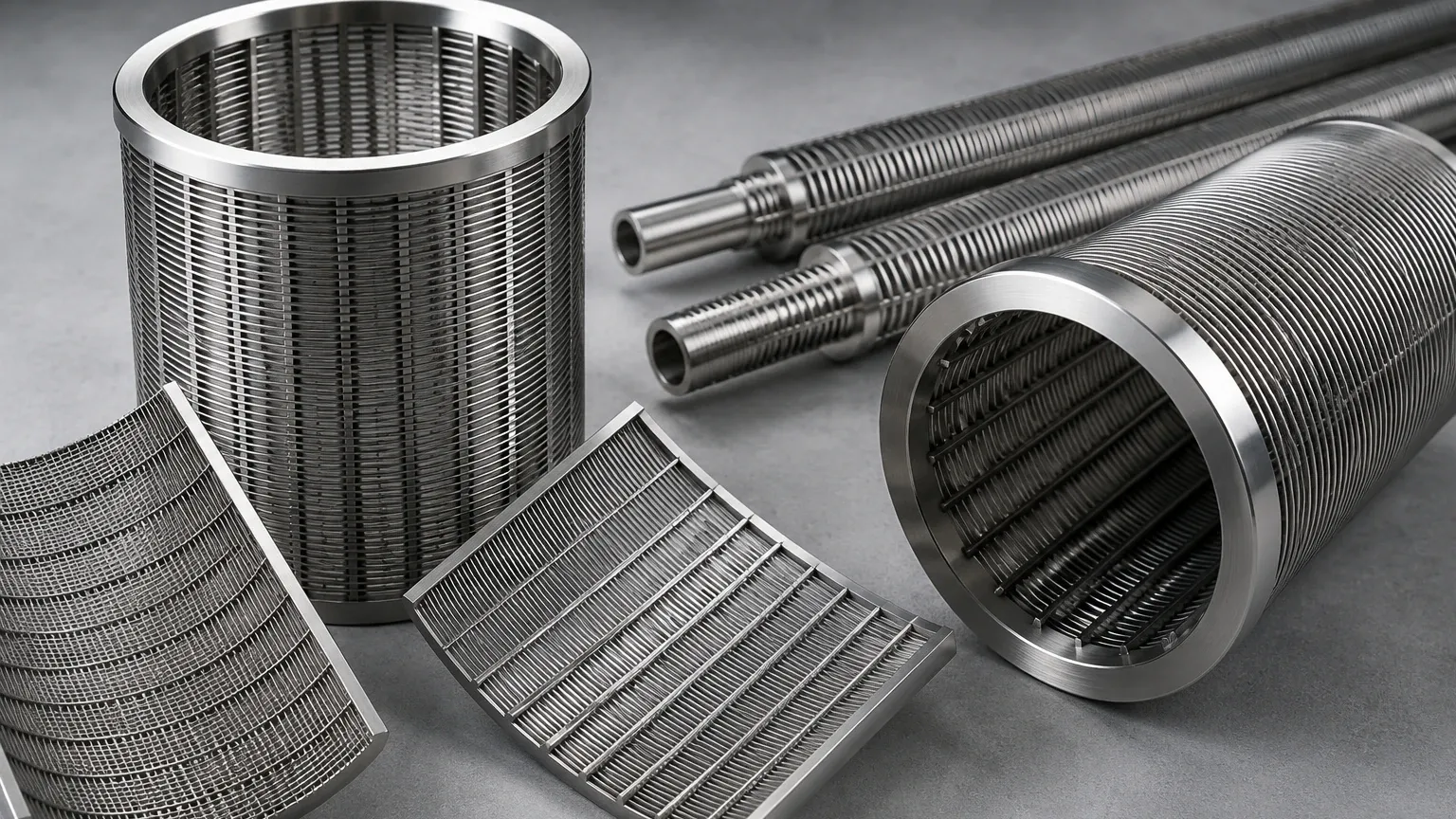
The versatility of wedge wire allows it to be fabricated into various forms, including flat panels, curved sieve bends, cylindrical cartridges, and complex reactor internals.
Water and Wastewater Treatment
In municipal and industrial water treatment, wedge wire is used for intake screens to protect pumps from debris while minimizing impact on aquatic life. It is also the standard material for resin traps in ion exchange systems and for underdrain media support in gravity filters.
Food and Beverage Processing
In the brewing industry, wedge wire "false bottoms" are used in lauter tuns to separate the wort from the grain. The precision slots allow for efficient drainage while providing a stable floor for the grain bed. Similarly, in sugar processing and vegetable washing, wedge wire provides a sanitary, easy-to-clean separation surface.
Mining and Mineral Processing
Wedge wire sieve bends and vibrating screen panels are essential for dewatering, sizing, and media recovery. The high abrasion resistance of stainless steel wedge wire ensures that the screens can handle tons of ore or coal slurry daily without rapid degradation of the slot accuracy.
Petrochemical and Refining
Inside chemical reactors, wedge wire components serve as catalyst support grids and center pipes. These components must withstand extreme temperatures and pressures while ensuring that catalyst beads are retained and fluid flow remains uniform across the bed.
Key Considerations for Procurement and Design
When consulting with a manufacturer like Kaifil for custom filtration solutions, engineers should have specific data points ready to ensure the wedge wire design is optimized for their process.
1. Flow Characteristics: What is the required flow rate (GPM or m³/h)? This determines the necessary open area and the overall dimensions of the screen.
2. Particle Profile: What is the size, shape, and concentration of the solids being removed? This dictates the slot size and the choice of profile wire.
3. Pressure Requirements: What is the maximum operating pressure and the expected differential pressure across the screen? This influences the selection of support rods and the frequency of the welds.
4. Chemical Compatibility: What is the pH, temperature, and chemical composition of the fluid? This guides the selection of the stainless steel grade or specialty alloy.
5. Cleaning Method: Will the screen be cleaned via automated backwashing, manual scraping, or ultrasonic baths? The design can be reinforced to handle the specific stresses of the cleaning method.
Conclusion
Understanding what is wedge wire is the first step in solving complex separation challenges. As a robust, high-precision filtration medium, wedge wire screens provide a level of reliability and efficiency that alternative materials often cannot match. By leveraging the V-shaped profile and resistance-welded construction, industrial operations can achieve finer filtration, reduce maintenance-related downtime, and extend the service life of their equipment.
For organizations requiring tailored filtration components, working with an experienced manufacturer is vital. Kaifil specializes in the design and production of custom stainless steel filtration solutions, providing the engineering expertise needed to translate application requirements into high-performance wedge wire products. Whether you are designing a new processing plant or looking to upgrade existing filtration systems, selecting the right wedge wire configuration is a strategic investment in operational stability.
