


Wedge Wire Screen Design
In industrial filtration and separation, the efficiency of a system often hinges on the precise engineering of its components. Wedge wire screens, also known as profile wire screens, represent a pinnacle of mechanical filtration technology. Unlike woven wire mesh or perforated plates, the inherent geometry and construction of wedge wire offer unique advantages in terms of strength, longevity, and resistance to clogging. For engineers and procurement professionals, understanding the nuances of wedge wire screen design is essential for optimizing process performance and reducing total cost of ownership.
At its core, a wedge wire screen is a fusion-welded structure consisting of V-shaped profile wires and support rods. This design creates a continuous slot that widens inwardly, ensuring that particles only make contact at two points on the surface. This "non-blinding" characteristic is the primary reason why these screens are preferred in demanding environments such as chemical processing, water treatment, and mineral extraction. This article explores the critical engineering considerations, material selections, and structural configurations that define high-performance filtration solutions.
Understanding the Core Components: Profile Wire and Support Rods
The fundamental performance of any wedge wire system is dictated by its two primary components: the surface profile wire and the internal support rod.
The V-Shaped Profile Wire
The surface wire is typically a triangular or V-shaped profile. During the manufacturing process, this wire is wrapped around or laid across support rods and resistance-welded at every intersection. The "wedge" shape is oriented so that the narrowest part of the V faces the incoming flow. This creates a slot that widens in the direction of the flow. If a particle is small enough to pass through the initial slot opening, it will easily clear the rest of the screen without getting wedged or stuck. This geometry significantly reduces the risk of "blinding"—a common failure mode in traditional mesh filters where particles become trapped within the apertures.
The Support Rods
While the profile wire determines the filtration accuracy, the support rods provide the structural framework. These rods can be round, rectangular, or even V-shaped themselves, depending on the mechanical loads the screen must withstand. The spacing between support rods (the pitch) is a critical factor in determining the screen's resistance to collapse or bursting under high-pressure differentials. In high-pressure hydraulic or deep-well applications, the support rod configuration must be engineered to handle significant hydrostatic and mechanical stresses.
Material Selection and Chemical Compatibility
Selecting the appropriate alloy is perhaps the most critical step in wedge wire screen design. Because these screens are often used in corrosive or abrasive environments, the material must offer both chemical resistance and mechanical durability. Kaifil specializes in stainless steel solutions, which are the industry standard for most industrial applications.
1. AISI 304/304L: The most common grade, offering excellent corrosion resistance and mechanical properties for general industrial use, food and beverage processing, and standard water treatment.
2. AISI 316/316L: Contains molybdenum, which provides superior resistance to chlorides and pitting. This is the preferred choice for pharmaceutical applications, chemical processing, and marine environments.
3. Duplex Stainless Steels (e.g., 2205): Used in highly aggressive environments where both high strength and extreme corrosion resistance are required, such as in the oil and gas industry or high-concentration brine filtration.
4. Specialty Alloys: For extreme temperatures or highly acidic environments, materials like Monel, Hastelloy, or 904L may be specified to ensure the longevity of the filtration component.
When evaluating materials, engineers must consider the pH levels, temperature fluctuations, and the presence of abrasive solids in the process fluid. A well-designed screen using the correct material can last for decades, whereas an incorrect choice may lead to premature failure through stress corrosion cracking or erosive wear.
Calculating Slot Width and Open Area for Optimal Flow
The slot width—the distance between two adjacent profile wires—is the most vital dimension in wedge wire screen design. It determines the filtration rating (the size of particles that will be retained) and the open area of the screen.
The Open Area Formula
The percentage of open area (OA) is calculated using the following formula:
$$OA = \frac{S}{S + W} \times 100$$
Where:
* S = Slot width (aperture)
* W = Width of the profile wire
A higher open area results in lower entrance velocities and reduced pressure drop (ΔP) across the screen. This is critical for energy efficiency and for preventing the "pinning" of soft particles against the screen surface. However, there is a trade-off: a larger open area often requires thinner profile wires, which may reduce the mechanical strength of the screen. Engineers must balance the need for high flow rates with the structural requirements of the specific application.
Precision and Tolerance
In precision filtration, even a slight deviation in slot width can compromise the entire process. Advanced manufacturing techniques, such as those employed by Kaifil, allow for slot tolerances as tight as ±0.01mm. This level of precision is essential in applications like catalyst recovery or resin traps, where the loss of expensive media can result in significant financial impact.
Structural Integrity: Pressure Resistance and Support Configuration
Industrial filters are often subjected to high differential pressures, especially during surge events or when the screen begins to accumulate a cake layer. The structural integrity of the Wedge Wire Screens is a product of the weld quality and the support rod arrangement.
Resistance Welding
High-quality wedge wire is produced using computer-controlled resistance welding. This process uses high current and pressure to fuse the profile wire to the support rod at every contact point. This creates a rigid, one-piece structure that can withstand vibration and mechanical shock far better than woven or mechanically fastened screens.
Reinforcement Techniques
For applications involving high-pressure backwashing or heavy mechanical loads, additional reinforcement may be necessary. This can include:
* Exterior Cages: Providing an extra layer of structural support for cylindrical screens.
* Reinforcing Rings: Welded at intervals along the length of a cylinder to prevent deformation.
* Custom Frames: For flat panels used in vibrating shakers or intake systems, heavy-duty frames ensure the screen remains flat and properly tensioned.
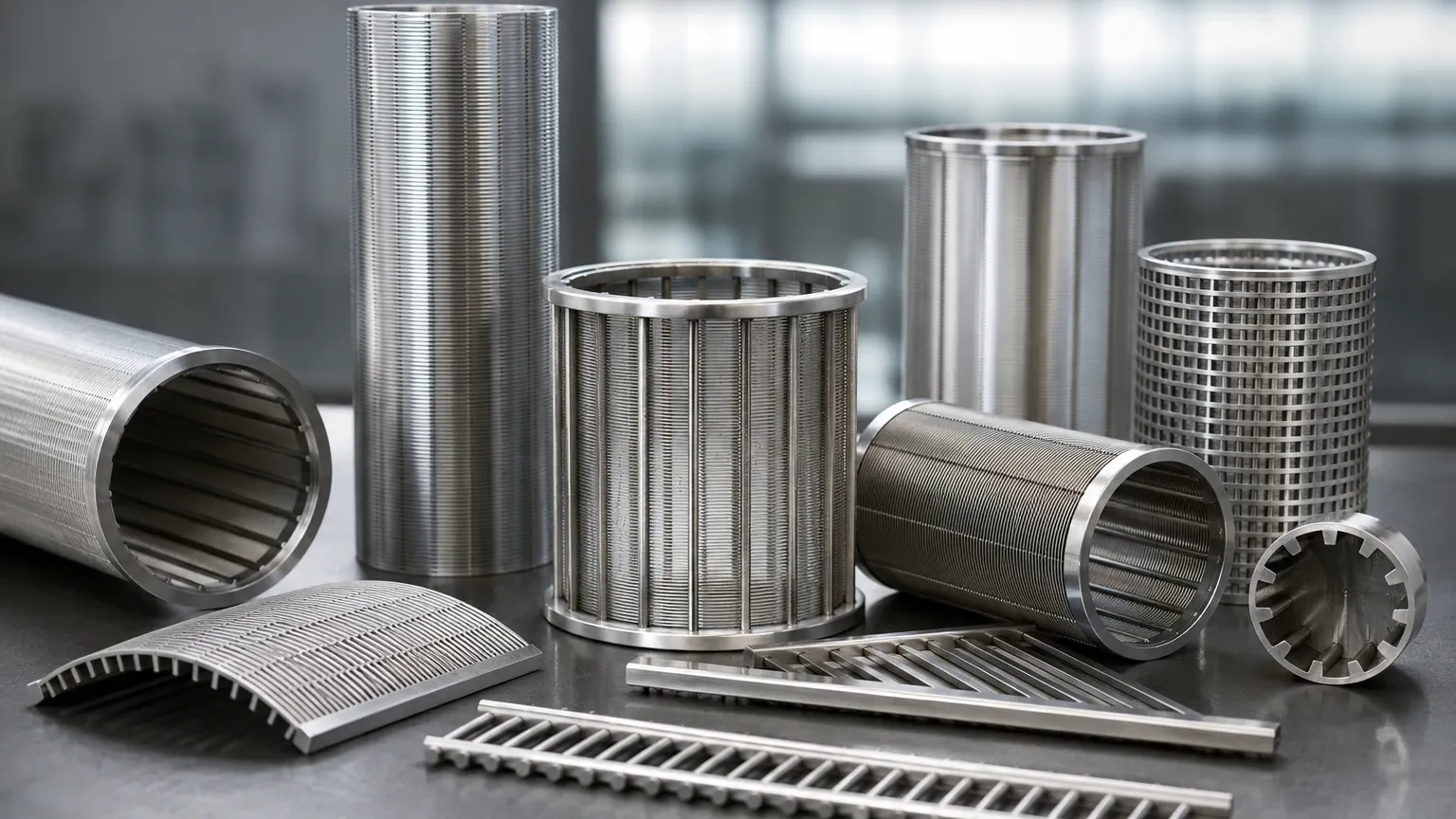
Flow Direction and Orientation in Wedge Wire Screen Design
One of the most versatile aspects of wedge wire is the ability to customize the flow direction. The orientation of the profile wires relative to the support rods determines how the fluid moves through the screen.
Flow-Out-to-In (FOTI)
In this configuration, the profile wires are on the outside of the cylinder, and the support rods are on the inside. This is the standard design for well screens and intake filters where the fluid moves from the surrounding environment into the center of the pipe.
Flow-In-to-Out (FITO)
Here, the profile wires are on the inside, creating a smooth internal surface. This is ideal for internally fed rotary screens or screw press separators where solids are moved along the inner surface by a flight or scraper. The smooth internal surface prevents mechanical damage to the cleaning mechanism and ensures efficient solids transport.
Radial vs. Axial Orientation
Profile wires can be oriented radially (around the circumference) or axially (along the length of the cylinder). Radial wires are standard for most filtration tasks, while axial wires are often used in applications where a scraper or brush moves along the length of the screen to remove debris.
Industrial Applications and Customization Requirements
The adaptability of wedge wire screen design allows it to serve a vast array of industries. Each application brings unique challenges that must be addressed during the design phase.
* Water Intake Systems: Large-scale intake screens for power plants or desalination facilities require designs that protect aquatic life (low approach velocity) while resisting biofouling. Stainless steel 316L or specialized coatings are often used here.
* Food and Beverage: In breweries or sugar refineries, screens must meet strict hygienic standards. Smooth surface finishes (electropolishing) and the absence of crevices are vital to prevent bacterial growth and ensure effective CIP (Cleaning-In-Place) cycles.
* Chemical and Petrochemical: These sectors often deal with high temperatures and aggressive solvents. Designers must account for thermal expansion and potential chemical degradation of the welds.
* Pulp and Paper: Wedge wire is used in pressure screens and fiber recovery. The design must handle high-consistency fluids and resist the abrasive nature of wood fibers.
Kaifil provides OEM and customized filtration solutions tailored to these specific needs, ensuring that the screen geometry matches the unique rheology and particle characteristics of the process fluid.
Maintenance and Cleaning Considerations for Long-Term Performance
While wedge wire screens are inherently resistant to clogging, they are not maintenance-free. Proper design includes provisions for effective cleaning, which extends the service life of the component and maintains process efficiency.
Backwashing and Backpulsing
Because of the widening slot geometry, backwashing is highly effective. Reversing the flow pushes particles away from the narrowest point of the slot, where they are easily flushed away. Design parameters such as the "burst pressure" must be calculated to ensure the screen can handle the sudden pressure spikes associated with backpulsing.
Mechanical Cleaning
In many applications, such as automatic self-cleaning filters, a scraper or brush is used to remove solids from the screen surface. In these cases, the wedge wire screen design must specify a "smooth-face" finish. Any misalignment in the profile wires could cause the scraper to jump or wear prematurely, leading to bypass or mechanical failure.
Total Cost of Ownership (TCO)
When evaluating the cost of a wedge wire screen, engineers should look beyond the initial purchase price. The durability of stainless steel, the reduced downtime due to the non-clogging design, and the ease of cleaning contribute to a much lower TCO compared to disposable filter cartridges or lower-quality mesh screens. Investing in a precision-engineered design upfront pays dividends in operational reliability and reduced maintenance labor.
Conclusion: Achieving Optimal Filtration
The design of a wedge wire screen is a sophisticated balancing act between filtration precision, hydraulic efficiency, and mechanical strength. By carefully selecting the profile wire shape, support rod spacing, material grade, and flow orientation, engineers can create a filtration solution that is perfectly matched to their specific industrial environment.
As a professional manufacturer, Kaifil provides the technical expertise and advanced manufacturing capabilities required to turn complex filtration requirements into reliable hardware. Whether the application calls for a standard cylindrical cartridge or a highly customized lateral system, focusing on factual engineering principles ensures that the resulting wedge wire screen will perform predictably under the most demanding conditions. For those looking to optimize their filtration processes, confirming the specific mechanical and chemical requirements of the project is the first step toward a successful implementation.
