


Wedge Wire Screen Open Area
In industrial filtration and separation, the efficiency of a system is often dictated by the physical characteristics of the filter media. For engineers and procurement specialists, understanding the technical nuances of wedge wire screen open area is essential for optimizing flow rates, minimizing pressure drops, and ensuring the structural longevity of the equipment. As a specialized manufacturer of stainless steel filtration solutions, Kaifil provides precision-engineered components designed to meet the rigorous demands of chemical processing, water treatment, and food production.
This guide examines the engineering principles behind open area calculations, the performance trade-offs involved in screen design, and the critical factors that influence the selection of Wedge Wire Screens for industrial applications.
Understanding the Calculation of Wedge Wire Screen Open Area
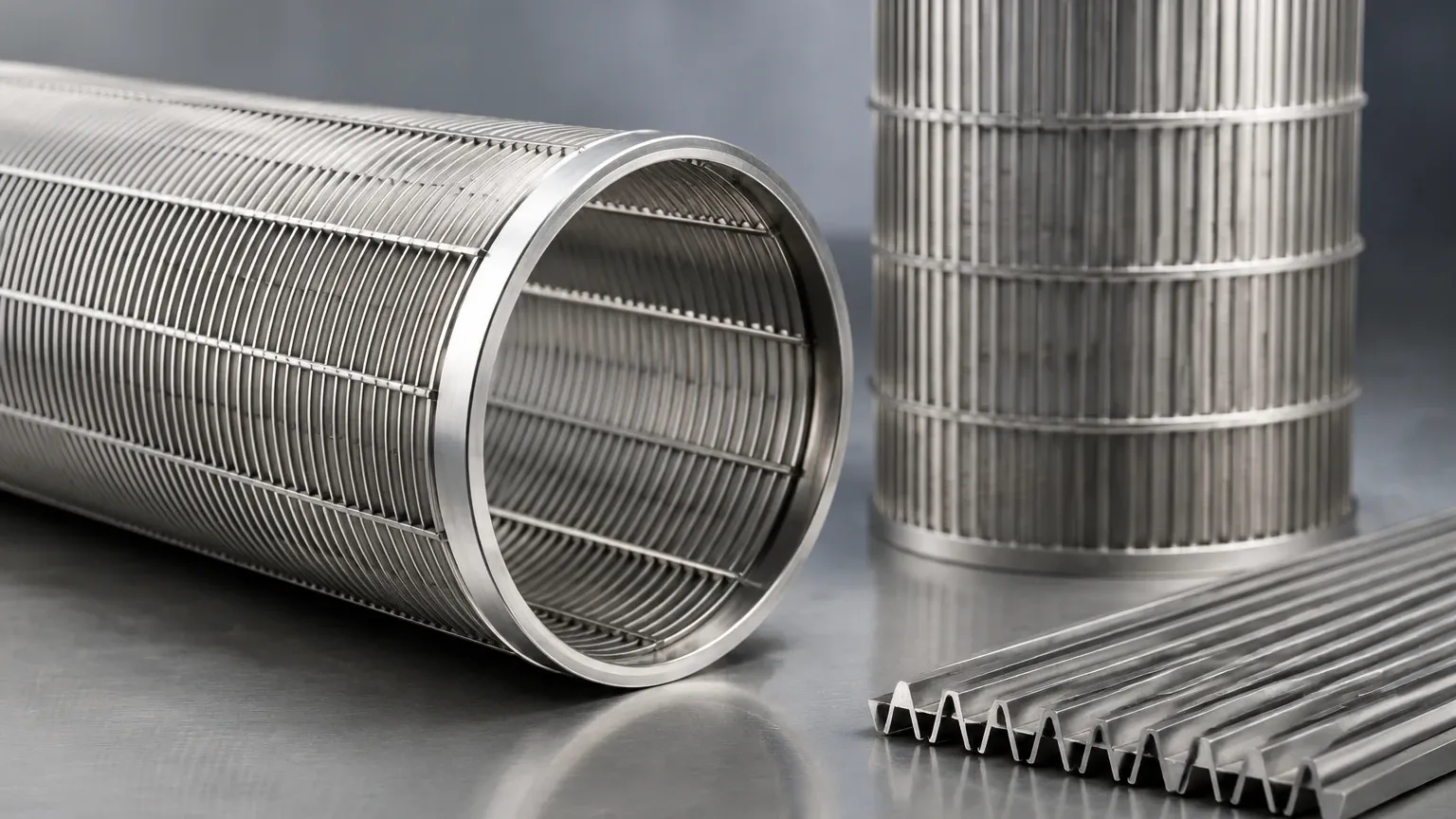
The "open area" of a wedge wire screen refers to the percentage of the total surface area that allows the passage of fluids or gases. Unlike woven wire mesh, where the open area is determined by wire diameter and mesh count in two directions, wedge wire screens consist of parallel V-shaped profiles (surface wires) resistance-welded onto perpendicular support rods.
The calculation for wedge wire screen open area is a fundamental geometric ratio:
Open Area (%) = [Slot Width / (Slot Width + Wire Width)] × 100
For example, if an application requires a slot width (aperture) of 0.5 mm and utilizes a surface wire with a width of 1.5 mm, the calculation would be:
[0.5 / (0.5 + 1.5)] × 100 = 25%
From an engineering perspective, this percentage directly correlates to the hydraulic capacity of the screen. A higher open area allows for a greater volume of fluid to pass through the screen at a lower velocity, which is often desirable to reduce turbulence and mechanical wear. However, increasing the open area typically requires either widening the slots (which changes the filtration rating) or using thinner surface wires (which may compromise the mechanical strength of the screen).
Factors Influencing Hydraulic Performance
The relationship between wedge wire screen open area and hydraulic performance is governed by the principles of fluid dynamics. When designing a filtration system, engineers must consider how the open area impacts several key performance indicators.
Pressure Drop (ΔP)
Pressure drop is the loss of fluid pressure as it passes through the filter media. A screen with a low open area creates higher resistance to flow, leading to a significant pressure differential. This requires pumps to work harder, increasing energy consumption and operational costs. By maximizing the open area within the constraints of the required filtration accuracy, engineers can achieve a more energy-efficient process.
Flow Velocity and Turbulence
Flow velocity through the slots is inversely proportional to the open area. If the open area is too small for the required flow rate, the velocity of the fluid through the apertures increases. High-velocity flow can lead to several issues:
1. Particle Impingement: High-speed particles can cause abrasive wear on the edges of the wedge wires, gradually widening the slots and reducing filtration precision.
2. Turbulence: Excessive velocity can create turbulent flow patterns on the downstream side of the screen, which may interfere with sensitive downstream processes or cause vibrations in the screen assembly.
3. Shear Stress: In applications involving delicate biological or chemical structures (such as in the pharmaceutical or food industries), high shear stress through narrow openings can damage the product.
Non-Clogging Characteristics
The V-shaped profile of the wires used in Wedge Wire Screens is specifically designed to provide a two-point contact for particles. This geometry ensures that any particle that passes through the initial slot width will continue to move freely through the widening gap between the wires. The open area must be calculated to ensure that this self-cleaning effect is maintained across the entire surface of the screen.
Balancing Structural Integrity with Filtration Capacity
One of the most significant challenges in screen design is the "Engineering Trade-off" between high open area and structural durability. While a high open area improves flow, it inherently reduces the amount of metal available to support the mechanical loads of the application.
Wire Profile Selection
The width and height of the surface wire determine its moment of inertia and resistance to bending. In high-pressure environments, such as deep-well water intake or high-viscosity chemical filtration, thicker wires are necessary to prevent the slots from deforming under pressure. If a thicker wire is used to maintain strength, the slot width must be adjusted or the total screen surface area must be increased to maintain the desired wedge wire screen open area.
Support Rod Configuration
The support rods provide the skeletal framework for the surface wires. The spacing between these rods (the "pitch") determines the span over which the surface wires must resist deflection. Closer support rod spacing allows for the use of finer surface wires (increasing open area) while maintaining structural rigidity. However, the points where the surface wires are welded to the support rods effectively block a small portion of the flow path. In precision engineering, this "blocked" area must be accounted for when calculating the *effective* open area versus the *theoretical* open area.
Material Properties
Kaifil utilizes various grades of stainless steel (such as 304, 316L, and Duplex steels) to provide the necessary yield strength and corrosion resistance. The choice of material affects the minimum thickness required for the wires. For instance, in highly corrosive chemical environments, a thicker wire may be selected to provide a "corrosion allowance," even if a thinner wire would have sufficed for the initial pressure requirements. This decision directly impacts the long-term stability of the open area.
Application-Specific Considerations for Open Area Selection
Different industries prioritize different aspects of screen performance. Selecting the correct wedge wire screen open area requires a deep understanding of the specific process conditions.
Water Treatment and Intake
In municipal water treatment or industrial cooling water intakes, high flow rates are the primary concern. Screens are often designed with a high open area to minimize the "approach velocity" of the water. Low approach velocities are critical for environmental compliance, as they prevent fish and other aquatic organisms from being pinned against the screen (impingement).
Food and Beverage Processing
In applications like mash tuns for brewing or juice extraction, the open area must be balanced with the need for easy cleaning. A screen with a consistent and well-defined open area facilitates effective Clean-in-Place (CIP) cycles. The V-wire design minimizes the risk of organic material becoming trapped, which is vital for maintaining sanitary standards.
Petrochemical and Refining
In reactor internals or catalyst support grids, the screens must withstand extreme temperatures and differential pressures. Here, the open area is often sacrificed in favor of heavy-duty wire profiles that can support tons of catalyst media without deforming. Precision in the slot width is paramount to prevent the loss of expensive catalyst fines.
Pulp and Paper
Screening and fractionation in pulp mills require precise control over the open area to ensure that fibers are separated according to size without clogging. The high-frequency vibrations often used in these processes mean that the screen must have a robust support structure, which influences the total available open area.
Maintenance and Longevity: The Role of Open Area
The longevity of a filtration system is not just about the durability of the metal, but about the stability of the filtration parameters over time. The wedge wire screen open area plays a vital role in the maintenance cycle.
Backwashing Efficiency
Many automated filtration systems use backwashing (reversing the flow) to clear the screen surface. A screen with an optimized open area allows the backwash fluid to reach the entire surface effectively. If the open area is too restricted, the backwash pressure may not be distributed evenly, leading to "blind spots" where debris continues to accumulate.
Wear Monitoring
As wedge wire screens age, abrasive particles can wear down the surface wires. Because the wires are V-shaped, wearing down the top of the wire actually increases the slot width. This leads to an unintended increase in the open area and a decrease in filtration precision. Engineers should monitor the pressure drop over time; a sudden decrease in ΔP (without a change in flow rate) may indicate that the wire profiles have worn down and the open area has increased beyond the design specifications.
Engineering Customization for Industrial Applications
At Kaifil, we recognize that standard off-the-shelf solutions rarely meet the complexities of modern industrial processes. Customizing the wedge wire screen open area involves a collaborative engineering approach:
1. Requirement Analysis: We evaluate the fluid viscosity, particle size distribution, operating pressure, and required flow rate.
2. Profile Optimization: We select from a wide range of surface wire and support rod profiles to find the optimal balance between flow capacity and mechanical strength.
3. Precision Manufacturing: Using advanced resistance welding technology, we ensure that slot tolerances are maintained within microns, providing a consistent open area across the entire screen surface.
4. Structural Validation: For demanding applications, we can provide calculations or simulations to ensure the screen will withstand the projected collapse or burst pressures.
Choosing the right screen involves more than just picking a slot size. It requires a holistic view of how the open area interacts with the entire system. By focusing on precision geometry and material integrity, Kaifil helps technical teams achieve reliable, long-term filtration performance.
For technical consultation on optimizing your filtration system or to discuss specific wire profile requirements, engineers and purchasing teams can explore our range of customized Wedge Wire Screens and technical specifications.
