


Wedge Wire Screen Panel
In industrial filtration and separation, the efficiency of a system often hinges on the mechanical integrity and precision of the screening media. A wedge wire screen panel is a specialized filtration component engineered to provide high-performance separation under demanding conditions. Unlike traditional woven wire mesh or perforated plates, these panels utilize a unique V-shaped profile wire that offers distinct advantages in terms of flow rate, structural strength, and resistance to blinding.
For engineers and procurement teams, selecting the correct wedge wire screen panel requires a deep understanding of fluid dynamics, material science, and mechanical stress factors. This guide examines the technical specifications, engineering considerations, and application-specific selection criteria necessary to optimize industrial filtration processes.
The Engineering Principles of Wedge Wire Construction
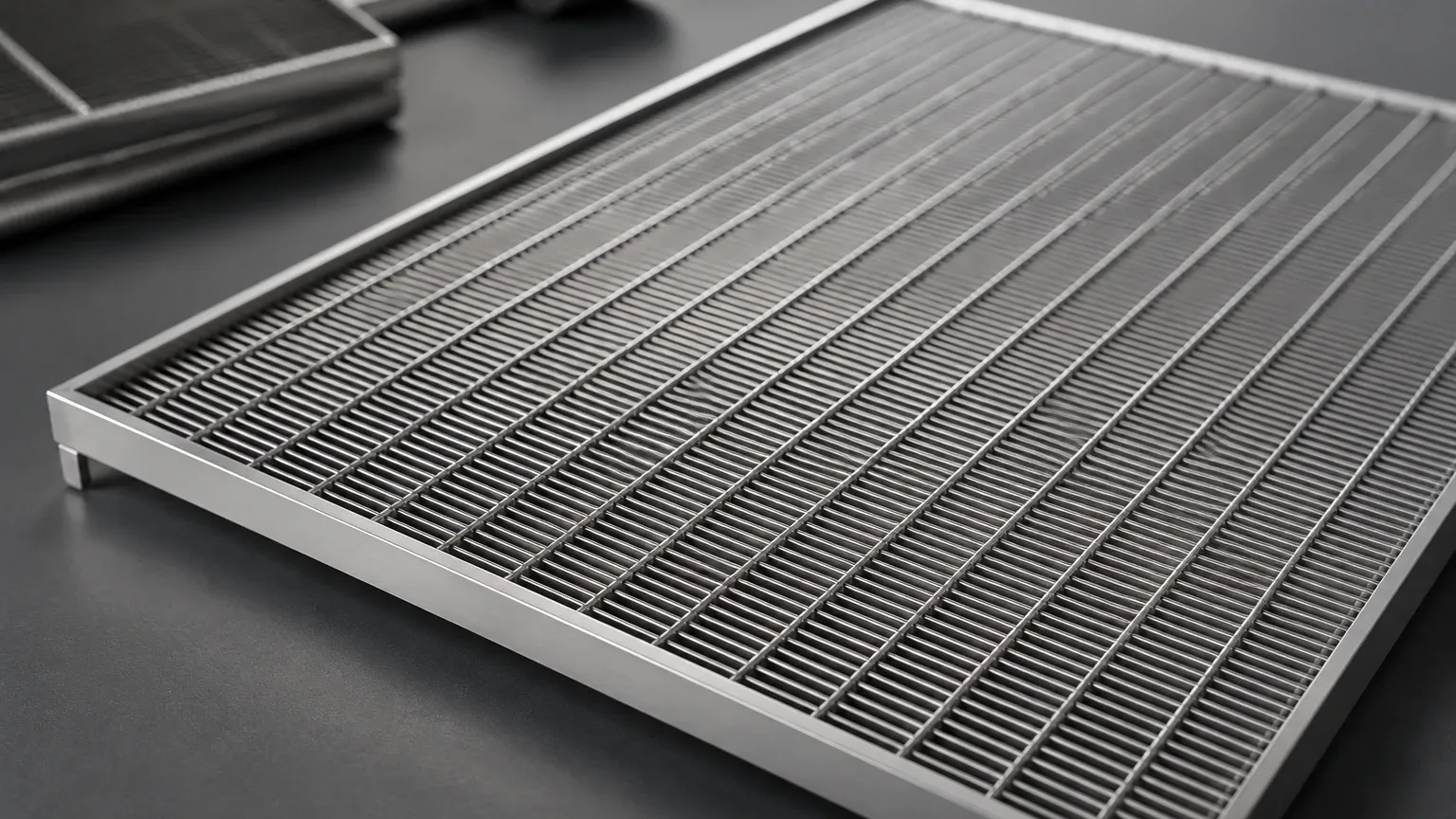
The fundamental advantage of Wedge Wire Screens lies in their geometric design. Each panel is constructed by welding a series of V-shaped profile wires onto perpendicular support rods at every intersection. This resistance welding process ensures a robust, single-piece structure that can withstand significant mechanical loads without shifting or deforming.
The V-Shaped Profile Advantage
The "wedge" in wedge wire refers to the cross-section of the surface wire. The V-shape is oriented so that the narrowest part of the wire faces the incoming flow, creating a slot that widens inwardly. This geometry is critical for two reasons:
1. Non-Clogging Characteristics: Particles that are slightly smaller than the slot opening pass through easily. Because the opening widens immediately after the surface contact point, there is no opportunity for near-size particles to become wedged in the gap, a phenomenon known as "blinding."
2. Effective Backwashing: During cleaning cycles, the widening slot allows for efficient reverse flow, ensuring that accumulated debris is easily dislodged from the surface.
Slot Precision and Open Area
The slot width, or the distance between two adjacent profile wires, determines the filtration rating. In a wedge wire screen panel, these slots are continuous, providing a significantly higher percentage of open area compared to perforated plates with the same aperture size. A higher open area translates to lower pressure drops across the screen and increased throughput capacity for the system.
Material Selection for Industrial Environments
Material choice is a primary factor in the longevity and performance of a wedge wire screen panel. Because these components are often exposed to corrosive fluids, abrasive slurries, or high temperatures, selecting the appropriate stainless steel grade is essential.
* Grade 304 Stainless Steel: This is the standard choice for general industrial applications. It offers good corrosion resistance and mechanical strength, making it suitable for water treatment, architectural applications, and standard food processing.
* Grade 316L Stainless Steel: For environments involving chlorides, acids, or high-salinity fluids, 316L is the preferred option. The addition of molybdenum enhances its resistance to pitting and crevice corrosion, which is vital in chemical processing and marine environments.
* Duplex Stainless Steels: In heavy-duty mining or high-pressure hydraulic applications, duplex alloys may be used to provide superior yield strength and resistance to stress corrosion cracking.
When specifying materials for a wedge wire screen panel, engineers must also consider the surface finish. Electropolishing or pickling can be applied to enhance corrosion resistance and reduce surface friction, which is particularly important in pharmaceutical and food-grade applications where hygiene and ease of cleaning are paramount.
Structural Design and Load-Bearing Capacity
Unlike flexible mesh, a wedge wire screen panel is a rigid component. Its ability to support weight—whether it is a bed of catalyst, a layer of mineral ore, or the pressure of a high-velocity fluid—depends on the configuration of the support rods and the frame.
Support Rod Configuration
The support rods provide the structural backbone of the panel. Their shape (round, rectangular, or teardrop), size, and spacing are determined by the intended load. For panels used in vibrating screens or heavy-duty dewatering, support rods are spaced more closely to prevent the profile wires from sagging or vibrating excessively, which could lead to fatigue failure.
Framing and Edge Details
A wedge wire screen panel is rarely used as a standalone piece of wire; it must be integrated into a larger machine or housing. Framing options include:
* Flat Bar Frames: Simple and cost-effective for panels that are bolted or clamped into place.
* Angle Iron Frames: Provide additional rigidity and are often used for large-scale floor screens or intake panels.
* U-Profile Edging: Protects the ends of the wires and provides a smooth edge for installation in tracks or guides.
Customization of the frame ensures that the panel fits perfectly within the existing equipment, preventing bypass—a common failure point where unfiltered fluid leaks around the edges of the screen.
Key Applications Across Industries
The versatility of the wedge wire screen panel makes it a staple in various sectors. Each industry utilizes specific design features to solve unique filtration challenges.
Water and Wastewater Treatment
In municipal and industrial water treatment, these panels are used as intake screens to protect pumps from debris and as underdrains in sand filters. The high open area ensures that large volumes of water can be processed with minimal energy loss, while the durability of stainless steel ensures a long service life in submerged conditions.
Mining and Mineral Processing
Dewatering and sizing are critical in mining. Wedge wire panels are used on vibrating decks to separate water from ore or to grade materials by size. The high mechanical strength of the resistance-welded structure allows these panels to handle the abrasive impact of heavy minerals without losing slot accuracy.
Food and Beverage Production
In the production of sugar, starch, and malt, wedge wire screen panels serve as false bottoms in lauter tuns or as separation screens in flumes. The smooth surface and non-clogging nature of the V-wire profile are essential for maintaining sanitary conditions and ensuring consistent product quality.
Chemical and Petrochemical Processing
Reactor internals often utilize wedge wire panels to support catalyst beds. These panels must maintain their structural integrity at elevated temperatures and resist chemical attack. The precision of the slot width is critical here to prevent the loss of expensive catalyst media.
Evaluation Criteria for Purchasing Decisions
When sourcing a wedge wire screen panel, engineering and purchasing teams should evaluate several technical parameters to ensure the product meets the application's demands. Moving beyond price, the total cost of ownership is heavily influenced by the following factors:
1. Slot Tolerance: How much variation is allowed in the slot width? For precision filtration, tight tolerances (e.g., ±0.05mm) are necessary to ensure consistent particle retention.
2. Pressure Drop Calculations: Based on the flow rate and fluid viscosity, what is the expected pressure drop? A panel with a higher open area may reduce long-term energy costs.
3. Mechanical Stress Analysis: Will the panel be subjected to vibration, thermal expansion, or heavy static loads? The manufacturer should provide guidance on the necessary wire and rod sizes to handle these stresses.
4. Cleaning Requirements: Is the system manual or automated? The orientation of the V-wire (whether the flat side or the point faces the flow) can be customized to facilitate specific cleaning methods like scraping or back-pulsing.
Common Risks and Mitigation Strategies
While wedge wire is exceptionally durable, failures can occur if the application parameters are not correctly matched to the screen design.
* Fatigue Failure: In vibrating applications, if the support rod spacing is too wide, the profile wires may vibrate independently, leading to weld failure. This is mitigated by precise engineering of the support structure.
* Erosion: In high-velocity applications with abrasive particles, the leading edges of the V-wires can wear down over time, widening the slots. Selecting harder alloys or increasing the wire width can extend the panel's life.
* Bypass Leakage: If the panel is not framed correctly or if the seals are inadequate, fluid will take the path of least resistance around the screen. Custom OEM designs that include integrated gaskets or precision-machined frames are effective solutions.
Conclusion: Selecting a Reliable Filtration Partner
A wedge wire screen panel is more than a simple metal grate; it is a precision-engineered tool designed to optimize industrial throughput and protect downstream equipment. Achieving the best results requires collaboration between the end-user and a manufacturer with deep technical expertise.
At Kaifil, we specialize in providing customized Wedge Wire Screens that address the specific challenges of your industry. From material selection and slot precision to custom framing and structural reinforcement, our engineering team works closely with you to deliver filtration solutions that offer durability, accuracy, and cost-effectiveness. Before initiating your next project, confirm your flow requirements, chemical compatibility, and mechanical load profiles to ensure your wedge wire screen panel is optimized for peak performance.
