


Wedge Wire Screen Products
In industrial filtration and separation, the choice of media directly impacts operational efficiency, maintenance frequency, and the purity of the final output. Among the various technologies available, wedge wire screen products have established themselves as a premier solution for demanding environments where high mechanical strength, precision slot openings, and non-clogging characteristics are required.
As a specialized manufacturer, Kaifil provides engineered Wedge Wire Screens designed to meet the rigorous standards of chemical processing, water treatment, and food production. Understanding the technical nuances of these components is essential for engineers and procurement teams looking to optimize their filtration systems.
The Engineering Principles of Wedge Wire
Wedge wire, also known as profile wire, is a precision-engineered metal structure typically made from stainless steel. Unlike woven wire mesh, which consists of interlaced wires, wedge wire is constructed by welding V-shaped profile wires onto support rods at every intersection point.
The V-Shaped Profile Advantage
The defining characteristic of wedge wire screen products is the V-shaped cross-section of the surface wire. This design creates a slot that widens inwardly. In a standard filtration setup, the particles are stopped at the narrowest point of the slot on the surface. Because the opening expands immediately behind the contact point, any particle that passes through the initial gap is unlikely to become lodged or "blind" the screen.
This non-clogging geometry is a critical advantage over perforated plates or woven mesh, where particles can easily become trapped within the depth of the media or at the crossover points of the wires. For applications involving sticky materials, fibrous solids, or high-viscosity liquids, the V-profile ensures a continuous flow and simplifies cleaning cycles.
Structural Integrity and Welding
The manufacturing process involves advanced resistance welding or TIG welding, depending on the application requirements. By fusion-bonding the profile wire to the support rods, the resulting structure is incredibly rigid. This inherent strength allows wedge wire screens to withstand high pressure differentials and heavy loads without deforming. This is particularly important in high-pressure hydraulic systems or large-scale water intake structures where the physical integrity of the filter media is paramount.
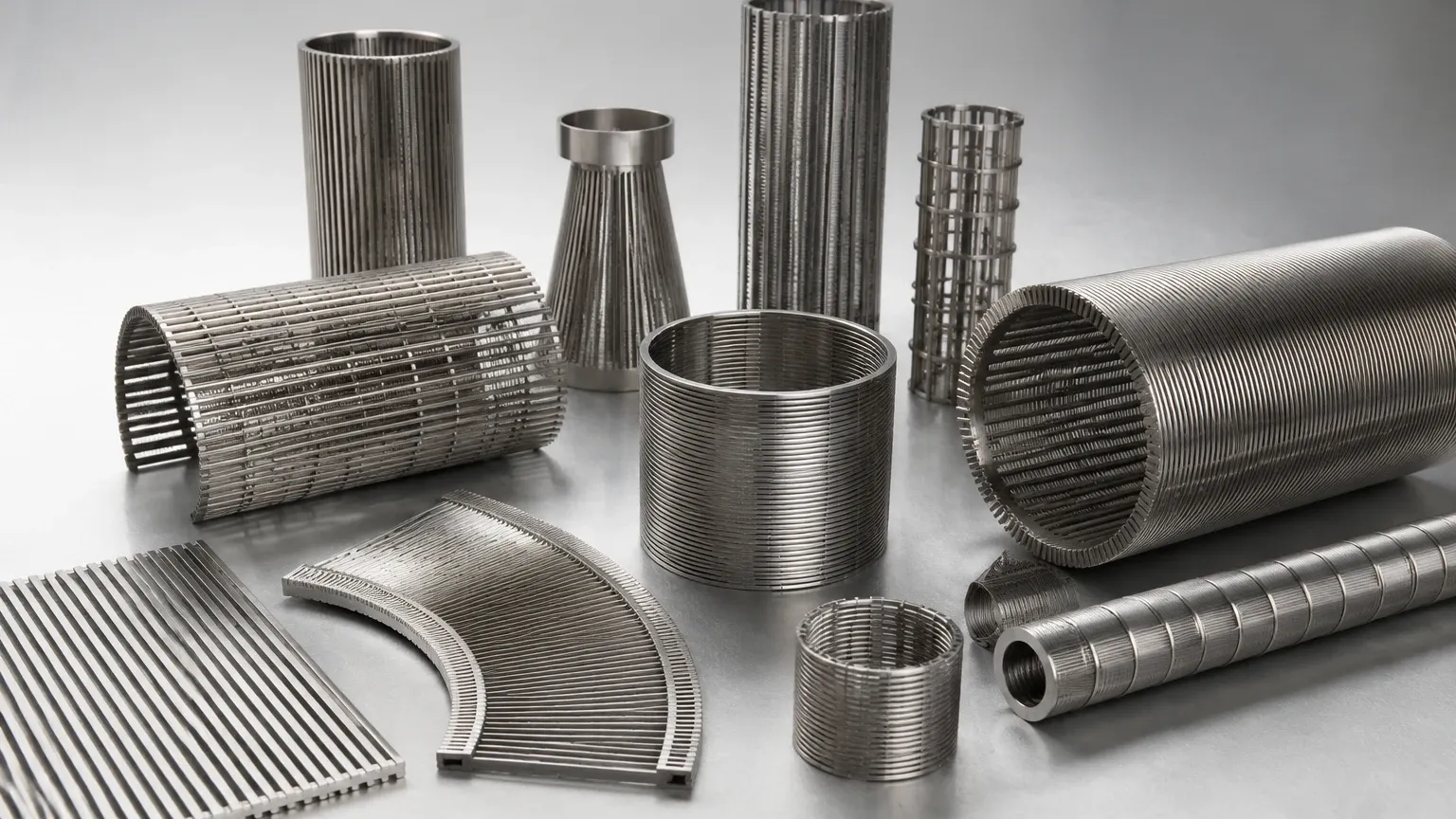
Categories of Wedge Wire Screen Products
Wedge wire technology is highly versatile and can be fabricated into numerous configurations to suit specific equipment designs.
1. Cylindrical Screens and Cartridges
Cylindrical wedge wire products are widely used in rotary screens, screw presses, and internal pipe filtration. They can be engineered for two types of flow:
* Outside-to-In (FOTI): The filtration occurs on the outer surface, and the filtrate moves toward the center. This is common in well screens and intake filters.
* Inside-to-Out (FITO): The filtration occurs on the inner surface. This configuration is often used in centrifuge baskets and internal pipe strainers where solids need to be collected or moved along the inner diameter.
2. Flat Panels and Sieve Bends
Flat wedge wire panels are used in vibrating screens, floor drains, and static sieves. A specific variation, the sieve bend (or DSM screen), utilizes a curved panel. As slurry flows over the curved surface, the leading edge of the wedge wire "slices" a thin layer of liquid and fine particles through the slots, while larger solids continue over the surface. This gravitational separation is highly efficient for dewatering and mineral processing.
3. Nozzles and Lateral Systems
In ion exchange units, sand filters, and carbon towers, wedge wire nozzles and hub-and-header laterals are used to distribute flow evenly and retain media. Unlike plastic nozzles, stainless steel wedge wire nozzles offer superior thermal stability and chemical resistance, preventing catastrophic media loss that can occur if a plastic nozzle fails under pressure or temperature spikes.
4. Resin Traps
Resin traps are safety devices installed in the discharge lines of ion exchange columns or other media-based systems. They are designed to catch expensive resins or catalysts in the event of a primary distribution system failure. Because they must handle the full flow of the system with minimal pressure drop, the high open area of wedge wire is an ideal fit.
Key Evaluation Criteria for Selection
When specifying wedge wire screen products for an industrial application, several technical factors must be confirmed to ensure long-term performance.
Material Grade and Corrosion Resistance
While Stainless Steel 304 is the standard for many general-purpose applications, harsher environments require specialized alloys.
* 316L Stainless Steel: Offers better resistance to chlorides and pitting, making it suitable for marine environments and chemical processing.
* Duplex Steels: Provide higher mechanical strength and exceptional resistance to stress corrosion cracking, often used in heavy-duty mining or petrochemical applications.
* Specialty Alloys: For extreme temperatures or highly acidic environments, alloys like Monel or Hastelloy may be required.
Slot Size Precision
The "slot size" refers to the distance between the profile wires. In precision filtration, slot tolerances are measured in microns. It is vital to match the slot size to the particle size distribution of the solids being removed. A slot that is too large will allow bypass, while a slot that is too small will increase pressure drop and frequency of cleaning. Kaifil’s manufacturing process ensures consistent slot widths across the entire surface area, which is critical for maintaining a uniform flow rate.
Open Area Calculations
The open area is the ratio of the total slot area to the total screen surface area. High open area reduces the velocity of the fluid passing through the slots, which minimizes the pressure drop and reduces the risk of particle impingement or abrasion on the wire surfaces. Engineers must balance the need for a high open area with the requirement for structural strength, as narrower support rod spacing or thicker profile wires will reduce the available open area.
Industrial Applications and Performance Expectations
Wedge wire screen products are utilized across diverse sectors due to their durability and efficiency.
* Water Treatment: Used in intake screens for power plants, wastewater treatment plants, and desalination facilities. They protect downstream equipment from debris while maintaining high flow rates.
* Food and Beverage: In brewing, wedge wire is used for mash tun bottoms (lauter tuns). In sugar processing, it is used for centrifugal baskets. The smooth surface and ease of sterilization make it compliant with food safety standards.
* Pulp and Paper: Used in fiber recovery, dewatering, and pulp screening. The ability to handle high-consistency slurries without blinding is a major advantage here.
* Petrochemicals: Employed in reactor internals, such as center pipes and basket strainers, where they must withstand high temperatures and corrosive hydrocarbons.
Customization and Engineering Considerations
Off-the-shelf filtration solutions rarely meet the specific needs of complex industrial processes. Customization is often necessary to integrate the screen into existing housing or to meet specific hydraulic requirements.
Mechanical Reinforcement
For applications involving high-pressure backwashing or heavy solid loads, additional reinforcement may be needed. This can include external shrouds, internal support rings, or thicker support rods. Engineering the screen to handle the maximum expected differential pressure (collapse or burst pressure) is a safety requirement that prevents system downtime.
Surface Treatments
Depending on the application, surface treatments such as electropolishing or pickling can be applied. Electropolishing creates a microscopically smooth surface that further reduces the risk of bacterial growth and makes the screen even easier to clean. This is particularly valued in the pharmaceutical and biotech industries.
Maintenance and Total Cost of Ownership
While the initial investment in stainless steel wedge wire screen products may be higher than that for disposable filters or plastic media, the total cost of ownership (TCO) is significantly lower in the long run.
1. Durability: Stainless steel construction ensures a long service life, often lasting years even in abrasive environments.
2. Cleanability: The non-clogging V-wire design allows for effective cleaning via backpulsing, backwashing, or manual scraping. This reduces the need for frequent replacements and minimizes labor costs.
3. Efficiency: Lower pressure drops translate to reduced energy consumption for pumps and better overall system throughput.
Engineers should establish a regular inspection cycle to check for physical wear or chemical erosion. In most cases, a simple cleaning protocol is sufficient to restore the screen to its original performance levels, unlike disposable filters that contribute to waste and recurring procurement costs.
Conclusion
Selecting the right filtration media is a balance of material science, hydraulic engineering, and operational practicalities. Wedge wire screen products offer a robust, high-performance alternative to traditional filtration methods, providing the precision and durability required for modern industrial processes.
By focusing on critical factors such as slot precision, material selection, and structural design, technical professionals can ensure their systems operate at peak efficiency. Whether you are designing a new water intake system or upgrading a chemical reactor, the integration of high-quality wedge wire components is a proven strategy for achieving reliable, long-term filtration performance. For those seeking tailored solutions, Kaifil offers the engineering expertise and manufacturing capability to deliver custom wedge wire products that meet the most exacting industrial specifications.
