


Wedge Wire Screen Wastewater
In the field of industrial and municipal water treatment, the efficiency of solids-liquid separation determines the overall performance and operational cost of the entire system. Among the various technologies available, the use of wedge wire screen wastewater solutions has become a standard for engineers seeking high durability and low maintenance. These precision-engineered components are designed to handle high flow rates while resisting the common pitfalls of traditional filtration media, such as blinding and structural deformation under pressure.
Selecting the correct filtration media for wastewater requires a deep understanding of fluid dynamics, particle characteristics, and material science. Wedge wire, characterized by its V-shaped profile wire and continuous slot design, offers distinct mechanical advantages in demanding environments. This article explores the technical specifications, application logic, and engineering considerations essential for integrating wedge wire screens into wastewater treatment processes.
The Engineering Principles of Wedge Wire Screens
At its core, a wedge wire screen is a welded stainless steel structure comprising surface profiles (the wedge-shaped wires) and support profiles (the rods). The unique geometry of the V-shaped wire is the primary reason for its effectiveness in wastewater applications.
Non-Clogging Geometry
The V-shaped profile creates a slot that widens inwardly. In a standard filtration setup, the narrowest part of the opening is at the outer surface. As particles pass through the slot, the increasing width of the opening ensures that any particle small enough to enter the slot will pass through without getting wedged. This "two-point contact" principle significantly reduces the risk of blinding, which is a common failure mode for woven wire mesh or perforated plates where particles can easily become trapped within the thickness of the material.
Structural Integrity and Precision
Unlike flexible mesh, Wedge Wire Screens are rigid structures. Each intersection of the profile wire and support rod is resistance-welded, resulting in a robust component capable of withstanding high differential pressures and heavy mechanical loads. For wastewater treatment, this means the screen can handle the weight of heavy sludge or the force of high-pressure backwashing without losing slot accuracy. Slot tolerances can be controlled to within microns, ensuring consistent filtration performance over the life of the equipment.
Critical Roles in Wastewater Treatment Processes
Wedge wire screen wastewater applications span across various stages of the treatment cycle, from the initial intake to final sludge management. Each stage demands specific configurations to optimize throughput and separation efficiency.
Primary Screening and Grit Removal
In the preliminary treatment phase, screens are used to remove large debris, rags, and inorganic solids that could damage downstream pumps and equipment. Wedge wire panels or rotary drum screens are preferred here because they can handle high volumes of raw influent with minimal manual intervention. The smooth surface of the wedge wire allows for easy mechanical cleaning, such as using brushes or scrapers, which are often integrated into automated screening systems.
Secondary Treatment and Bio-Solids Management
In biological treatment stages, such as Moving Bed Biofilm Reactors (MBBR) or Sequencing Batch Reactors (SBR), wedge wire screens serve as media retention elements. They prevent the loss of plastic bio-carriers while allowing the treated effluent to pass through. The high open area of wedge wire ensures low head loss, which is critical for maintaining the hydraulic balance of the plant.
Sludge Dewatering and Thickening
Managing sludge is one of the most cost-intensive aspects of wastewater treatment. Wedge wire cylinders are frequently used in screw presses and gravity thickeners. The mechanical strength of the welded stainless steel allows the screen to withstand the high torque and compressive forces required to squeeze water out of the sludge. By increasing the dry solids content of the sludge, facilities can significantly reduce disposal and transport costs.
Optimizing Wedge Wire Screen Wastewater Performance
To achieve optimal performance, engineers must balance several technical variables during the specification phase. A "one-size-fits-all" approach often leads to premature failure or inefficient separation.
Slot Size and Open Area Calculation
The slot size is the distance between two adjacent profile wires. This dimension determines the filtration rating. However, decreasing the slot size to capture smaller particles also reduces the total open area, which increases the flow velocity through the slots and the pressure drop across the screen. Engineers must calculate the "Effective Open Area" to ensure that the approach velocity does not lead to particle impingement or excessive head loss.
Flow Direction and Profile Orientation
Wedge wire can be configured for flow from "out-to-in" (FOTI) or "in-to-out" (FITO). In wastewater drum screens, the flow direction determines whether the profile wire is wrapped on the outside or the inside of the support rods. For internally fed rotary screens, the V-shape should open toward the outside to facilitate the passage of solids. Incorrect orientation can lead to rapid clogging and mechanical stress.
Material Selection for Corrosive Environments
Wastewater is rarely just water; it often contains a complex mix of chemicals, salts, and organic acids. Material selection is therefore a critical factor in the longevity of the screen.
* Grade 304 Stainless Steel: Suitable for standard municipal wastewater where chloride levels are relatively low and the pH is near neutral.
* Grade 316L Stainless Steel: The standard for industrial wastewater and municipal plants with higher salinity or chemical exposure. The addition of molybdenum provides superior resistance to pitting and crevice corrosion.
* Duplex Stainless Steels: In extreme cases, such as seawater intake or highly acidic industrial effluent, Duplex alloys may be required for their exceptional mechanical strength and resistance to stress corrosion cracking.
Beyond the alloy type, surface treatments such as electropolishing or pickling and passivation are often recommended. These processes remove surface contaminants and enhance the protective chromium oxide layer, further extending the service life of the wedge wire screen wastewater components.
Customization and Engineering Integration
One of the primary advantages of working with a specialized manufacturer like Kaifil is the ability to customize the filter geometry to fit existing infrastructure. Wastewater systems are often retrofitted, requiring filtration components that match specific dimensions and mounting requirements.
Form Factors
Wedge wire can be manufactured in several forms:
* Flat Panels: Used in vibratory shakers, stationary sieve bends, and intake flumes.
* Cylindrical Baskets: Integrated into centrifugal separators and pressurized filter housings.
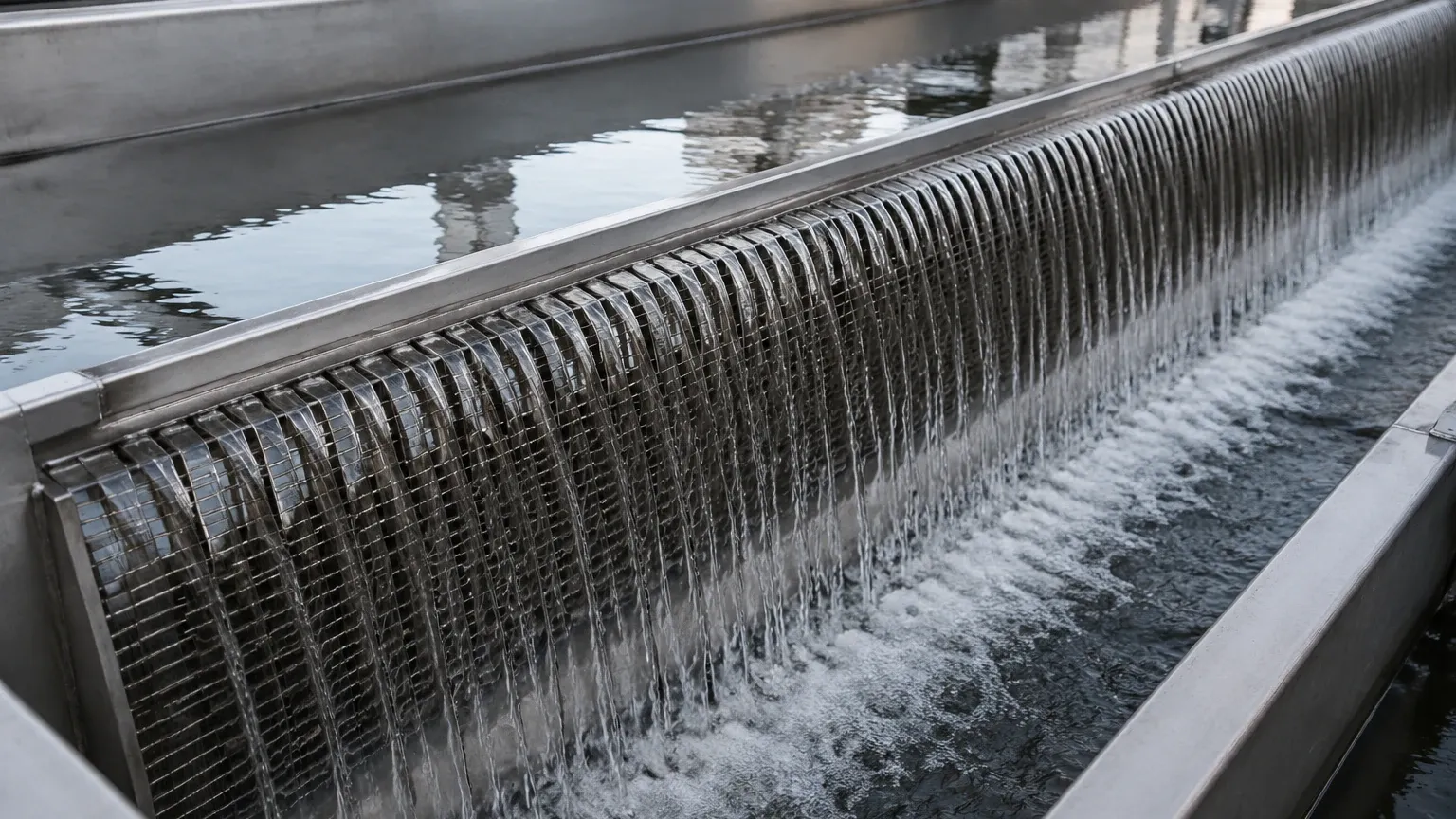
* Sieve Bends (Parabolic Screens): Utilize the "Coanda effect" to separate solids from liquid using gravity and the curve of the screen, making them highly efficient for high-flow primary screening.
Support Structure Design
The support rods do more than just hold the profile wires in place; they provide the structural backbone of the screen. In high-pressure applications, such as deep-well injection or high-head pumping stations, the spacing and shape of the support rods must be engineered to prevent buckling. Engineers should confirm the maximum expected differential pressure (ΔP) during the design phase to ensure the screen is sufficiently reinforced.
Maintenance and Total Cost of Ownership
While the initial capital expenditure for stainless steel wedge wire may be higher than for plastic or woven mesh alternatives, the total cost of ownership (TCO) is generally much lower. This is due to three main factors:
1. Durability: Stainless steel wedge wire is resistant to abrasion from sand, grit, and other hard particles found in wastewater. This reduces the frequency of replacement.
2. Cleanability: The smooth, non-clogging surface responds well to automated cleaning systems, including back-pulsing, chemical CIP (Clean-In-Place), and mechanical scraping. This maintains consistent flow rates and reduces energy consumption by preventing high-pressure drops.
3. Operational Uptime: Because these screens are less prone to sudden failure or blinding, the treatment plant can operate with fewer unscheduled shutdowns, which is critical for meeting regulatory discharge requirements.
Technical Checklist for Purchasing Teams
Before finalizing a specification for wedge wire screen wastewater applications, engineering and purchasing teams should confirm the following data points with the manufacturer:
* Fluid Characteristics: pH levels, temperature, and chemical composition (especially chloride concentration).
* Solids Loading: The concentration of solids (TSS) and the particle size distribution (PSD). This informs the choice of slot size.
* Flow Requirements: Minimum, average, and peak flow rates to determine the required screen surface area.
* Mechanical Constraints: Maximum allowable pressure drop and physical dimensions of the installation site.
* Cleaning Mechanism: Will the screen be cleaned manually, via backwash, or with a mechanical scraper?
By addressing these factors, engineers can ensure they select a filtration solution that provides reliable, long-term performance in the challenging environment of wastewater treatment. The transition to precision-engineered wedge wire is a strategic investment in the reliability and efficiency of industrial and municipal water infrastructure.
